Depicting Mary by Natalie Weaver

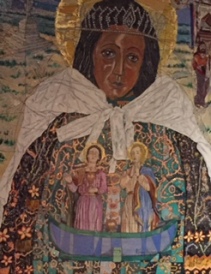
In October I had the opportunity to travel to the Louvre Museum on a free day I had from a conference I was attending in Leuven, Belgium.  I went predisposed to consider images of the Madonna as I had been thinking about her representations in art for some time.  In my own painting, I have been developing a version of the Annunciation that depicts Mary as a teenage girl reading a pregnancy test.  Her fear and consternation, coupled by the shock of the event of learning of her pregnancy strikes me as a more accessible telling of the true vulnerability and risk of the unwed child Mary than classic depictions of Mary as a reclining queenly figure quietly receiving the angel’s message.  I likewise had been working on a wood burnt figure of a Black Madonna as a study in both icon making and also understanding the tradition of Black Madonnas found throughout Eastern Europe.

I am deeply aware that representing this figure is a culturally laden task because the Madonna speaks both to some of the deepest spiritual needs and inclinations of many faithful Christians world over, just as she is almost shorthand for division among Christian communities.  Her presentation is tremendously political as it is received by fans and critics simultaneously as at once championing women (and the divine within women) and also condemning real women whose maternity and bodies can never be as morally or physically pristine as Mary’s.  Mary’s skin, clothing, age, gesturing, posture, gaze, and more speak volumes about the social location of her patrons and creators as well as the manner in which the viewer is being invited to receive her.

Continue reading “Depicting Mary by Natalie Weaver”

Holy Women Icons Bearing the Light of Advent by Angela Yarber

There’s nothing like the holiday season to bring out everyone’s least feminist self. In one of the courses that I teach—Gender, Food, and the Body in Popular Culture—students are assigned to examine gender roles throughout the holiday season through the lens intersectional ecofeminism. Inevitably, almost every student returns from holiday break with the same assessment: mom, grandma, and a kitchen full of women prepare, cook, and clean every family meal; women do the holiday shopping; men in the family watch sports. Of course, this isn’t true of everyone. There are plenty of families who subvert and dismantle stereotypical gender roles, but the holidays seem to heighten these roles, undergirding them with some kind of nostalgic and theological weight that claims that if mama doesn’t arduously prepare her famed casserole, the season will be ruined. Otherwise committed feminists find themselves singing carols filled with sexist language and participating in holiday rituals that they would critique any other time of the year. Subversion be damned because we want our traditional family holiday!

I’ve long struggled with creative ways to subversively approach the holidays as a queer clergywoman, parent, artist, and author. People like their nostalgic and heart-warming traditions, even when they sometimes smack of patriarchy, racism, and heteronormativity. I’ve confronted this as a preacher and worship planner, often to raised eyebrows or angry phone calls from congregants who just want to sing the carols without the preacher changing the words, or dismissing the notion of a virgin birth, or hanging enormous paintings of pregnant women all over the sanctuary.

Continue reading “Holy Women Icons Bearing the Light of Advent by Angela Yarber”

What I Believe (Post-2016) by John Erickson

Ever since the election of You-Know-Who, I have been doing a lot of creative writing.

Ever since the election of You-Know-Who, I have been doing a lot of creative writing. Unlike academic publications, policy reports, or my dissertation, creative writing, much like my mentor Dr. Marie Cartier has written about, provided me with a needed escape from a world that seems to grow darker with each passing day.  In college, I served as Poetry Editor for the Wisconsin Review, the oldest literary journal in Wisconsin. Continue reading “What I Believe (Post-2016) by John Erickson”

Bridging Beyond Binaries: Painting Gloria Anzaldúa by Angela Yarber

One of the great joys of being an artist and writer is working on commissions, enlivening in paint, canvas, and word the stories of revolutionary holy women who have emboldened and inspired the one commissioning the Holy Woman Icon. Gloria Anzaldúa was on my list of holy women for a while when Dr. Robyn Henderson-Espinoza finally gave me the nudge to paint her by commissioning an icon. Anzaldúa gave Robyn—and so many others—the framework, the bridgework, for dismantling the binaries of difference, for finding the beauty that resides at the borderlands of race, gender, and sexuality. As a scholar-activist, Robyn speaks of Anzaldúa as a patron saint, saying:

“Anzaldúa has always been for me the bridge between theory and action, and her work, both in writing and teaching, compels me to live into my vocation as a public theologian, which at root is bridging across lines of radical difference. Without Anzaldúa and without her bridging frame, I am unable to do the work that I now do. This icon offers me a visual reminder of the ways in which I’m called to be a bridge in curating communities of radical difference.”

Queer borderlands. Chicana borderlands. Feminist borderlands. Gloria Anzaldúa (September 26, 1942 – May 15, 2004) was an American scholar who focused on the intersections among queer theory, feminist theory, and Chicana cultural theory. Born in the Rio Grande Valley of south Texas, Anzaldúa also bridged the borders of personal and academic writing, weaving together theory with lived experience, English with Spanish, and inviting readers into a new world—Mundo Zurdo—that transcended these seeming binaries. Continue reading “Bridging Beyond Binaries: Painting Gloria Anzaldúa by Angela Yarber”

Book Review: FLORENCE IN ECSTASY by Jessie Chaffee

FlorenceInEcstasy3DBook


Jessie Chaffee‘s Florence in Ecstasy is the most luminous debut novel I have read in a very long time. Imagine, if you will, a darker and more literary version of Elizabeth Gilbert’s popular spiritual seeker’s memoir, Eat Pray Love. This is not to diminish Gilbert’s memoir, which I loved, but Chaffee offers a much deeper dive into the dark night of a woman’s soul.

Hannah, a young American from Boston, goes to Florence, Italy to heal herself after her professional and personal life back home has disintegrated due to her anorexia. Surely, in life-loving Italy, where every meal is a celebration, Hannah can heal her disturbed relationship with food and her own body. Similarly, Eat Pray Love, with its luscious descriptions of Italian cuisine and Gilbert’s rejection of dieting in favor of buying a bigger pair of jeans, deals with body image issues and is often recommended reading for women and girls recovering from eating disorders.

But Chaffee’s novel, unlike Gilbert’s memoir, is no easy-going, feel-good read. Continue reading “Book Review: FLORENCE IN ECSTASY by Jessie Chaffee”

Honoring St. Mary of Magdala by Gina Messina

Gina Messina-Dysert profileWhile I am joining the conversation a bit late, I find it necessary to comment on the significance of the “upgrading” of the celebration of  St. Mary of Magdala to a feast – on par with the male apostles.  While such a day that honors her is quite overdue, I am grateful to Pope Francis for acknowledging this incredible woman and her leadership in the Christian movement.

As we know from the Gospels, it was Mary Magdalene who stood at the foot of the cross with Mary the mother of Jesus, during his crucifixion.  When the male apostles ran in fear – and rightfully so – Mary of Magdala stood with Jesus refusing to disavow him and was a face of love for him to see during his darkest moment.

It was Mary of Magdala who was the first witness of Christ’s resurrection.  The very first Easter began with her and she was commissioned by Jesus to go and share the good news – to tell the other apostles – and that is why she is known as the apostle to the apostles. Continue reading “Honoring St. Mary of Magdala by Gina Messina”

Our Ladies of Sea, Earth, and Sky by Joyce Zonana

Sara and the Marys
Sainte Sara encompassing Sainte Marie-Salome and Sainte Marie-Jacobe

O Sainte Marie-Jacobe, priez pour nous.

O Sainte Marie-Salome, priez pour nous.

O gardeures de la Provence, priez pour nous.

The priest intoned the words in deep, liquid accents, his voice echoing from the ancient stone church in the remote village of Les Saintes-Maries-de-la-Mer, in the Camargue region of Southern France, where the waters of the Rhone River meet the Mediterranean Sea in a wild, wide, flat expanse populated by black bulls, pink flamingos, and white horses.

“O, Saint Mary-Jacobe, pray for us.”
“O, Saint Mary-Salome, pray for us.”
“O, guardians of the gates of Provence, pray for us.”

I could feel the words resonating through me, bringing sudden, hot tears. The people gathered in the small village square repeated the priest’s chant, their voices rising above the low, white-washed houses into the sunlit sky, out towards the shimmering sea where legend tells us the two Marys had drifted two thousand years ago in a boat without rudder or sail.

Continue reading “Our Ladies of Sea, Earth, and Sky by Joyce Zonana”

Moving Away from Normative Maternal Roles in the Catholic Church by Michele Stopera Freyhauf

FreyhaufEarlier this week, social media was all abuzz about the Pope’s investigation into restoring women to the diaconate. In the complete transcript of the Pope’s comments,  the traditional notion of women’s maternal role in the church is mentioned in relation to the Church.  Certainly this is nothing new.  Here the Pope describes important “maternal” work such as working with the marginalized, catechesis, and caring for the sick – once again, nothing new.

However, in the next sentence, a very subtle shift is seen when it comes to normative gender roles:

…. there are men who do the same [work as consecrated women], and it is good…..and this is important.

What does this mean – a change in language?  a laying of groundwork? or nothing at all?

imgres

It is no secret that cultural constructs of women as maternal and how a mother is defined as or even does has radically changed in today’s society; but, the Church continues to remain steadfast in normative roles between the priesthood and the “motherhood” of the Church (and therefore “motherhood” in general).

Continue reading “Moving Away from Normative Maternal Roles in the Catholic Church by Michele Stopera Freyhauf”

Lucy Pick’s Pilgrimage by Mary Sharratt

mary sharrattIn medieval Europe, religious devotion provided an alternate narrative for women’s lives in a male-dominated culture. Defiant women who stood up for themselves in the face of rape, incest, and murder were hailed as virgin martyrs. Religious vocations, such as becoming a nun or a beguine, provided a viable and esteemed alternative to forced marriage.

Even women who were married with children could escape their domestic entanglements and conjugal duties by taking an oath of celibacy as 15th century English mystic Margery Kempe did, leaving behind her husband and 14 children to go on pilgrimage to Santiago de Compostela, Rome, and Jerusalem. Her Book of Margery Kempe, the tale of her travels, reads like a kind of late medieval Eat, Pray, Love and is the first autobiography written in the English language.

Though it might seem surprising to us today, women of the European Middle Ages possessed more rights and freedoms than their descendants in the Renaissance, Early Modern, and Victorian ages. Women worked as craftspeople and artisans and were members of the guilds, alongside men. Monarchs such as Eleanor of Aquitaine were global power brokers while religious leaders such as Hildegard von Bingen devoted their lives to intellectual and artistic pursuits, composing music and writing weighty philosophical and theological books that are still being discussed today.
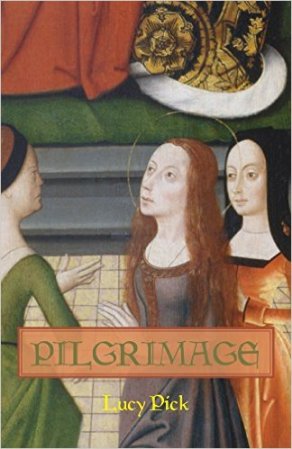
lucy pick pilgrimageThe cover of academic historian Lucy Pick’s novel Pilgrimage shows details from a painted altarpiece dedicated to Saint Godeleva. A victim of forced marriage who was strangled by order of her husband, this legendary saint was a patron of abused wives. Lucy Pick’s novel concerns the saint’s daughter, the blind Gebirga of Gistel in Flanders. What would it be like to be the daughter of a martyred saint whose miracles cured everyone except you?

Considered unmarriageable due to her blindness, Gebirga rejects life as a nun in an abbey dedicated to her sainted mother. Instead, in a bid for freedom, she embarks on a pilgrimage to Santiago de Compostela in faraway Iberia, an epic journey for that time. She serves as the companion to a highly strung teenage noblewoman and is charged with delivering the girl to the Spanish king she is contracted to marry. During their travels, Gebirga must use all her intelligence and resourcefulness to protect herself and her young charge from the considerable dangers and political intrigues they face on their way. Though they encounter hardship and heartbreak, this is a pilgrimage of miracles, healing, and redemption.

Lucy Pick, the Director of Undergraduate Studies and Senior Lecturer at the University of Chicago’s Divinity School, has infused her novel with impeccable research into the lives of medieval women. This novel is a medievalist’s delight and fans of the late Margaret Frazer will devour this book.

Mary Sharratt’s book Illuminations: A Novel of Hildegard von Bingen, won the 2013 Nautilus Gold Award, Better Books for a Better World. Her forthcoming novel, The Dark Lady’s Mask: A Novel of Shakespeare’s Muse, tells the tale of the groundbreaking Renaissance women poet Aemilia Bassano Lanier and will be published by Houghton Mifflin Harcourt in April 2016. Visit Mary’s website.

 

Coloring Holy Women by Angela Yarber

angelaColoring is a fast growing trend among over-stressed adults. Soothing coloring pages are a top Google search item. There are coloring books featuring mandalas, garden scenes, inspirational quotes, and even curse words written in fancy calligraphy sprouting branches, flowers, and swirls eager to be illuminated with colored pencils toted by hipsters, young professionals, retirees, clergy, and other adults searching for artistic ways to tap their creative spirit and sooth their jangled nerves. Articles—popular and academic—whose authors range from psychologist to spiritual director purport the power of coloring to calm anxiety, relieve stress, and provide a creative and spiritual outlet. Is this a feminist issue? I’d say so.

There are, indeed, feminist coloring books and goddess coloring books, though I’ve seen very little that fuses together both feminism and religion. In order to fill this gap, while also seeking to expand my own creative expression, I have finally completed the drawings for my forthcoming Holy Women Icons Contemplative Coloring Book. Continue reading “Coloring Holy Women by Angela Yarber”