

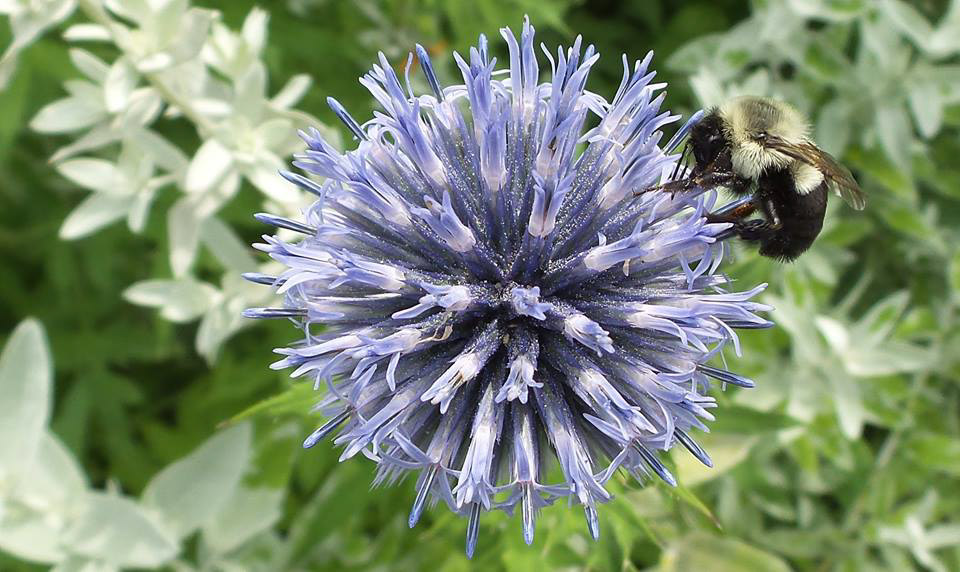
The glorious
white stars
waited in vain
for rain
for miner
sweat
mason
or bumblebee
to feast
on pollen
sacred to All
after three days
petals
drooped
golden
eyes shut
pearled
almonds
fell
one by one
next year’s
compost
soaked in
unshed
tears.
Perhaps
Bee Goddess
has a plan
Changing Woman
transforms
Sky Woman
holds the
seeds …
clasping
bloodroot
spears
and
buds
wrapped in
gray shawls
she may
yet
choose
to
intervene.
Postcript
I thought I was writing this poem about bloodroot adapting to a spring that hasn’t arrived, but I see now that I have written a prayer to honor the Power of the Goddess who I cannot separate from Nature. She manifests as a Bee (too many myths to mention), as Changing Woman’s mountain (Navajo), and finally as Sky Woman Falling to earth as a flower petal that surrenders to the winds of change (Anishinaabe creation myth). This poem speaks to both the tenacity and fragility of all life including my own. Will the Goddess intervene to help us navigate an unknown future? What is rarely articulated is the fear that underlies so many lives. We have two choices, continue to resist or find a way to transcend…
A hopeful side note: If the bees don’t come to pollinate these flowers Bloodroot has developed an alternate strategy to reproduce. This wildflower self- pollinates by folding her petals into the center of her yellow eye. As a naturalist I can’t help wondering if this secondary method of reproduction might take over if bees continue to decline? Nature adapts!
I will remember the ‘spring that wasn’t’ through the eyes of my wildflowers in 2026. Instead of lush greenery and the first flush of blossoms reaching for the sun, during the first week in May I am looking into a sea of wind whipped dull gray green and turkey scratched dirt. One bloodroot cluster bloomed. The rest are closed. All are about half their normal size and about two weeks late. But the first clump who loves the sun and celebrates Sky Woman’s seeding tells the tale of what is happening behind the scenes with changing weather.
This year marsh marigolds hearts froze so solid in March it killed new leaves. Temperatures continue to hover anywhere between the 20’- 40 degrees or skyrocket into in the 80’s. Gray drizzle or a merciless hard sun – too many extremes. The size of all the clusters speak volumes to the ravages of relentless spring winds, bone dry ground, and last year’s drought which continues – every drop of drizzle gets blown back into the air. So far, the wild bees that pollinate steadfast bloodroot are absent.
Since the miners or mining bees live here in volcanic dirt piles of their own construction I keep asking – are the bees still asleep? What about the sweat bees who also live in the ground? The mason bees? Poplars and other members of the willow family along with alders have been providing food for insects since the second week after a three – day heat wave in early March. The small two spotted pollinating bumblebees that fly close to the ground are amongst the missing too. Two days ago, I saw Pheobe at the birdfeeder trying to get seed. Oh no, I thought in dismay. Phoebes are insectivores. Since phoebe’s arrival around the middle of April all insects have been scarce except for ticks. I remind myself that nature has an abundance of strategies that allow most wildflower species to survive. However, all these temperature extremes will probably affect the lives of all spring wildflowers because most need to bloom, be pollinated and set seed before summer closes in. They also need water. Another troubling factor is that so much of their habitat has been destroyed. Is this why I have become so obsessed by searching for bees?
Miner bees are probably the most common bloodroot pollinator and the most extensively studied. They are solitary, ground nesting bees that like to establish their homes in well-drained soils, like clay, and are present in banks, hummocks and hills. They have also been found burrowing between stones of old buildings and between logs in cabins or barns. Most commonly, the female digs a tunnel in the soil using loose earth to construct a chimney-like turret, with a hole in ki’s center under which a single nest is constructed. Nests are often clustered together in close quarters, with females caring for their own. Miner bees have been known to nest in the same neighborhood for many years. I’m sure they do here.
After mating and establishing their nests, A. abrupta females line the tunnel walls with a glandular secretion which turns to a solid waxy plate. This process waterproofs a cup-like cell for the eggs. A single egg is laid in each cell and floats on a pollen mixture foraged by the females for about five days before hatching. The larvae consume the pollen substance and cell lining over the following three weeks. The young overwinter in the prepupae stage, and come April, they shed their skin. Two weeks later the bees emerge from their burrows as adults.
Sweat bees (Haliciaee) love bloodroot too. Theu are small, often metallic green, blue, or striped in different shades of brown · They are primarily ground-nesters digging tunnels in loose soil, sunny spots, or occasionally in rotten wood. While many are solitary, some species in Maine are communal, sharing a nest entrance with others.
While 70% of native bees are ground-nesters, mason bees prefer above-ground, narrow, tubular spaces. Around here deadwood is everywhere and holes abound so I can expect these pollinators to be around all season
The two spotted bumblebee is a small bumblebee that I also see on cool mornings pollinating violets and other ground lovers like ajuga that live close to the ground. I have also seen them on bloodroot. I rarely see other bumblebee species even throughout the summer. Most are in severe decline. The two-spotted bumblebee (Bombus bimaculatus) nests in the ground in Maine, preferring abandoned rodent burrows or dry cavities 6–12 inches underground, often near wooded areas. They will also nest in thick vegetation or even a tree.
All of the forementioned bees are absent this spring. They need sun or temperatures above 50 degrees to fly and although we have had spikes, the temperatures have not been consistently warm enough and the wind has been too fierce.
Historically, during the spring summer and fall seasons other bees visit here too but I wanted to end by discussing the primary spring pollinators because we need them so. Because leaves cover most of the open ground and woods (except for the field) and bogs, springs and streams are nearby I have ideal bee territory. When the fruit trees are in bloom I can expect honey-bees to make a brief appearance.
Bees are “keystone organisms” in most terrestrial ecosystems. They are essential for maintaining the integrity and sustainability of many types of ecosystems: the forest understory, pastures, fields, meadows, roadsides, agricultural crops, fruit orchards, and backyard vegetable and flower gardens. Without bees, many flowering plants would/will eventually become extinct unless the Goddess intervenes.
Discover more from Feminism and Religion
Subscribe to get the latest posts sent to your email.


Many Goddesses take the shape of Bees. I remember a few years ago here on the Feminism
And Religion blog someone had written about Priestesses and Bees but I can’t remember the specifics now. Well done as always Sarah, 👊 🐝
LikeLiked by 1 person
I feel really dumb – The goddess is a bee – one reason I am so fascinated by them – I don;t know why I neglected to mention the obvious. Thank you for extrapolating the connection – it’s why I sent this one in.
LikeLiked by 1 person
No don’t feel that way! Sometimes the greatest wisdom comes from the most obvious source. I have had my own spirits smack me across the head for missing the obvious sometimes lol. But there’s too many angles to everything to see it all at once. I think they forget that sometimes. And we do too. I loved this article. The concern for nature blended seamlessly with the love of it. And our all mighty Mother or Mothers. Whomever we see. Coincidentally, my Mother Orisha in Santeria is Oshun. The Goddess of love, prosperity, magic, fresh water, Queen of Witches, and the Queen of Nature. She often assumes the form of a bee or a peacock. She loves honey. She’s a prolific shapeshifter. Usually Orishas if they turn an animal only assume specific animals. But she loves animals in general. But the Bee and Peacock are her two favorites.
LikeLiked by 1 person
Ah yes, I am familiar with Shun and her many sisters – but isn;t it funny that I wrote that whole article with the goddess in mind and never mentioned her as Bee Goddess!
LikeLiked by 1 person
The best writings often transmit the message without mentioning the meaning. That’s what yours did. 😃
LikeLike
Thank you!
LikeLiked by 1 person
No problem. It’s nice to see a writer who respects their audience’s intelligence. I think nowadays everything is dumbed down. Even on tv and movies it seems. No one wants to take the time to pay attention and retain information.
LikeLiked by 1 person
I could not agree more – as a researcher I find I have to wade through all kinds of shit to get to anything with depth and breadth – there’s a reason for that that wasn’t present ten years ago – the dumbing down of the US has brought us to???
LikeLiked by 1 person
Sadly, yes. There’s a movie from 2006 I recommend. It’s a comedy but my God I think they may have predicted the future by accident. It’s called Idiocracy. It’s a sci-fi comedy movie.
LikeLike
What an informative and moving read this was. I felt a sad hopefulness. Nature will always have Her way in the end. For the good of us all may it be so.
LikeLike
Oh I am glad someone really enjoyed this essay – I think Nature knows exactly what she is doing! And I am happy to say that that I do have bees –
LikeLike
I so appreciate your intimate observation and knowledge of all the life around you, your compassionate witness of hardship and loss. That’s what love is.
LikeLiked by 1 person
Yes, that is what love is – and you know that firsthand.
LikeLike