Peace of mind vs Dogma and Capitalism by Oxana Poberejnaia

oxanaWhen I said in my response to Carol P. Christ’s comment that on one level Goddess spirituality and Buddhism are about the same thing, I am afraid it could have sounded shallow. What I wanted to express is that for a Goddess adherent, the primary goal is not to go through death and be reborn. Neither is the primary goal for a Buddhist to go through death and not be reborn. I believe they both seek the same thing: to be happy in this lifetime, to be comfortable with themselves and the world, to be OK with the reality of their own death. Carol says: “For me, regeneration applies to the community, to nature, to the whole, not to the individual”.

The two faiths just lead to this result by using different theology and practices. One of the ways Buddhism installs this peace of mind is by dissolving the very notion of an “individual” and thus, their impending death becomes less of a problem. From the Goddess side of things, listen to an episode of Karen Tate’s Sex, Religion, Politics podcast Enlightenment for the Rest of Us/Shamanism with Polly Campbell, author of Imperfect Spirituality: Extraordinary Enlightenment for Ordinary People. Karen is a Goddess advocate, and what Polly was teaching could be called secular Buddhism: the same breathing techniques, being in the moment and being grateful.

Continue reading “Peace of mind vs Dogma and Capitalism by Oxana Poberejnaia”

Liberations of Immigrant Women in Western Religious Conversion by Andreea Nica

Andreea Nica, pentecostalismThe prolonged debate around feminist subjectivity and religious participation continues to evoke much compelling discussion in academia, political arenas, and public space. There have been a number of academic studies around the intersection of gender, religion, and migration, specifically on how gender and immigration assimilation is constructed and managed within western religious systems.

I am currently researching the trajectories of immigrant assimilation and conversion, and how gender relations and religious identities are managed within these processes to further develop my proposal for doctoral study. I find this area of research fascinating as it’s so diverse and pertinent to the progression of gender equity amongst religious participants. Continue reading “Liberations of Immigrant Women in Western Religious Conversion by Andreea Nica”

What Would Malala Do? by Gina Messina-Dysert

Gina Messina-Dysert profileOctober 11th was International Day of the Girl – a movement that empowers girls around the world to see themselves as powerful change agents. This year’s theme is “Innovation for girls’ education.”  Certainly, this makes sense given that education is one of our most powerful resources – just ask Malala.  During her recent interview on The Daily Show, Malala reminded the world that it is education that can solve global problems – not war.

The youngest person in history to be nominated for a Nobel Peace Prize, Malala is clear in her message; the only way to make change is through peace, dialogue, and education.  When asked about her reaction to the threat to her life by the Taliban, Malala responded saying that she thought quite a bit about what she would say if she came face to face with a Talib.  “I would tell him how important education is and that I would even want education for your children as well. That’s what I want to tell you, now do what you want.”

Although the Taliban has continued to threatened her life, Malala says striking back is not the right approach.  “If you hit a Talib, then there would be no difference between you and the Talib. You must not treat others with cruelty. … You must fight others through peace and through dialogue and through education.”  Such words of wisdom from a child. Continue reading “What Would Malala Do? by Gina Messina-Dysert”

An Ethics of Anger by Ivy Helman

me bio-suitSometimes I feel angry.  I would say that more often I’m upset, disappointed, annoyed or just plain frustrated.  These are easier emotions for me to handle because I tend to shy away from confrontation and conflict.  Of course, when they come up I can deal with them but I’d rather put time and energy into fruitful communication before difficult conflicts erupt.  Nevertheless, this doesn’t always work and other people handle situations and communication differently than I do.  So how does one approach anger?  The anger inside one’s self?  Another’s  anger?  What about when two individuals are angry with each other?  I would like to spend a little bit of time treating each one of these scenarios separately and then conclude with a few general remarks about the importance of empathic feelings of anger over the situations of others.

First of all, everyone handles anger differently.  I’m not sure that there is only one correct way to approach it.  Personally, I use anger as a reflective tool.  Why am I angry?  What happened or didn’t happen to provoke my anger?  Is my anger an appropriate response to the situation in which I find myself?  Are there some concrete actions I can do to right the situation?  These questions allow space for me to not only explore my feelings and ground myself, but more importantly they give me some space between what made me angry and whatever action or inaction I take toward that feeling of anger. Continue reading “An Ethics of Anger by Ivy Helman”

Rebranding Feminism by Linn Marie Tonstad

Linn Marie TonstadFeminism has a “brand”? A recent contest – still running, if you want to get in on it! – asks for suggestions about how to “rebrand feminism.” The contest has corporate sponsors. Saying that although feminism “has brought us the right to vote, drive and have our own bank accounts,” it is nonetheless the case that “Feminism has been given a bad rap, and gotten a bad rep.” Elle UK’s November issue does the same, claiming to rebrand “a term that many feel has become burdened with complications and negativity.”

I suspect that most readers here at Feminism and Religion will have similar reactions to this development: disgust and distaste. Why do feminists need to overcome the negative stereotypes and reactions that are used to dismiss them by anti-feminists? Most of us have heard the usual derisive responses, I suspect, and are tired of being instructed that it is our responsibility to overcome stereotypes we have done nothing to earn. I once wrote the words “feminist” and “Christian” on the board in an introductory theology class, and asked students what the first word that came to mind was in each case. Predictably, the first response for “feminist” was “femi-Nazi.” The student wasn’t intending to imply that such a designation was fair, but the immediacy of the reaction was telling. So why should feminists subordinate our political and social aims to corporate self-promotion? And is feminism really just about getting the vote, being able to drive, and having bank accounts? This list of issues brings together the trivial (when were women unable to drive in the UK or USA?), the liberal status quo (voting), and the assumption that feminism means the full ability to participate in the capitalist system. That’s not to suggest that these concerns are unimportant. But all of them involve acceding to an already-constituted public, financial, political, and social space. Is feminism simply about, as so many popular invocations have it these days, equality and giving women the same opportunities as men? Continue reading “Rebranding Feminism by Linn Marie Tonstad”

An Interview with Lyz Liddell from the Secular Student Alliance by Kile Jones

KileIn this post I interview Lyz Liddell, Director of Campus Organizing at the Secular Student Alliance.  I first got in contact with Lyz about the idea of building a Humanist Center at my school, Claremont Lincoln University.  She was very helpful and inspiring.  I then had the pleasure of meeting her face-to-face when I gave a presentation on “Atheism and Interfaith” at the Secular Student Alliance’s Annual Conference in Las Vegas.  So once again, I give you an interview with a strong female non-believer:

Lyz Liddell of the SSA

Can you give us a little background to how you became interested in secular activism and how you became the Director of Campus Organizing for the Secular Student Alliance?

I first became interested in secular activism via our Executive Director August Brunsman, close to ten years ago.  The editor of our newsletter had recently acquired some fame (that was Hemant Mehta, with the fame from his experience of selling his soul on eBay) and was no longer able to commit to the regular editorial schedule; I was asked to step up, and since I had some editing experience, I took it on.  Up until that point, I had been a “layman,” if you will – secular for sure, but not really an activist.  Through several years of editing that newsletter, I learned what secular student groups were doing, and what was happening in the secular movement at large.  The more I encountered, the more enthusiastic about it I was.  I started going to conferences to get more information and news for the newsletter, and got more involved with the organization’s staff and volunteers and affiliates.  When the campus organizer position opened up in late 2008, I stepped up into that position, and we’ve grown it from there (2 full time staff and some volunteers, a board of mostly college students) to the professional organization we are today (9 full time staff, 4 part-timers, a professionalized board and dozens of dedicated volunteers; we’ve grown from ~100 affiliates in 2008 to over 400 today).

The Sisters In Our Midst by Natalie Weaver

Natalie Weaver

On September 28, 2013, Ursuline College hosted a symposium entitled The Impact of Vatican II on Women Religious in the United States.  The symposium featured five speakers.  Sister Karen Kennelly, CJS. gave the keynote address entitled “Women Religious in the U.S.: From the Vatican Council to the Present.”  Four other speakers gave breakout talks.  Sr. Mary Frances Taymans, SND, spoke on education.  Sr. Kathleen Feely, SND, spoke on social services.  Sr. Patricia Talone, RSM, spoke on health care, and Sr. Loretta Harriman, MM, spoke on foreign missions.  The symposium began with a Friday evening event featuring a lecture called “Progress and Promise: Local Conversations,” which surveyed the history of women’s religious communities in Northeast Ohio (FAR blogger Michele Stopera Freyhauf worked on this project with our team as well!).  In addition to the talks, the Northeast Ohio component of the national Women & Spirit exhibit (now retired), which was produced by the Leadership Council of Women Religious and which toured throughout the country from 2009-2012, was on display.

Having been a collaborator in the organization and management of the symposium, I had several months to reflect on the intentions, purpose, and hoped-for outcomes of the event.  As our conference committee reflected on an appropriate theme for a conference commemorating the 50th year anniversary of the Second Vatican Council, we wanted to focus on women religious, a group often conspicuously overlooked and generally under-represented in Vatican II anniversary conferences. Continue reading “The Sisters In Our Midst by Natalie Weaver”

Feminism vs. Humanism: A response to an idealized feminist identity by Mariam Williams

Mariam williams, Feminism vs. Humanism: A response to an idealized feminist identity

My first thought after reading Gina Messina-Dysert’s  post, “Feminism vs. Humanism: Continuing to claim a feminist identity” was, “Guess she missed that whole #SolidarityIsForWhiteWomen trend on Twitter last week.” Until I saw Gina’s bio signaling the end of the post, I thought she was building the foundation for a witty piece of satire. The feminism she wrote about was so ideal compared to humanism that I thought she was using irony to address feminism’s imperfections. She wrote that “humanism does not value diversity and difference,” which implied that feminism does, always or at least consistently. Humanism “reinforces western, privileged … values,” but feminism doesn’t? As in doesn’t ever? Is that what she meant to say?

It isn’t that Gina, or the Feminism and Religion blog as a whole, doesn’t acknowledge diversity among feminists. It’s that in the post, she didn’t recognize that feminism can be just as exclusive as humanism according to the definition of humanism she provided. Continue reading “Feminism vs. Humanism: A response to an idealized feminist identity by Mariam Williams”

Enduring the Trials of Graduate School: From Conception to Labor Pains and Birth (Revisited) By Michele Stopera Freyhauf

Freyhauf, Feminism, Religion, Durham, Old Testament, Blogger, Bible, Gender, Violence, Ursuline, John Carroll

With the new school year in full swing, I thought this post from almost two years ago would be an appropriate reflection, encouragement, and outward support to those returning to school or nearing the completion of their degree.  Remember – do not give up – the sweat, sacrifices, and struggles are worth it in the end AND  You are not alone.  Remember the strength and courage it took to return to school or take that next step to pursue your educational goals will become the tool to help you persevere and reach that finish line!!

Going back to school at 30-something to complete a B.A. in a completely different field (from accounting to Religious Studies and Theology) was an interesting endeavor.  After many years of legal and business writing as well as crunching numbers, learning how to write academically, including formatting citations and using new technology was quite an undertaking that has proven to be rewarding.  All the searchable databases in the library no longer included card catalogues and microfiche.  This was amazing!  No more correction ribbon and electric typewriters (am I showing my age yet?!)  Going to college in 1985 is different then going back to college in 2006. Continue reading “Enduring the Trials of Graduate School: From Conception to Labor Pains and Birth (Revisited) By Michele Stopera Freyhauf”

Truths My Mother Taught Me by John Erickson

I never gave much credence to religion but through my mother, I met G-d, and through her I understood that I’m not a feminist because of the books I’ve read but rather because of the woman I call mom.

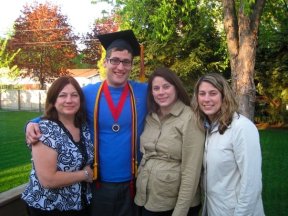
Graduation PhotoThe first question I always get asked when I’m in feminist spaces is: “What inspired you to become a feminist?”  Although I could go into the various histories revolving around men’s involvement in the early stages of the women’s movement to the similarities between the LGBTQ and women’s movements, my simple answer has always relied on one person: my mother.

I’ll be the first to admit (as well as many other people who will join me in the same chorus) that my mother deserves Sainthood for having put up with all the shenanigans I have, and still continue to, put her through. From running away from our local Catholic church the moment she dropped me off at Sunday School, to swearing like a sailor on leave at a very early age in front of Father Schmidt (who still fondly remembers me and the list I brought in with me to the confessional booth). Continue reading “Truths My Mother Taught Me by John Erickson”