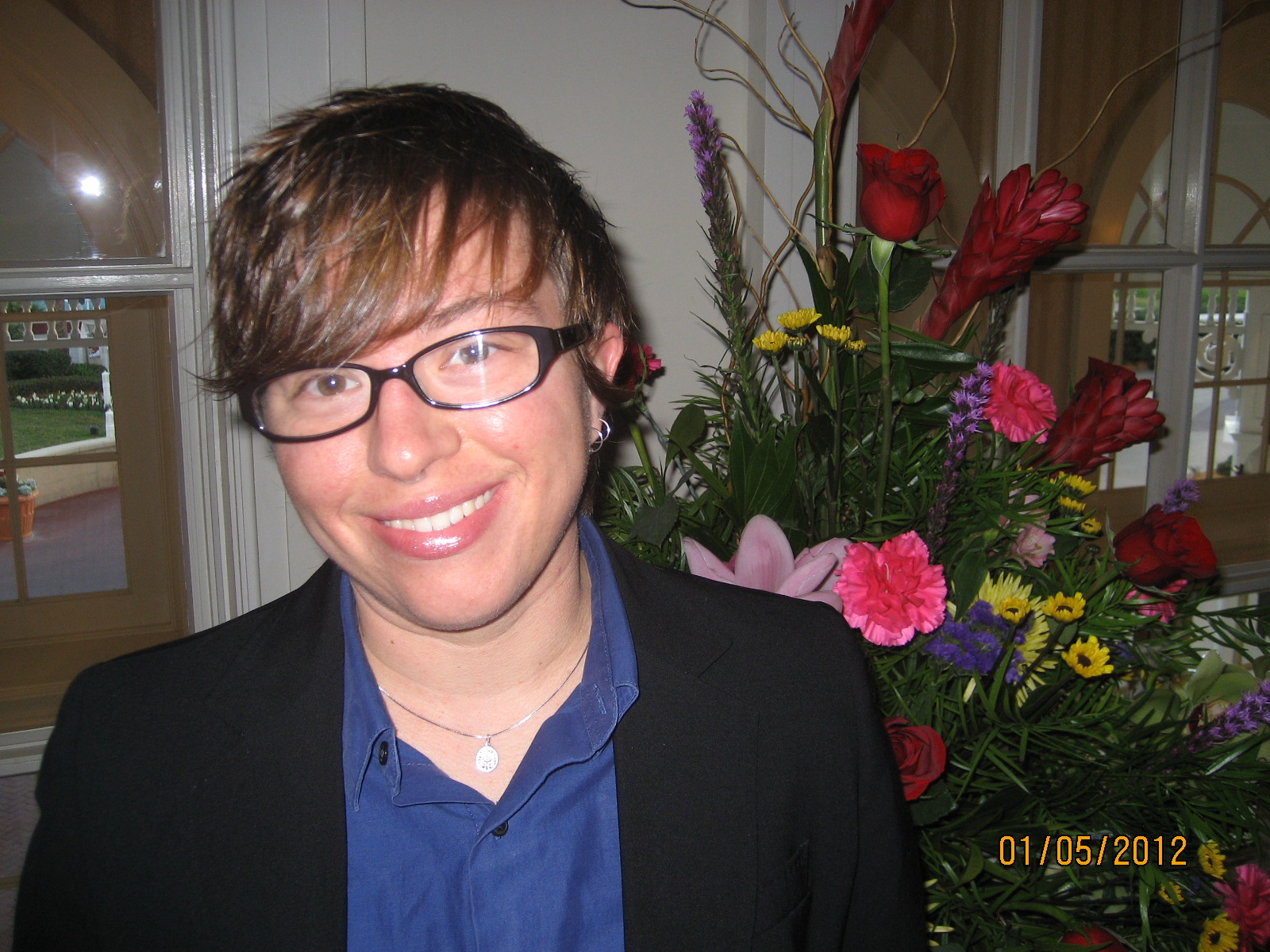
Feminist Ethics Class and Final Problem Solving by Marie Cartier

This spring I taught “Feminist Ethics” at California State University Northridge. I have posted two blog on this site regarding the students’ projects for that class: April 4, 2012:  The Feminist Toolbox by Marie Cartier, and May 12, Change My Mind, Move My Heart: Feminist Ethics in Practice by Marie Cartier.

In the original blog I explained that the students were asked to identify a private or public a problem that they could find a full or partial solution for and that their actual final had to actually implement their proposed solution. Students had to use “The Feminist Ethical Toolbox,” or what they call “Cartier’s Toolbox,” in their solution. The toolbox addresses questions such as, “Is everyone affected by the decision (the solution to the problem) at the decision making table?” and “If they are not at the table, are they represented at the table by someone who will speak to their interests?” among others.

The second blog addressed combining art with scholarship/activism so that we do not only change minds but also move hearts. Students had to attempt to combine art with their problem/ solution-consciously using art as a “toolbox” element helps facilitate social change. It is in the integration of both art and scholarship that the most poignant and effective social change strategies are birthed. Continue reading “Feminist Ethics Class and Final Problem Solving by Marie Cartier”

The Crime of Being a Girl Scout: The Sin of Raising Strong Female Leaders by Michele Stopera Freyhauf

Cradle Catholic and Woman

Educated by the U. S. Vowed Religious

Support the U. S. Catholic Sisters

Support, Minister, and Live the Social Gospel

Theologian, Feminist, and Critical Thinker

Former Girl Scout Leader of Three Troops

Former Girl Scout

I am all of these things and more.  By the recent attacks by the hierarchy of the Catholic Church, I am beginning to think I am the problem.  I seem to stand for everything the Vatican and USCCB seek to silence.  Is it because of my organizational ties with the U. S. Vowed Religious and Girl Scouts, or my writings as a Feminist and Theologian?  Maybe the answer is simply – because I am a woman.

According to the criticisms launched by the USCCB and the Vatican, I seem to be part of the problem rather than the solution.  Why is this so?  It was not until I started my journey in ministry that my idealistic “Catholic” bubble popped – not so much by me, but by those in ministry and leadership, by those that did not like laity to pose questions and think critically about their faith beliefs, and by  those that do not like people who do not fit within the preconceived mold of what a “good Catholic” should be.  This ideological construct is difficult enough when you are part of a Church community, but when you begin to embrace leadership as a woman, question teachings, exercise your canonical rights, your peers and even people you thought were your friends, no longer talk or associate with you. The betrayal is vicious and runs deep – it is behavior not becoming of a minister or one who professes the Catholic faith.

If the attack on you is not enough, these same people victimize your children through their words and behavior.  It is a difficult position for anyone to survive spiritually.  For children of the Church who bear witness to this hypocritical behavior, a journey begins – they search for meaning within the spiritual realm and become disgruntled with anything that resembles organized religion.  A place where one seeks community and spiritual nourishment becomes a place of oppression and starvation.  If attacking family is not enough, let’s start attacking groups that promote community – groups like the Girl Scouts of America.

So, what is the USCCB’s problem with the Girl Scouts of America?  Basically, this organization is under fire for suspected deviant thinking and positions that stand opposed to Church teaching. Continue reading “The Crime of Being a Girl Scout: The Sin of Raising Strong Female Leaders by Michele Stopera Freyhauf”

Vatican Lays a Cunning Trap for American Nuns by Mary Johnson

At the end of this month, the Leadership Conference of Women Religious will meet to formulate a response to a Vatican trap whose cunning is best appreciated within the long tradition of religious authorities who craft impossible dilemmas for those they perceive as threats.

Two millennia ago, the chief priests sent someone to ask Jesus, “Should we pay taxes?” If Jesus said yes, he would pit himself against Jewish resistance to Roman occupation and therefore, in Jewish eyes, against God. If he said no, the Romans could execute him for sedition. Instead, Jesus famously replied, “Render to Ceaser what is Ceaser’s and to God what is God’s.”

In the fifteenth century, Joan of Arc’s ecclesiastical inquisitors asked her, “Do you know yourself to be in God’s grace?” If Joan answered yes, she would commit heresy because the Church had long taught that no one could be certain of being in God’s grace; if no, they could interpret her answer as an admission of guilt. Joan looked them in the eyes and replied, “If I am not in God’s grace, may God put me there; if I am, may God so keep me.” Continue reading “Vatican Lays a Cunning Trap for American Nuns by Mary Johnson”

When Music Touches Your Soul by Elise Edwards

It’s incredibly liberating to have the co-mingled sensation of being elevated by aesthetic delight, affirmed by words that reflect the life experiences of you and your loved ones, and honored by another’s desire to relate to you.  This type of liberation is spiritual.

Last month, I attended a Lalah Hathaway concert, the first live concert I think I’ve attended in about a year.  For those of you who don’t know, Lalah Hathaway is an R&B singer and daughter of the late Donny Hathaway.  It was my first time hearing her perform and the audience’s response to her artistry sparked some thoughts in my mind about authenticity, soul, and participation in the black church.

I should probably admit that my favorite genre of music is R&B/soul because of what its name suggests – the ability of the music to connect to the innermost parts of my being, the spirit inside of me that recognizes what is true.  Whether they are speaking about joy or pain, love or loss, soul singers have a way of making me feel the authenticity of their souls conveyed through their music and lyrics.  Because I agree with the feminist principle that the personal is political, I believe that feminists must take the time to recognize what is personally true for them and what is most real.  This is so that feminists’ energies directed toward making the world a more just place can be sustained during times of struggle, and maintained with integrity, regardless of what sphere they’re located within.  Soul music helps me remember who I am. Continue reading “When Music Touches Your Soul by Elise Edwards”

How Does Goddess Change the World? by Xochitl Alvizo

It can only be that She begins in a small way at a single place in the world. It can only be that She begins within us. 

Carol Christ’s post this week made me think of a favorite little passage I love from a Catholic theologian, Gerhard Lohfink, who wrote a book about whether God needs the church. I’m not going to engage that specific question here nor am I going to talk about the ins and outs of the book. I simply mention it because it holds within it the beautiful passage that deeply resonates with me and has become the primary image I hold on to when thinking about how I want to participate in the transformation of the world. The passage comes from a part of the book where Gerhard Lohfink muses about how God would start a revolution while still respecting human freedom and participation:

God, like all revolutionaries, desires the overturning, the radical alteration of the whole society – for in this the revolutionaries are right: what is at stake is the whole world, and the change must be radical, for the misery of the world cries to heaven and it begins deep within the human heart. But how can anyone change the world and society at its roots without taking away freedom? (Lohfink, 26)

The issue is that for centuries people have tried and tried again to change the world, to ‘free the masses’ and save people from suffering, misery, and oppression – but too often revolutionaries resort to violence as their means. The systems are so rigidly and stubbornly in place that the revolutionary comes to see no other way to bring about radical social change except through a widespread violent overthrow. Continue reading “How Does Goddess Change the World? by Xochitl Alvizo”

Why I Failed Feminism 101: Gender, Sexuality, and the Power of Relationships

I forgot, that relationships, like feminism, are not easy, and that it is a conscious and continual effort of renewal to remind yourself everyday why you love the person you love and more importantly, in the case of feminism, why you fight, “the good fight.”

I was once told by my ardent feminist advisor in undergrad to “not put all my proverbial eggs in one man basket” after discussing my relationship with my boyfriend over a cup of coffee.  Thinking my relationship was different and that we were special, I heeded the warning but thought of it no further.  Now, looking back on it three in a half years later, I wish I would have.

Relationships are a powerful tool.  They help to make you feel special.  They help to bring you joy.  They help you discover the reason why a divine presence may have endowed us with the ability to love and most importantly they help you realize and discover things about yourself you may have never taken the time to notice.

Feminism 101 is more than just the pop culture stereotype of a bunch of women advising the younger generation of girls to be weary of men and the pain they can bring.  Feminism, specifically as what I now call Feminism 101, is the transformative ability to listen to your elders, trust yourself, and ultimately, if you happen to trust in the relationship you have built, knowing deep down that it is built on equality, love, and trust. Continue reading “Why I Failed Feminism 101: Gender, Sexuality, and the Power of Relationships”

Painting the Shulamite By Angela Yarber

Calling the Shulamite holy is my way of affirming female sexuality, the beautiful variety of the body’s shapes and sizes, and including the LGBT community in the canon of saints.

Several years ago, after experiencing the innate maleness and straightness of most traditional icons, I decided to give iconography a folk and feminist twist.  Biblical women, mythological figures, poets, artists, dancers, scholars, literary figures, and personal loved-ones graced my canvases and with a brush-stroke they were canonized.  Miriam, Sappho, Gaia, Jephthah’s daughter, Virginia Woolf, Tiamat, Mary, Baby Suggs, Isadora Duncan, Fatima, the Shulamite, Dorothy Day, Mother Teresa, Mary Daly, Sophia, Sojourner Truth, and many of my friends and colleagues became “Holy Women Icons.”  It is these icons—these holy women—that will be the focus of my monthly articles in Feminism and Religion.

This month, the Shulamite is the center of our attention.  She is a dancer made famous by the erotic love poetry dedicated to her sensuous curves in Song of Songs:

Return, return, the Shulamite.

Return, return, and let us gaze on you.

How will you gaze on Shulamite in the dance of the two camps?

How beautiful are your sandaled feet, O prince’s daughter.

The curves of your (quivering) thighs like jewels crafted by artist hands.

Your vulva a rounded bowl; may it never lack wine.

Your belly a mound of wheat hedged by lotuses.

Your breasts like two fawns…

(Song of Songs 7:1-4 translation mine) Continue reading “Painting the Shulamite By Angela Yarber”

JUDGES 19: A BRIEF PAUSE FROM JUSTICE-WORK TO BE WITH HER IN THE SILENCE BY IVY HELMAN

Elie Wiesel, Holocaust survivor and renowned Jewish thinker, believes that no one can ever truly understand the profundity and tragedy of the Shoah unless one experienced it.  For him, silence is the best way to express the events since words fail to do justice.  The principle of letting silence speak, when words no longer can, when pain is so real it debilitates and when tears flow more freely than thoughts, is not original to the twentieth century.  The Bible contains many events and personal stories in which this is the case.

Judges 19 begins with two characters: a Levite and his concubine.  The concubine has recently run away to her father’s house, when her husband decides to visit her there trying to win her back.  He seems to have only good intentions in mind.  After leaving her father’s house with his wife, the Levite discusses his future plans with his servant who apparently accompanied him on the journey.  He still has not spoken a word to his wife.

The servant and the Levite decide to spend the night in Gibeah, a Benjaminite city.  The three of them sit in the city’s square waiting for someone to take them in but no one arrives until evening.  At dusk, an old man comes by and offers to take care of the needs of the entire party, including the donkeys, as long as they promised not to spend the night in the city square. Continue reading “JUDGES 19: A BRIEF PAUSE FROM JUSTICE-WORK TO BE WITH HER IN THE SILENCE BY IVY HELMAN”

The Sainthood of Hildegard von Bingen by a Feminist-Friendly Pope? by Cynthia Garrity-Bond

While I celebrate the rise in status of Hildegard to official saint and soon to be Doctor of the Church, I cannot help but be suspicious of the Vatican’s motivations.  One only has to take in the last two months behavior of the CDF, sanctioned by Pope Benedict, to see the real intentions of this papacy—the continued subjugation of all women to clerical authority.

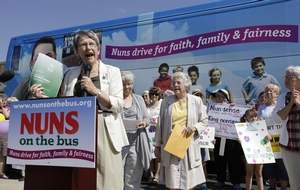
The past month or so has been a very busy time for the Congregation for the Doctrine of Faith or CDF and their examination of women. First they (and this includes Pope Benedict XVI) decided American nuns are guilty of the sin of silence by not speaking out on abortion & homosexuality.  Their “radical feminist” ideology of standing with the poor and disenfranchised, while good, is not good enough for the CDF.  The firestorm of solidarity coming from both laity and religious surely caught the Vatican off guard.  Right?  Well, not quite.  This past week the CDF began its investigation of the Girl Scouts for their purported association with the likes of Planned Parenthood and Oxfam.  While both address the needs of the poor, it is the latter and its troubling advocacy for safe sex via condom use that initiated the inquiry. Keep in mine that in 2010 Pope Benedict retracted from his earlier position and bane on condoms, seeing instead their use as a “lesser evil” in the fight against HIV/AIDS.  The CDF angst is that the message of condom use might be too much sex-talk for impressionable young women.  Continue reading “The Sainthood of Hildegard von Bingen by a Feminist-Friendly Pope? by Cynthia Garrity-Bond”

Liberalism as Feminist Religious Tradition: Friend or Foe? By Amy Levin

Come, come, my conservative friend, wipe the dew off your spectacles, and see that the world is movingElizabeth Cady Stanton

Whenever I find myself in conversation with a liberal skeptic who assumes that the existence of a liberal Mormon or Catholic is about as likely as aliens walking the planet, I do two things. First, I show them our blog. Second, I attempt to describe the complicated, long, and constantly evolving relationship between American liberalism, religion, and feminism. The roots of this complex triad are planted in a complicated history whereby, on the one hand, religious liberalism helped women gain equal rights and social justice, while on the other hand, it created divisions among some religious women who felt liberalism threatened their theological beliefs. Of course, the term “liberalism” is fraught with its own contemporary meanings. However, religious feminists throughout history have nevertheless engaged in practices we could place under the rubric of liberalism, including the push toward cosmopolitanism, modernism, and political progressivism. The difficulty was (and still is) maintaining their religious practices and beliefs.

Continue reading “Liberalism as Feminist Religious Tradition: Friend or Foe? By Amy Levin”