And We Are Singing, Singing for Our Lives! by Carol P. Christ

Last week I wrote about the grief I feel for the state of my nation (the United States) and of the world. A few days later one of my favorite writers, Katha Pollitt, asked why we are not all in the streets all the time, keeping alive the enormous energy that came together in the first of the women’s marches against Trump and that continued for several months thereafter in protests women’s rights, for immigrants, for the planet.
After reading Pollitt’s essay, I thought: we should be weeping and wailing in the streets. Instead of pink hats we should be wearing black, the color of mourning. But then I pulled myself up short. In the symbolism of our Old Europe, black is the color of rebirth and regeneration: the dark place where seeds must be placed if they are to germinate, the color of rich and fertile earth. If we are going to protest the racism of the Donald and his followers, we must be careful not to repeat the Indo-European binary in which light is associated with truth and goodness, while the devil and all that is evil is dark.

Nonetheless, I like the idea of acknowledging our grief for all that is being lost publicly and with others. Continue reading “And We Are Singing, Singing for Our Lives! by Carol P. Christ”

Temple Magdalen by Elizabeth Cunningham

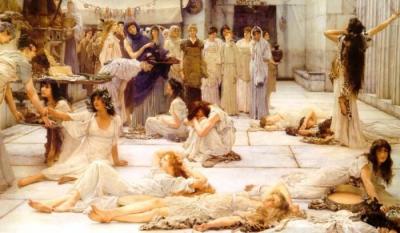
The Women of Amphissa, 1887, by Lawrence Alma-Tadema

Since I began writing for FAR in July 2012, I have written about Mary Magdalen, or excerpted a passage from one of my novels, near or on her July 22 Feast Day. For why I made the controversial choice to depict her as a prostitute, see last year’s post. The below excerpt is from The Passion of Mary Magdalen. I made this selection in remembrance of all the refugees in the world today. In this passage, Judith, a Jewish widow whose family was driven from the land by tax collectors, returns to the place where Maeve (my fictional Celtic Magdalen) and her friends have recently founded a Temple to Isis on the outskirts of Magdala. Maeve has just invited Judith to join them. (Edited for brevity.)

She stared at me, her eyes full of anger and longing.

“I will not be a slave and a whore where I was once a wife, the one who made the challah bread, who said the Sabbath prayers over it. This was our place, my husband’s and mine. We brought the best we had to the temple, the finest oil and wine, the unblemished kid—”

“Goats? You kept goats? You know how to make cheese?”

She sat quietly for a moment before she answered. “How can I live here with you?” she wondered. “I don’t understand.”

Continue reading “Temple Magdalen by Elizabeth Cunningham”

Beaches and Books by Esther Nelson

Even though I’ve traveled and lived throughout much of the world, I’ve never thought of any one place or geographic location as home.  I have always felt a little envious of people who claim to have a strong, visceral connection to a particular house, garden, village, landscape, or city in a specific, geographic area.

We often use the word home to indicate a space where we feel accepted, safe, nurtured, loved, and at peace.  Although I’ve never sunk deep roots anywhere I’ve lived—or even visited—I feel most grounded when standing on a sandy beach anywhere in the world, overlooking an expansive view of the ocean.  Perhaps the cowboys in American folklore and legend felt “home, home on the range where the deer and the antelope play,” but I don’t.  I am much more at ease with home, home on the beach where the wind swirls the water and sand.

I often hear the beach calling me.  Sometimes I listen and allow myself to fall under her spell and into her fluid embrace.

Continue reading “Beaches and Books by Esther Nelson”

Facing Life Part 1 by Janet Maika’i Rudolph

I remember the first time I killed a living animal for food. I was a college student. I was traveling with other students on a month-long backpacking trip along the Sea of Cortez in Baja, Mexico. It was a very long time ago, yet the experience was so impactful that the memories are etched into my being.

Truth be told, my prey wasn’t all that sexy. It was scallops. There are certain benefits to “hunting” scallops. They have no legs or fins to force someone into a chase, no arms to fight back, and no reproving eyes to haunt dreams. All fairly milquetoast. Or so it appeared to me on the surface.

The way to harvest scallops is straightforward. They are made up of two shells, the lower one is plastered to rocks in the water. The upper one moves up and down by pivoting on a membrane. A diver plunges into the depths of the sea to find them. Then a diver inserts a knife between the two halves of the opened shells in order to cut the membrane at the back. There is delectable meat inside both shell halves. The top shell will come free to be taken to the surface. The meat is cut out of the lower shell, which is immovably attached to the rock.

Continue reading “Facing Life Part 1 by Janet Maika’i Rudolph”

Independence Day? by Sara Wright

She haunts me

little bear,

too slight,

too wary

to seek

seed I cast

for her

under

White Pine

in whose strong arms

she finds

comfort and safety,

if only for one night.


The animals are innocent


Where was she when

exploding fireworks

whitened a black velvet sky

split stars night after night?

Where was she

when mindless drones

spewed raging gunfire

screaming for Right?

Who comforted her

in her fright?


The animals are innocent

Continue reading “Independence Day? by Sara Wright”

All Are Our Teachers by Elisabeth Schilling

Art by doanminh0205

What can we learn from each other? Some people teach us that we need help with boundaries. Some remind us that we are easy to love. We can observe the way some lovers make us want to escape, simmering a queasy feeling in our stomach that we practice patience and non-attachment with so that we are not harmed too much whilst in their presence and other lovers are always ready with a supportive word, assuring us that what we desire is valid, that we do not need to justify our path.

The people who we react to the most intensely, most of the time negatively, are these people our lessons? That sounds rather crass when thought to apply to anyone in an extremely oppressive and/or abusive situation. I would not suggest we apply this to anyone but ourselves, if indeed, it works for us. This is not the fatalistic idea of people belonging in a certain state or being punished for something. This is more a strategic curiosity of looking at our own agency from a back door. For example, my body might contort in frustration and sadness with someone, which could indicate I need to not be in relationship with their energies, but until I can create another path (maybe due to work commitments, relational obligations, financial situations, etc.), I feel more empowered reflecting so that I can learn about myself and others so as to perhaps not invite the same energies in during the future or to not have them affect me so harshly so that it doesn’t matter.

Continue reading “All Are Our Teachers by Elisabeth Schilling”

Grief, Have I Denied You? by Carol P. Christ

I have never had so much trouble trying to find a topic for blog and to begin writing it as I have this time. It is 6:58 am in Greece, three hours and two minutes before my blog is due to be posted, and I still do not have a topic. It is not that topics have not occurred to me. There is the rape allegation against Donald Trump by E. Jean Carroll. There is the fact that it was ignored by the press—as if it somehow does not matter that the President of the US is or might be a rapist. There is the declaration by Kamala Harris that if elected President she would move to immediately process hundreds of thousands of unprocessed rape kits. There are the new reports of the horrendous conditions in which children, women, and men are being kept in detention at the US border. And this morning there is the President’s racist rant against progressive congresswomen Alexandria Ocasio-Cortez of New York, Ilhan Omar of Minnesota, Rashida Tlaib of Michigan and Ayanna S. Pressley of Massachusetts. Continue reading “Grief, Have I Denied You? by Carol P. Christ”

Coming to Terms with Privilege: A Personal Reflection by Elise M. Edwards

elise-edwardsIn my two previous posts, I shared my recent experience talking about privilege at a church near me.  Today, I will wrap up this short series with a more personal reflection about privilege from a Christian perspective.  Last month, I was thinking theologically about what those of us who have privilege should do with it.  But, as feminists and womanists, acknowledging our privilege can be complicated.  Most of us in this FAR community do possess some forms of privilege while, at the same time, we lack other forms of privilege.  Each of us remains the same person wherever we go, yet our status can change when we switch contexts.  As a black woman, I do not have white privilege or male privilege.  But I am privileged when it comes to education and class and physical ability.  I am a Christian who works at a Christian university in a part of Texas that is culturally predominantly Christian. So that’s a form of privilege.  Although as a single woman without children, I don’t fit the cultural norm where I live, my sexual orientation and cis-gendered identity afford me some privilege, too.

Continue reading “Coming to Terms with Privilege: A Personal Reflection by Elise M. Edwards”

To Find My Soul by Katie M. Deaver

Breathe in… 2…3…4… breathe out… 2…3…4…

Pay attention to your footfalls, make sure you are landing correctly, breathe and count…

Breathe in deep… fill your lungs… and breathe out the stress and the heaviness.

Over the last few weeks I have been trying to get back into running. A few years ago I discovered that I loved running. I loved being alone with my thoughts, focusing only on how my feet hit the ground and continuing to breathe as I ran far more consecutive miles than I ever would have imagined possible. I even ran a half marathon, which I never would have believed I would be capable of… but, somehow, I was… and actually it wasn’t too bad, I looked forward to doing it again and even started to day dream of the possibility of one day running a full marathon.

In the typical day to day busy-ness of life I hadn’t been able to run much last fall and then this winter I took a bad fall on the ice that left me barely able to hobble along at a walk let alone run any distance. After many months of physical therapy and (mostly) sticking to my stretching and strengthening routine, I finally decided I was brave enough (and trusted my knee enough) to try and get back into my running groove.

Continue reading “To Find My Soul by Katie M. Deaver”

Patriotism Reconsidered by Carol P. Christ

Originally published on July 8, 2013 on FAR under the title “What Is Patriotism?,” this blog asks questions that seem even more important today, when tanks have been paraded in front of the Lincoln Memorial and children are held in appalling conditions at our borders because their parents dared to seek asylum in the United States.

July 4, American Independence Day, has come and gone. Perhaps now is as good a time as any to reflect on patriotism. What is it? What does it mean from a feminist perspective?  What is the relationship between patriotism and militarism?  Can one be a patriot and oppose war?  Can one be a patriot and deny that “America is the greatest country in the world,” the foundation of  the doctrine of American exceptionalism?

In a recent blog, Caroline Kline called attention to the use of patriarchal God language in the patriotic hymns her child was asked to sing in the 1st grade.  She wondered if this God language could be changed to female positive or gender neutral.  Her post prompted me to ask if changing pronouns would be enough and to revisit the question of patriotism and nationalism. Continue reading “Patriotism Reconsidered by Carol P. Christ”