Grief and Rebirth by Gina Messina

Rebirth is challenging. It demands that we be accountable, acknowledge failures and fears, recognize the ramifications of our actions, and the ways we impact those who share our journey. We often don’t realize that denying self-love and care in favor of sacrifice for others results in a double negative. If we don’t care or ourselves, we cannot care for anyone else. 

Warning…TMI ahead. I’ve thought a lot about writing this piece. I believe in the spirit of sharing experience; learning from one another—recognizing our own stories and finding we are not alone—when someone is willing to speak her truth. My gratitude to Carol Christ whose courage to share experience has empowered me to brave (I feel an overwhelming urge to insert emojis to express my emotion and gratitude; and although I am desperately trying to restrain myself… 🤗❤️🙏).

Being vulnerable is scary. It is uncomfortable. It requires us to share our deepest fears, that for which we feel shame. It can be embarrassing. We don’t want to be judged. And yet, our vulnerability can also promote our own healing and offer a sense of comfort to those who share in our struggle. And so, I feel like I should shout out Geronimo…

This month marks eleven years since losing my mother to violence. It also marks fours year since I chose to leave my seventeen year marriage. I hadn’t before made the connection about these two events occurring the same month until this very moment of my writing – but it occurs to me that there is a significance in finding strength during a time when I was grieving the anniversary of my mother’s passing. Perhaps a reflection for another post…

I remember the moment I knew that my marriage was likely going to end; I felt like I was dying. I begged my husband to stay. I recited prayers that have never brought me comfort. I went to a church that offered me no community. I sought counseling from a priest who devalues me because I am a woman. I turned to the traditional interpretation of my religion to keep me firmly placed in an unhealthy marriage. Power structure enforcing power structure.    Continue reading “Grief and Rebirth by Gina Messina”

Surviving My Recovery by Esther Nelson

For the past fourteen months, I’ve been going from doctor to doctor trying to figure out what ails me.  Specialists I’ve seen included wonderfully competent people immersed in their individual disciplines of nephrology, cardiology, rheumatology, and neurology.  At long last, the neurologist diagnosed my condition (accurately, I believe), and I’m slated to have surgery in July.

I’m overjoyed to finally have a diagnosis, with a positive prognosis no less, offered to me.  My everyday life has become more and more constricted over this past year.  I can’t walk far without pain.  I can’t stay in one position for long without pain.  I can’t practice yoga without pain.  I can’t do those everyday chores—grocery shopping, vacuuming, laundry, scrubbing the bathroom, and washing dishes—without pain.  Pain wakes me throughout the night as I attempt to sleep.

I do have concerns about how well I’ll tolerate the upcoming surgical procedure, but am even more concerned about my recovery period.  For six weeks after the procedure:  No lifting.  No bending.  No twisting.  No exercise except for frequent, short walks.  How will I ever manage?

Continue reading “Surviving My Recovery by Esther Nelson”

Magical Forests by Judith Shaw

judith shaw photoThe forest calls me. I long for her lush coolness, her sheltering trees, her world filled with life.

Continue reading “Magical Forests by Judith Shaw”

Befriending our Dragons by Sara Wright

“We are an overflowing river.
We are a hurricane.
We are an earthquake.
We are a volcano, a tsunami, a forest fire…”

These words written by Judith Shaw speak to the underlying merging of woman’s anger with Earth’s natural disasters, suggesting to me that women use “natural” violence in order to create change.

Violence, not the values of compassion and cooperation.

Violence and power over are the primary tools that Patriarchy uses to control women and the Earth.

Engaging in more violence will not solve the problems we face.

So many women including me are struggling like never before to survive on the edge of a culture that continues to sanction the vicious ongoing rape of both women and the Earth.

I use the death of trees as a primary example of the latter. By logging trees by the billions or killing them in “controlled burns” we are literally destroying human and non – human species. Without trees/plants we lose the oxygen we need to breathe.

We need “woman – centered” women to say NO!!! WE WON’T TOLERATE LIVING IN A DEATH DESTROYING CULTURE PREDICATED ON RAPE OF WOMEN AND THE EARTH.

We need women who are willing support other women – Women who refuse to remain neutral – Women who don’t wait until their mothers, daughters, sisters, nieces, granddaughters are assaulted to take a stand with other women – Women who refuse to stand behind their men when those men continue to support individuals (males or male identified women  – the latter are often “Father’s Daughters” in Jungian parlance) – Women who refuse to support a Patriarchal system that is destroying us all.

Continue reading “Befriending our Dragons by Sara Wright”

Raven’s Cry by Sara Wright


Fake coyote calls split
a moon cracked sky in two.
False ‘Indian’ hoots and drums
stunned sleeping birds –
Why do ‘whites’
insist upon using Indigenous ways,
to make a point?
Coyotes know.

Did they think that she was blind
or that her dreaming body,
a roiling belly
wouldn’t warn her?
Deception is a ruse
to twist and hide from truth
even when La Llarona’s river
becomes a mirror
shivering under
winter solstice flight. Continue reading “Raven’s Cry by Sara Wright”

The Healing Feminine Energy of Food by Elisabeth Schilling

In our society, relationships with food are complicated. Sometimes we might be anxious that our food is not safe, that we are not told the whole story, that we have to educate ourselves on what we can and guess the rest. Sometimes there are emotions connected with food such as ecstasy, joy, guilt, remorse, anxiety, or disgust. Sometimes thinking about food can be stressful, that we don’t have enough money to feed ourselves and others in the ways we would like or at all. Other times, we might wish food away because it is boring or we have limited skills or vision. I cannot say that my relationship with food is the healthiest. I have used food as a punishment and way to self-harm, I’ve been restrictive with food or scared of certain foods. I’m a little or a lot OCD and neurotic with how I handle food.
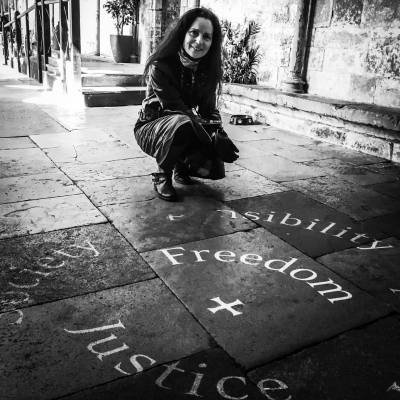
Ultimately, though, I love good food, and I rather enjoy cooking, especially when I have time to myself and am alone in the kitchen. There is something soothing in cleaning the preparation space and items, chopping the vegetables, combining the green, orange, purple together, letting my intuition guide me for spices. I know that food can be a ritual. It is a time where I listen to the water spill from the spout, the crackle of garlic in oils, the silence in the gaps where I pause before completing another step. Sometimes I go renegade, experimental or familiar, and other times the recipe is liturgy as it requires my faith to be guided by another’s wisdom. Continue reading “The Healing Feminine Energy of Food by Elisabeth Schilling”

Sawbonna: Godde and Another Route to Forgiveness by Margot Van Sluytman

From the day my Father, Theodore, was brutally and callously murdered in Toronto, on Easter Monday, March 27, 1978, I wanted to meet his killer. I wanted to know how it was possible to do such a horrific thing. I wanted to know how he felt about destroying the lives of so many; my family’s, and his own.

We did meet. The meeting occurred in July of 2007. Because of reading about an award I received for my Therapeutic Writing Workshops and the publication of my books about healing, voice, and agency, he emailed me. Our meeting, our reconciliation, even those many years after that dark, dark day, was a rich blessing in my life, and proved helpful for him too.

The word forgiveness, is one that can lead to great suffering for victims and offenders alike. Victims are told that if they do not forgive, they cannot heal. Offenders are told that if they are not forgiven, they cannot move on from the crime they have committed. Forgiveness is a loaded word, with as many understandings, expectations, and definitions as there are experiences of savage loss, savage grief, savage pain.

Continue reading “Sawbonna: Godde and Another Route to Forgiveness by Margot Van Sluytman”

The Goddesses Ereshkigal and Epona and Their Help in My Grief by Anjeanette LeBoeuf

AnjeanetteIn November, my paternal grandmother passed. She was five days away from her 93rd birthday. As I was/am going through the grieving process, I started to actively recall all the studies I have done regarding death and grieving practices across the globe and throughout the centuries. Mixed with the grieving process was constructing a January term class called “Goddesses Around the World.” As I marked each culture, religion, and goddesses we would be studying I kept coming back to an interesting fact. In many ancient cultures, it was the divine feminine who oversaw death, not only at times as the bringer of death but more importantly, as the guardian of the dead, the protector of all those that have gone from the earthly realm. Continue reading “The Goddesses Ereshkigal and Epona and Their Help in My Grief by Anjeanette LeBoeuf”

Mantra and Meditation in Buddhist Hospice Chaplaincy to Alleviate Anxiety by Karen Nelson Villanueva

Karen Nelson Villanueva has recently successfully defended her doctoral dissertation, “Invoking the Blessings of the Tibetan Buddhist Goddess Tara Through Chanting Her Mantra to Overcome Fear,”

Mantras are not just the prescribed sound formulas or sentences found in Eastern religions, but they can also be thought of as the words or phrases that we continually repeat to ourselves. The word mantra comes from Sanskrit and its roots are manas-, meaning “mind,” and -tras, which can be translated as “tool.” Thus, mantra is a tool to protect the mind.

How often do we engage in negative self-talk like “It’s my fault” or “I’m to blame for what’s happened to me” or “No one loves me”? These expressions can become mantras, as we believe their messages from constant repetition. In hospice and hospital settings, one often finds patients who have convinced themselves that “This is God’s punishment” or “Everyone has forgotten me” or “I’m so scared.” These phrases, rather than protect the mind, become what is believed by the mind and may lead to increased anxiety, stress, and depression, and consequently the need for spiritual and emotional support.

Chaplains, as members of the care team in hospice and hospitals, provide spiritual and emotional support to patients and their families. Most often, chaplains attentively listen to patients and their caregivers (often family members) about the patients’ life story, their relationships, their dreams unfulfilled, and their wishes for those whom they are leaving behind. Chaplains take part in family meetings where decisions are made about patients’ care, sometimes interjecting to ask for clarification of medical terms and to ensure that the family understands. Sometimes, the chaplain will lead prayer with the patients and their families, and at other times, the chaplain will pull other tools from her toolbox such as mantra meditation.

Continue reading “Mantra and Meditation in Buddhist Hospice Chaplaincy to Alleviate Anxiety by Karen Nelson Villanueva”

Shedding Shame by Joyce Zonana

As I follow my program, I grow clearer and stronger. I know exactly what I want and I take it. When I sit down to eat, I feel my appetite, healthy and strong. I feed that appetite, choosing just what I need and what will truly nurture me. When I get up from the table, I am complete and whole within myself. Whether I reach my “goal weight” or not, I’ve already succeeded. And so, this New Year, I won’t be making any new resolutions. I’m already on my path, shedding shame.

jz-headshotAt the lovely small Chanukah party I attended earlier this month, I did not taste the latkes, those delicious potato pancakes fried in oil and typically served with sour cream and applesauce. My hostess offered them to me repeatedly, proudly noting that she’d used her Polish grandmother’s recipe. But I politely said “no thank you,” I’d just started a diet. “Who starts a diet in December?” someone asked. Someone else pointedly wondered “How can you not eat latkes at Chanukah?” but I quietly insisted that I needed to refrain. I promised, though, that I’d have some next year, once I’d shed the extra pounds that were making me uneasy in my own body.

In my Middle Eastern Jewish home it was the height of rudeness not to partake of what someone offered you to eat. So my refusal was difficult on many levels. But in fact, we never ate latkes at Chanukah. Instead we had deep-fried beignets, little balls of dough, sticky-sweet and drenched in rosewater-scented sugar syrup. I wouldn’t be having any of those this year either. And though another friend at the party assured me I didn’t need to lose weight— “You’re zaftig and beautiful just as you are,” she said—I’d decided a few weeks earlier that, Chanukah or no Chanukah, Christmas or no Christmas, this December was exactly when I wanted to begin my journey to what I believe is, for me, a healthier body weight.

Continue reading “Shedding Shame by Joyce Zonana”