You Can’t Debate Mutuality by Sara Frykenberg

I use words like “mutuality,” “listening,” and “love,” here as I discuss my understanding of feminist justice-making and eschew debate…I want to make it abundantly clear: I see these as powerful, often forceful and even angry tools. We listen to what oppressors say so that they cannot deceive with their “alternative facts.” We love forcefully…We counter violence—we do not debate it—with anger, humor, creativity and power, in order to redirect its energies into more mutual possibilities.

Sara FrykenbergParticipating in the Women’s March on Jan. 21st in Los Angeles fed my soul deeply. I didn’t realize how much I needed to protest in this way, how stuck I had been in grief and despair after the election, and the way that coming together as a community would help me to mourn. There’s nothing quite like standing together with hundreds of thousands of people who also care deeply with hope, humor, and real power. Marching helped me to find the energy to fight back. It refilled a reservoir, so depleted in 2016, much as the badly needed winter rain in my home state of California has helped to abate the severe drought. Continue reading “You Can’t Debate Mutuality by Sara Frykenberg”

Alice Paul & the Women Who Will Keep Marching by Kay Bee

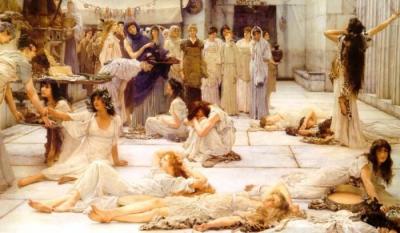
Hedwig Reicher as Columbia on the steps of the Treasury Building in Washington, DC, March 3, 1913.

The day before Woodrow Wilson’s inauguration, the 1913 Women’s Suffrage Parade took place in Washington, D.C. to demand the attention of the incoming administration and advance the cause of suffrage. Organized primarily by Alice Paul, 8,000 women marched on Washington on March 3, 1913.

Alice Paul is an often overlooked figure in American suffragette history. She’s no longer as common a name as Susan B. Anthony or Elizabeth Cady Stanton. Her early feminist contemporaries weren’t always very fond of her, for that matter. Many found her “too radical,” especially after her return from training with the British suffragettes, where she was arrested multiple times. But Alice Paul knew how to get things done. Continue reading “Alice Paul & the Women Who Will Keep Marching by Kay Bee”

New Year and Sustainable Resolution by Sara Frykenberg

At the end of 2016, my foot hurt—my body telling me: it is painful to move forward as you have been. You have to walk differently. Yow have to walk with more support, and sometimes, carrying less weight.

I am writing this blog on New Year’s Day, so Happy New Year! Today I say these words as both a statement of hope and as invocation. Happy New Year: may it be! My twin sister told me that our horoscope said that 2017 would be a party: we should throw our energies into anything and everything we want to see happen in our worlds because it can and will happen this year—may it be! Because it certainly doesn’t feel like a time for flourishing. I echo the introductory sentiments of Kate’s blog last Friday:

I am fried. These last two years proved personally & professionally exhausting. And yet, another year looms ahead unavoidably — another incredibly demanding year which will require more than I can fathom I actually have to give at this moment.”

Yes Kate. Oh my god/dess yes. This is exactly how I feel… and sitting down to write this blog this morning, I felt overcome with a wave of anxiety and stress, focused on all the things I have to do, the lack of time I have to do them, and the lack of energy I feel. Lurking beneath this stress is real pain and fear. What should we expect this year, in light of what’s already happening, in light of the hate already ignited? I think I have been locked in this pain and this fear. Continue reading “New Year and Sustainable Resolution by Sara Frykenberg”

A Lament for My Daughter by Katey Zeh

I wrote this the morning after the Presidential Election. While there will be time for hard work, there must also be space for the sacred work of lament. This is mine. photo-1461733558461-ff6968a0ae80.jpeg

Last night I dressed you in the Hillary shirt I ordered the morning after the first Presidential debate.  As I placed you in your crib, I kissed your sweet face and turned on the noise machine to block out the celebratory cheers that I knew would be coming in a few hours. We wouldn’t want to wake you.

As you drifted off to sleep, downstairs in the kitchen your dad was cooking shells for taco salads. The champagne was chilling in the bottom of the fridge. The news was streaming, filling our home with words of “too close to call.”  I said, “Let’s mute it for now while we eat. Let’s enjoy.” I painstakingly created an “H” out of shredded cheese and snapped a picture to post on Instagram.

Last night I sported my “I voted” sticker on the collar of the white pant suit I’d proudly worn to the polls to cast my vote for the first woman President. White, the color of women’s suffrage. White, the color of supremacy and oppression, a legacy of racism that awards me and you undeserved, boundless privilege.

Through the night I watched in horror as these United States turned redder and redder. The color of rage, of blood. “Have another glass of wine, Katey. You’ll feel better.”

No, I need to feel this. Every ounce of this pain. The pain that I often choose to not see, now staring me in the face. I couldn’t look away.

I took as much as I could bear. At midnight we part ways with our guests. Take the champagne with you.

I swallowed one of the bitter yellow pills my doctor had prescribed me earlier that day when I told him I couldn’t block out the noise: the gun shots, the threats, the gleeful cheers of white supremacy and sexism and homophobia and Islamaphobia and transphobia, and the sinful silence from people like me in response to these horrors. The pill dragged me into dreamless sleep for a few short hours.

And then you woke up, singing sweet songs in your crib. Happily oblivious. Cocooned. I envied you. For the first time in your life I wished that I could pull you back inside of me and keep you there forever, the amniotic fluid muffling out the horrors of the world outside.

But instead I didn’t hide my red swollen eyes from you. I let you see my tears, even though you can’t yet understand their source. I want you to see. I won’t–can’t–shelter you from my pain, from my fear for you. For all our babies.

Today I feel my heart breaking open, wider and wider. Creating more excruciating pain, yes, but also creating exponentially more room within me for love.

Love wins. I do not know how. But love wins.

Katey Zeh, M.Div is a thought leader, strategist, and connector who inspires intentionalKatey Headshot communities to create a more just, compassionate world through building connection, sacred truth telling, and striving for the common good.  She has written for outlets including Huffington Post, Sojourners, Religion Dispatches, Response magazine, the Good Mother Project, the Journal for Feminist Studies in Religion, and the United Methodist News Service. Her book Women Rising will be published by the FAR Press in 2017.  Find her on Twitter at @kateyzeh or on her website kateyzeh.com


Mother Demdike, Ancestor of My Heart, Part 2 by Mary Sharratt

mary sharrattContinued from Part 1. As I sought to uncover the bones of the cunning woman Mother Demdike’s story, I was drawn into a new world of mystery and magic. It was as though Pendle Hill had opened up like an enchanted mountain to reveal the treasures hidden within. Every stereotype I’d held of historical witches and cunning folk was dashed to pieces. Continue reading “Mother Demdike, Ancestor of My Heart, Part 2 by Mary Sharratt”

Mother Demdike, Ancestor of My Heart, Part 1 by Mary Sharratt


beltaine-pendle-view

Pendle Hill, seen from the back of my house, in May.

mary sharrattThe Soul of Gaia is the numinous earth beneath my feet, her soil cradling the bones and the stories of the ancestors who have died into the land and become part of the ever-living spirit of the place.

An expat writer, my home is everywhere and nowhere. A wanderer, I have lived in many different places, from Minnesota, my birthplace, with its rustling marshes haunted by the cries of redwing blackbirds, to Bavaria with its dark forests and dazzling meadows and pure streams where otter still live. But I don’t know if any place has touched me as deeply as Lancashire, England, my home for the past fifteen years. Continue reading “Mother Demdike, Ancestor of My Heart, Part 1 by Mary Sharratt”

Nominating Holy Women Icons by Angela Yarber

Who is your Holy Woman Icon?

When I began the academic study of religion in 1999, I was struck by the pantheon of male saints, venerated, honored, painted, adored, perhaps even worshipped. From virtually every tradition, men reigned supreme—in leadership, iconography, decision-making, worship—which is one of the myriad reasons groups like Feminism and Religion must exist. To combat this oppressive supremacy.

In 2010, I decided to put my wonder and this patriarchal dis-ease on canvas. I painted a triptych of Sophia, the feminine Greek word for wisdom often understood as the feminine face of Jesus, for a group triptych exhibition. Inspired stylistically by the art of Shiloh Sophia McCloud and He Qi, I endeavored to give traditional iconography a folk twist in an attempt to make it more accessible, perhaps a bit less brooding and intimidating. Emboldened by the works of womanist and feminist scholars in religion, my icons aim to subvert traditional—and often patriarchal—depictions of a virtually all-male sainthood. Though there are surely some women depicted Catholic and Orthodox iconography, and a robust number of women and goddesses in Hindu iconography, I found myself at a loss when it came to positive, affirming, and empowering icons of women across the vast spectrum of religious and spiritual traditions. Continue reading “Nominating Holy Women Icons by Angela Yarber”

Hey, Diddle, Diddle by Barbara Ardinger

Hey, diddle, diddle
The cat and the fiddle.
The cow jumped over the moon.
The little dog laughed to see such sport
And the dish ran away with the spoon!

From her lips to our ears.

What is this? Maybe it’s an absurdist play. An operetta. An oracle. A carnival. Or all at once. I’m only a Seeing Woman, not a Priestess or a Thealogian, but I’ve permission to be present at great events and small. So I was there. I was watching. It was indeed a carnival, but one of our old-time carnivals where we celebrate all there is celebrate in life. Not one of those new-fangled carnivals of those new religions, where they grab everything good they can for one day before they have to give up all the pleasures in life while their god does…well, whatever he and his disciples and prophets do up there in the sky.

Dish and spoonWhat on earth, I hear you asking, got into that dish? Why did she run away? Well, let me tell you. It was at one of our last carnivals. It was an enchantment. That dish was our Princess, and she was under the enchantment. Actually, the whole Royal Family was enchanted. The warriors came galloping in from the steppes beyond the river, but first they sent a Prince. He told our Queen that they were coming to “protect” us, that they were bringing new gods to us. Bringing what they called new civilization and new ways, bringing us what they called “good news.” Well, our Queen and Her Consort were rightly skeptical about all these news, and they locked the Princess up in a safe tower. Kept her there for who knows how long while that handsome but rapacious Prince came and went and the warriors surrounded our lands. Back and forth, back and forth. It was them that declared the carnival and threw that enchantment on all our important people. The Prince lured her down out of the tower—he’d stolen the magic words that unlocked the door—and then he told her he was going to eat her up. She thought it was a joke. He dressed himself up as a big spoon and persuaded her to dress herself as a dish. And then, when the invasion got serious, she ran away with him. Maybe she thought she was saving herself. Continue reading “Hey, Diddle, Diddle by Barbara Ardinger”

Body Sovereignty: Tracing the Relationship Between Feminism & Fat by Sydney Bell

Sydney BellAcknowledging and responding to feminine divine energy is an inherently radical, feminist act. With age my feminism and spiritual path have become inexorably intertwined and I have become more comfortable and confident in my identity as a daughter of the goddess, a priestess, and as a feminist. My feminism is continually being shaped by a call to serve the goddess in a variety of ways, particularly in response to an activating third element in my feminist goddess path (no surprise for fellow triad lovers who practice a Celtic spiritual path).  This third activating element is my relationship with my body and my work to reclaim Body Sovereignty.  

As with many readers of this site, mine is not an uncommon journey. I’ve heard the stories of  women whose feminism and/or goddess path has either sparked or been sparked by their desire to have a positive relationship with their body and break free from oppressive cultural body norms.  I believe many feminists realize societal expectations of beauty are restrictive and contain a harmful element of required thinness. Yet even among feminists there seems to be a reluctance to engage in a collective response to weight stigma and the oppression and injustice faced by fat people. This is perplexing considering the available data demonstrating inequities in areas like educational attainment, employment, income, and access to healthcare due to body size (see list of data sources below).

When trying to understand this strained relationship between feminism and weight stigma I’ve found it helpful to look at the historical relationship between the two.  A great resource is Amy Farrell’s book Fat Shame: Stigma and the Fat Body in American Culture. Farrell takes us to the early years of the feminist movement and suggests that the politics of fatness or body size was not explored by the first feminists.  Interestingly, as the fight for women’s right to vote raged in the early 19th century, Farrell points out that the attack used by both the suffragettes and those working against women’s right to vote was to publish political cartoons with unflattering ‘fat’ images representing their respective opponents. It wasn’t until the second wave of feminism in the 60’s and 70’s when Susie Orbach’s ground-breaking work Fat is a Feminist Issue opened up the discussion of body size through a gendered lens and set the tone for early feminist thinking about body size.   Continue reading “Body Sovereignty: Tracing the Relationship Between Feminism & Fat by Sydney Bell”

On Being Halfway To …Not Seeing You In August (or the Loss of Michfest) by Marie Cartier

michfest2Normally—and I mean normally as in the past thirty-seven years of my life, this is the time of year when I start thinking about the upcoming Michigan Womyn’s Music Festival and the fact that I will be seeing friends of mine from around the world for our one ten-day excursion deep into “womyn’s land.” Where I will howl at the moon with thousands of women. Where I will stay up late around my favorite campfire –the DART fire pit—where the physically challenged folks camp and where I am unofficial DART support. One of my best friends at Fest is a fabulous moonshine maker from Appalachia. Every year we have a date in the back of night stage—where literally this past year 7,000 women were dancing and singing and listening to a world class concert/rock n’ roll show under the moonlight. Way in the back my friend H. and I toasted on our annual “date” with her latest brew…that she trucked in by wagon next to her chair and her service dog. “So raise a glass,” we toasted with red cups high in the air, singing along with the woman way down front on the stage, performing in synchronicity with our toast.

This post “raises a glass” to Michigan. I have no idea whether or not this post can bring to life what it is, unfortunately now was, like there for the legions of women who trucked themselves “to the land” for forty years—but here goes. Continue reading “On Being Halfway To …Not Seeing You In August (or the Loss of Michfest) by Marie Cartier”