


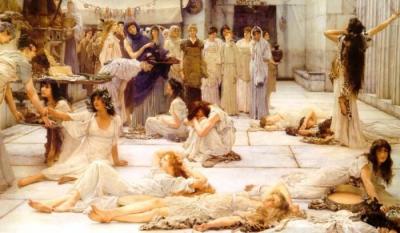
For by my side you put on
many wreaths of roses
and garlands of flowers
around your soft neck
and with precious and royal perfume
you anointed yourself.
On soft beds you satisfied your passion.
And there was no dance
no holy place
from which we were absent.
–Sappho (trans. Julia Dubnoff)
Sappho, the poet from Lesbos (630-570 BCE), was considered one of the greatest poets of her time—one of her epithets was “the tenth Muse.” I discovered the poems of Sappho in my thirties and was utterly captivated. I had newly embarked on a relationship with a woman and Sappho’s love poetry (though by no means exclusively lesbian) supported the expression of eros between women. Yet even more than that, Sappho’s poems supported an erotic relationship between self and world—a relationship that included ritual as a form of intimacy. I’m not a Greek scholar—I experience Sappho’s poems in translation. Yet the translations I read back then were a revelation: a world in which women lived in circle with one another.
Continue reading “Sappho’s Poems as an Ethos for Women’s Ritual by Jill Hammer”
 This week’s Torah parshah is Behaalotecha: Numbers 8:1 to 12:16. By now, much of what comes to pass should sound familiar. The parshah starts with another discussion of leadership and the priesthood. It then prescribes a second Pesach for those who happened to be ritually unclean for the first one and describes the consequences of not participating in the first Pesach if you had been ritually clean. Next, the Israelites’ wanderings through the desert are detailed which includes the divine appearing as natural phenomena and the very loud rumblings of the Israelites’ tummies. Finally, the parshah ends with a discussion of Moses’ wife and Miriam’s punishment.
  Every year when the cherries, pears, plums, and apple trees begin to bloom, I go out walking. I look for every spot in my vicinity where white and pink blossoms are blooming in exquisite profusion like foam on an ocean. Every year I take photographs, even though I already have so many. I walk at every hour of the day because, as the light changes, the colors change. I have albums and albums of pictures of my beloveds, the trees.
 This week’s Torah portion is Emor, or Leviticus 21:1 – 24:23. It details purity and the priesthood including whose funeral a priest can attend, who can marry a priest, bodily blemishes and temple services, and under what circumstances daughters of priests can still eat temple food. Emor also discusses the treatment of animals. A baby animal must be 7 days old before it can be sacrificed and cannot be killed the same day as its mother. In addition, the parshah describes the holiday calendar, including the counting of the Omer, how to harvest fields, and what type of oil should be used in the Temple’s Menorah. Finally, it outlines punishments for various crimes including blasphemy and murder.
  When I was growing up, I was fascinated to see my father each day recite the morning blessings mandated for Jewish men. While the rest of the household bustled sleepily—my mother in the kitchen, my brother and I taking turns in the bathroom, my grandmother slowly getting dressed—my father, still in his pajamas, would stand in the center of our small living room,
  This week’s Torah portion is Vayikra (Leviticus 1:1 – 5:26). Vayikra is essentially one long discourse on animal sacrifice with an occasional grain or oil offering included. This killing of animals, their subsequent burning and the shared eating of their flesh was the predominate way deities were worshipped in ancient Canaan. It was believed that the smell of cooking meat appeased the gods and most importantly stifled their anger. It is no wonder then that the ancient Israelites so integrated within the surrounding culture adopted similar methods of worship.
 Feminism and Religion