Oppression is systemic. Injustice is systemic. It pervades the whole – it seeps into everyday actions and becomes habits and patterns that function as default. As a result, the actions that fall within these patterns hardly need justifying. If anything, the questioning of them is what is put on the defensive. And those who stand against injustice must usually do so in the face of militarized policing, before vast forces that serve to preserve the status quo.
I can’t help but see the similarities between the everyday existence of young black men, of boys in this country, and that of women. The lack of safety in public places; the need to always be aware of one’s surroundings; the lack of trust in the intentions of another; living with the knowledge that people like you experience violence at much higher rates than others. It is a racist, violent, patriarchal world we live in. And, yes, it is also other things, good and beautiful things, but sometimes the hard reality of everyday life blocks out that light. Continue reading “Systemic Violence and the Killing of Michael Brown by Xochitl Alvizo”
Notwithstanding the widespread belief that contraception is not consistent with the principles of Christianity, there is no basis for it. On the contrary, contraception was closely associated with early Christianity.
Matthew 19:12 is the only passage quoting Christ that is on point. Christ has been speaking about family law (adultery), acknowledging here that the issue is not relevant to eunuchs, including those who castrate themselves “for the kingdom of heaven.” At a minimum it seems problematic how this verse is to be understood today. Yet, the evidence for Christians castrating themselves in the first few centuries after Christ comes from a variety of sources, many of which are considered to be otherwise reliable. It is very difficult to see why Matthew 19:12 itself should not be taken both as evidence of the practice and Christ’s implicit endorsement of it.
I’m moving to Prague in the Czech Republic at the end of August. (In case anyone is concerned, I will still be a regular contributor to this blog.) In part, moving to Europe feels like diving headfirst into the unknown. At the same time, it also feels right.
A full-time teaching job still did not materialize again this year despite my best efforts. I’m beginning to see the blessing in that since a full-time job would have made the decision to go that much harder. Yet, the decision to move wasn’t easy either.
My plan in Prague is to teach English to local business people as well as feminism and ecology at Charles University. Neither of these plans is solid. I don’t have any job offers yet. I could go there and everything could fall through or I could go there and decide to do something totally different. In many ways, it’s up to me. I’m not sure if I have ever placed myself into a situation in which I have so much freedom. At the same time, I’m also quite nervous about the entire situation. At least I’m not moving to Prague alone. Continue reading “Choosing Well by Ivy Helman”
A few days ago I had the pleasure of giving a talk at the Secular Student Alliance Conference on how non-believing persons can work with Churches. Amidst the chaos of conferences–managing your time, deciding which talks to attend, and making sure you have enough water (it was a Burning Ring of Fire outside in Tempe, AZ)–I got to meet some pretty incredible secular women.
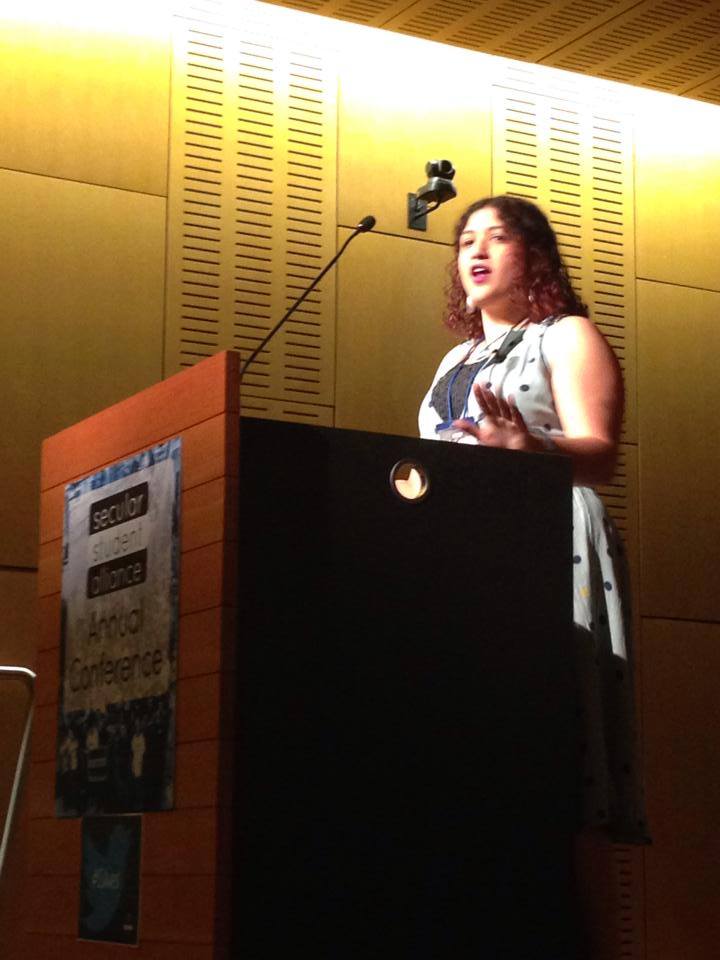
One of them was Heina Dadabhoy.
Heina speaking at SSA.
Former Muslim, blogger at Freethought Blogs, and overall bad-ass, Heina spoke about ways in which secular groups can create a more welcoming environment for ex-Muslims and Muslims beginning to doubt. Her talk, “Of Murtids and Muslims,” (a “murtid” is a public apostate) was not only about her experiences coming out as a secular humanist, but considered some of the absurd questions people ask her (and other ex-Muslims) about leaving Islam. “So did your parents try to honor kill you?” “Have you gone through FGM?” It was disturbingly humorous.
What I considered to be Heina’s main point, was that we should respect each others’ individual differences and not generalize and caricature all Muslims with the depictions of some. “Just because you read Ayaan Hirsi Ali’s book,” Heina notes, “does not make you an expert on Islam.” Heina made sure to emphasize the radical diversity that exists in Islam. She also spoke of the some of the issues that people go through when they leave Islam: How do I create a new identity when my old one was intricately tied up in my Muslim community, family, and culture? How do I navigate popular culture when I have missed a bunch of it? How do I find myself in this new secular world? Heina’s answers were refreshingly honest and insightful.
P.S. Aisha (one of Muhammed’s wives) should not simply be reduced to the young person Muhammed married; she was also a war leader, influential Muslim thinker, and someone who contributed greatly to early Islam. This is, of course, Heina’s insight.
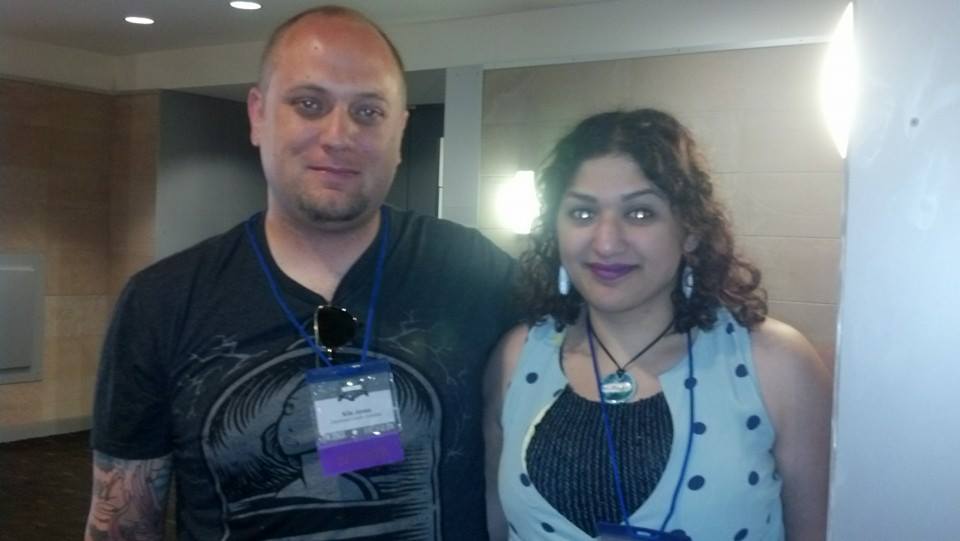
Me and Heina at SSA
Another awesome secular woman I met, was Sarah Morehead.
Sarah. Photo from Apostacon.
Sarah is a former evangelical Southern Baptist, Executive Director of the “Recovering From Religion” project, and another overall bad-ass. She spoke on how to start up a Recovering From Religion group on your campus. Here is a blurb about Recovering From Religion,
“If you are one of the many people who have determined that religion no longer has a place in their life, but are still dealing with the after-effects in some way or another, Recovering From Religion (RR) may be just the right spot for you. Many people come to a point that they no longer accept the supernatural explanations for the world around them, or they realize just how much conflict religious belief creates. It can be difficult to leave religion because family and culture put so much pressure on us to stay and pretend to believe the unbelievable. If this is you, we want to help you find your way out. Don’t let people convince you that you just didn’t have ‘enough’ faith, or that you just haven’t found the “right” religion.”
Sarah and I chatted (and often laughed) about our old experiences as conservative Christians. We discussed some of the funny language (Christian-eze) we used to use, the various levels of guilt and shame that were cast upon us, and how science helps explain some of the interesting displays of piety often seen at Pentecostal services. Sarah’s jovial and welcoming demeanor was calming, and as an Executive Director for a project aimed at helping people “recover” from religion, I cannot think of a better person for the job.
Lyz. Photo by SSA.
The last woman I have in mind is Lyz Liddell.
Lyz is the Director of Campus Organizing for the Secular Student Alliance. I have an interview I did with her a while back, on this very blog! Besides running around with her headset on, standing on chairs for announcements, and generally keeping the world of SSA from not crumbling into oblivion, Lyz is a great motivation and example. If you are ever interested in starting a SSA group on your campus, talk to her.
To all those who attended this years SSA West, or who are involved with helping secular students: Unite!
Kile Jones holds a Bachelors of Theology (B.Th.) from Faith Seminary, a Masters of Theological Studies (M.T.S.) and a Masters of Sacred Theology (S.T.M.) from Boston University, and is a current Ph.D. in Religion student at Claremont Lincoln University. He also holds a Certificate in Science and Religion from the Boston Theological Institute. Mr. Jones has been published in Zygon: Journal of Religion and Science, Philosophy Now, Free Inquiry, World Futures, Human Affairs, and the Secular Web. He is the Founder/Editor-in-Chief of Claremont Journal of Religion (www.claremontjournal.com), and is the Founder/Director of Interview an Atheist at Church Day (interviewatheists.wordpress.com).
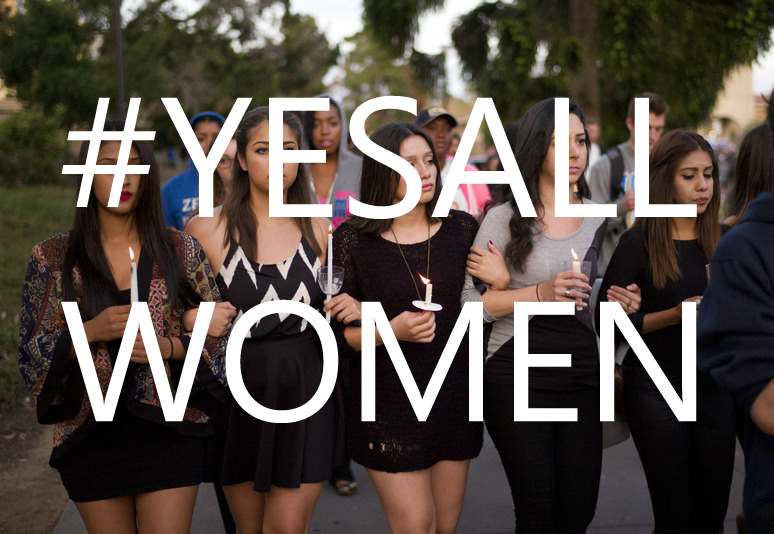
#YesAllWomen proved that although not all men commit horrible crimes against women, the men that often get the headlines and create the most controversy are the ones that need to be watched out for.
The one thing I typically will choose to do on the rare occasion that I’m able to sit down and relax is to watch a documentary. While some people may go to the gym, read a book, or hang with friends, I typically choose to stay in, nestle up on my couch, and learn. While on my last bout of relaxation, I chose to watch the HBO documentary Questioning Darwin. Although it offers very little new insight into the evolution vs. creationism debate, it does offer an interesting new way to look at the recent social media hashtag war feminists, allies, and supporters found themselves in over the #YesAllWomen movement that took the world by storm.
Now, before I discuss #YesAllWomen, I have to admit that I did not enter into the safe space women created for themselves to tell tales of the horrible things they have and have had to face on a daily basis. I firmly believe that men should not have entered into the digital space Continue reading “#YesAllWomen, the Darwin Debate, and the God Complex by John Erickson”
When my son was a teenager, living with his father in another state, he came to visit me in the suburbs of Virginia. He is nearly 6 feet tall, chestnut brown skinned. Like many suburbs there is no concept of the corner store. But about a half mile from our house was a gas station, with the usual quick shop that was pretty much the same thing as the corner store in residential urban centers. To get to this gas station by car was a short run. There was a shortcut through the woods behind my house, so that anyone trying to reach the store by foot could cut off some of the distance required in a car. I suggested this out of the way path to him. He told me in no short order. “Mom, I’m a Black male. I can’t be sneaking out of the woods at almost dark in this part of the world.”
I was embarrassed to think I had not considered how potentially perilous this might be, but starkly reminded what it is like to survive as a young Black male in the US, still today.
I remember reading an article that stated unequivocally that the income of the average college graduate Black male was about equal to the income of the average white high school graduate. I made the point with both my sons: college education was not an option. It was mandatory, to even begin to compete. I guess they got the message because both went straight through college directly after high school (and one of them even returned later for a law degree). My three daughters, on the other hand took a more circular path meanwhile. All of them went to college, but none of them either went directly from high school or route maintained a direct course through to the first degree. Continue reading “My Brother’s Keeper by amina wadud”
Three weeks ago, I played a video entitled “Kingdom of David: Rivers of Babylon” from the PBS Empires series. The series first aired in 2003. For the first time, and I’ve played the video in class for probably six semesters in a row, I noticed that all of the biblical scholars, archaeologists and rabbis interviewed to discuss the Torah, the history of the Jews, the Talmud, the exile and the prophetic tradition were men. This reminds me of a few months back when a female colleague of mine discussed about an encounter she had had with the producers of another documentary about the Hebrew Bible. They had only interviewed one woman. When asked about this decision, the producers told her that their audience finds men more authoritative than women when it comes to explaining topics of a religious nature.
***
Two weeks ago, on a Wednesday, an older woman walked into the liquor store where I work. She wandered around for awhile and then appeared somewhat overwhelmed, which is usually my cue to inquire if the customer needs help. She said she was just fine. Five minutes later she was still wandering the store apparently unsure what to purchase so again I approached her and asked if she’d like some help. She seemed somewhat desperate at this point and asked for my opinion on the Irish Cream Liquors and which one tasted the most like Bailey’s. I told her I wasn’t exactly sure. I had not tried them all but the one she was holding in her arms was very popular and we sell quite a bit of it. She continued to hem and haw explaining to me that she was having a bunch of old ladies over for lunch. She intended to offer them sips of Irish Cream afterwards. Then out of the blue she looked at me and said that she still couldn’t decide so she was going to ask a man for his opinion. This man also happened to be my boss. He said that he hadn’t tried it, but that it was very popular. His words, exactly the same as Continue reading “Sexism and “Jerusalem” by Ivy Helman”
Mother’s Day schmaltz in the media and in our malls makes me wonder if others struggle with some of the mixture of deep gratitude—and impatience I feel.
So I asked a few friends if they would tell me what they wished for most as mothers. Not surprisingly, all wanted their children to know how much they would always be loved, no matter how their lives unfolded. A few went a little further.
Mika K. is the mother of four beautiful children. Over the last couple of years, in addition to caring for her older children, she has nursed the youngest through a near catastrophic health crisis. That crisis left him with multiple disabilities. She continues to keep abreast of the latest in neuroplasticity and neuromuscular therapies that might help further her child’s potential to lead an independent life.
Mika and kids
Mika says: “My wish, these past few Mother’s Days, has been to NOT be Mom for a day. Don’t get me wrong – I LOVE my kids, LOVE my family, but some days, I am so wrapped up in being Mom that I lose sight of the woman I was before I was Mom. And I don’t just want a “day off.” Here’s how I feel: I feel like I’m running a race and I don’t know how long it is – 5K? 10K? Or is the finish line around the corner? So I don’t know how to pace myself. And I’m carrying a backpack filled with rocks. I appreciate the people on the sidelines cheering me on, and I appreciate the people who tell me to stop and rest. But what I don’t have – and would like – is for someone to carry that backpack for a couple of miles. Or carry ME for a couple miles! Right now, I can take a day off, but that just means I have more to do tomorrow. And I have to be confident that if someone does carry my backpack (or me) that they stay on the course. If they show me a better path – awesome! But don’t take me backwards or on a detour. Does that make sense?” Continue reading “Mother’s Day Wish: “Don’t take me backwards or on a detour” by Dawn Morais Webster”
First, there was the kidnapping and threatened sale of Nigerian girls by Boko Haram, which claimed religious acceptability for their acts. As Muslim theologian Jerusha Lamptey opined, this is not my sharia.
Then, the Sultan of Brunei’s horrific new penal code came into effect. Unlike the Nigerian girls, where a social media campaign garnered White House attention, the Brunei law gained visibility because the Sultan–who is dictating law that his track record suggests he does not observe–indirectly owns the famous Beverly Hills Hotel. Hollywood figures have objected to the rules, due to come into effect next year, which would punish proven male-male anal sex with death. (As far as I know, the code does not prescribe any particular punishment for lesbian acts, though the rhetoric has become that the new law prescribes “stoning gays and lesbians.”)
Claims like that of the Sultan or Boko Haram that “Islam” demands implementation of “sharia” ignore the complex reality in which there is not now nor has there ever been a uniform set of identifiable rules that Muslim scholars have agreed on much less that governments in Muslim majority countries have implemented over the centuries. As I wrote elsewhere, so-called sharia laws on the books in Brunei, Nigeria, Pakistan, Iran, Saudi Arabia, or Morocco are not directly revealed by God. They are human products with human histories negotiated in human contexts. The pretense that these laws are straightforward implementations of God’s will not only serves to justify these otherwise unjustifiable rules but also feeds the demonization and dehumanization of Muslims. Though happening on two continents and perpetrated by two quite distinct sorts of actors – a multibillionaire monarch enmeshed in global capitalism and a militant anti-Western, anti-government insurgency – the Nigerian kidnapping and the Brunei law became exhibits A and B for the vilification of sharia. Continue reading “Whose Sharia Is It? by Kecia Ali”
We hear it everywhere these days–five words directed towards women and men in military uniform, but also directed towards “vets”–people whose histories include “time served” in some branch of the armed services. TV show hosts say those five words before adding, “Let’s give a hand to the brave people in uniform who keep us safe.” Government officials shout it out in military gatherings, “Thank you for your service to the greatest democracy in the world.”
School systems partake in the spirit of it all by surprising an elementary or middle school-aged child during a reading or math class with a father’s (rarely a mother’s) sudden appearance–back home from the war zone safe and sound–at least for now. Airlines “support our troops” by inviting men and women in uniform (usually wearing army fatigues) to board their flight before the rest of us do. It’s a trite phrase, “Thank you for your service,” repeated over and over again much like, “Have a nice day.” What exactly are we thanking our men and women in uniform for?
Some would say our brave young women and men keep us (citizens of the USA) safe from those who would take “freedom” (our way of life, our values, whatever it is we hold dear) from us. In other words, those in military service are our saviors. They give up their lives (or are willing to do so) in order that we may live. In mythology, stories with this theme abound. Who of us is not familiar with the Christian story/myth telling about Jesus dying for our sins so that we may live eternally–free from death, the consequences of our sin? So, thank you vets for dying (or, at least being willing to die) so that we can live. Continue reading “Thank You For Your Service by Esther Nelson”