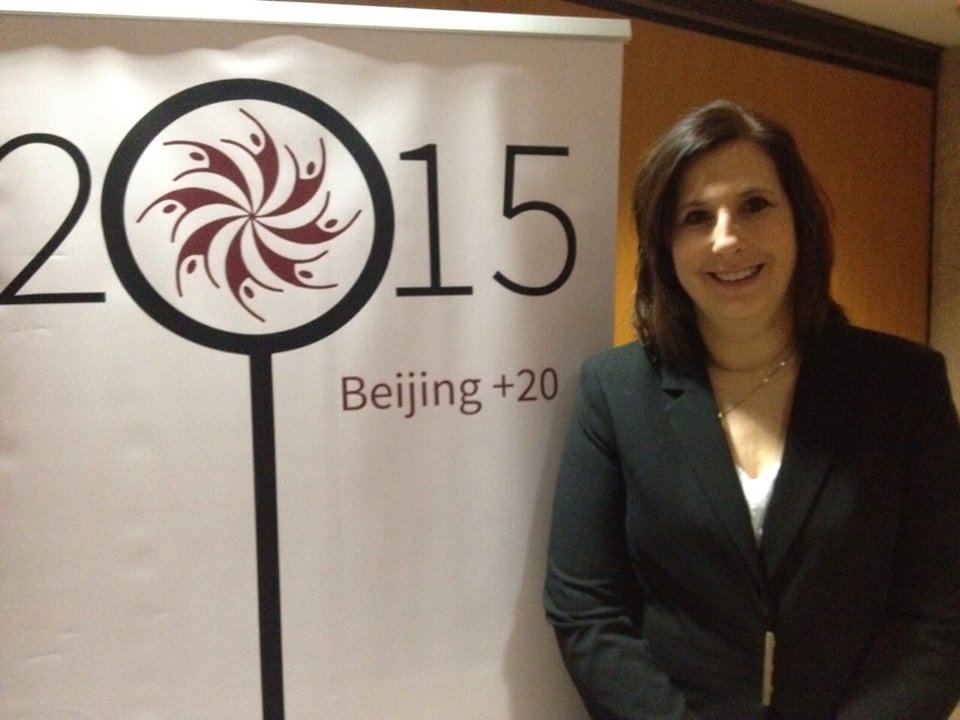
The Feminization of Poverty: The Impact on Migrant Mothers in the U.S. by Michele Stopera Freyhauf

Freyhauf, Durham, United Nations, Feminism and Religion, John Carroll, UrsulineI had the honor of speaking at the United Nations during the Commission for the Status of Women this past March about the Feminization of Poverty and the Impact on Migrant Mothers.  Below is the text of my speech delivered.  By posting my speech, it is my hope to use social media to help draw attention to this problem and use our resources to find solutions.

Over the last thirty years, rich countries have grown much richer, and poor countries have become, in absolute and relative terms, poorer. Global inequality in wages are striking and poor countries are turning to the IMF or World Bank for loans, which require “so-called” structural adjustments of devaluing currency, cuts in support for “noncompetitive industries,” and the reduction of public services such as healthcare and food subsidies, which has provided disastrous results for the poor, especially women and children.

The feminization of poverty not only means that more of the world’s poverty is born by women, thanks in large part to globalization of the world economy, but includes a denial of access to fundamental human rights, including health, education, nutritious food, property, representation, etc. Feminized poverty encompasses more than matters of individual suffering – it ensnares a vicious cycle of poverty that impacts their entire family.

Feminization of poverty has no singular cause. The United Nations Development Fund for Women identified 4 key dimensions that indicated a heightened rate of poverty for women:

First is called “the temporal dimension,” which means that women are often the primary caretakers of children and household duties. Women who live in developing nations may also have agricultural or physical responsibilities. With these demands, less time is available to devote to paid employment causing them to earn a smaller income even though they effectively do more work than their male counterparts.

Second is “the valuation dimension” which is defined as unpaid labor that women perform to take care of family members and other household chores. Work that is considered “less than” because formal education or training is not required.

Third, is “The employment segmentation dimension.” Women are natural caretakers and thus corralled into “women’s work”, such as teaching, working with textiles, or domestic servitude that includes caring for children or the elderly.

Finally, “the spatial dimension.” When employment is non-existent or difficult to find, women may have to migrate to other areas to find work temporarily. If a woman has children, she may refuse to take the job and stay to care her family. However, Some opt to leave their families behind, to secure what they consider a better life – a means of support – but this choice often comes a great cost. Continue reading “The Feminization of Poverty: The Impact on Migrant Mothers in the U.S. by Michele Stopera Freyhauf”

From the Archives: I Believe Anita! by Marie Cartier

Moderator’s Note: This has been posted on FAR twice, originally on April 7th, 2014 and then again on

Marie Cartier

During the past week I attended a Los Angeles premiere of a new documentary Anita: Speaking Truth to Power (Dir: Freida Lee Mock USA, 2013). The screening was sold out and I had great seats saved for me– sitting with a friend who works at Samuel Goldwyn, the distributor of this fine film.

In 1991, Anita Hill provided testimony she hoped would serve to dissemble the nomination of Clarence Thomas as a Supreme Court justice. Although the vote would end up being close (52-48) Hill’s testimony did not serve to dissuade the decision — Clarence Thomas’ nomination was confirmed and he was appointed to a life term on the Supreme Court four days after Hill’s testimony concluded. Here is an outline of the debate.

Continue reading “From the Archives: I Believe Anita! by Marie Cartier”

In Memoriam – God Hates Fags

Phelps didn’t just live a life filled with hate but he also embodied the very reasoning why so many communities cannot cross that proverbial bridge to work together to see past their differences and maybe never will. In the case of Phelps, sticks and stones may break our bones, but words really do hurt.

Fred Phelps, an American PasFred Phelpstor who headed the Westboro Baptist Church in Topeka, Kansas died at the age of 84 on March 19, 2014.  While some individuals leave behind legacies of their good deeds and loving memories, the only thing Phelps left behind was a family and church founded on the principle of hate.

A frequent eyesore at various events ranging from military funerals and gay pride gatherings to mainstream events that captured the attention of our pop-culture obsessed society, Fred Phelps and his clan believed it was their sacred duty to warn others of God’s anger over the growing acceptance of not only modernity in general but also issues like gay rights and abortion.  From slogans and signs such as ‘God Hates Fags’ to ‘Thank God for IEDs (Improvised Explosive Devices), Phelps has caused many controversies both during his lifetime and after his death.

Continue reading “In Memoriam – God Hates Fags”

We Rose for the One Billion on V-Day by Jameelah X. Medina

Jameelah Medina

Every February I gear up to participate in local V-Day 1 Billion Rising events where activists rise up to end violence against women and girls. This year’s theme was the journey to justice, and there were two local events. I delivered a speech at the second event. This is so meaningful to me because it testifies to how far I have come in my journey. Just a few years ago, I would never have spoken what I considered the unspeakable. I have found that with each utterance, I gain more freedom and encourage others to do the same in their own way.

One in every three women/girls will be sexually assaulted in her lifetime, and someone is sexually assaulted every two minutes in the USA. Knowing this and being one of these women, I dedicate this month’s post to my fellow survivors in hopes that you find some healing in it. Below is what the crowd heard from me on V-Day:

Justice is one of those tricky concepts that has many faces. For some survivors, justice is restorative where they are willing to engage in a dialogue with the perpetrator, community, and other stakeholders to attempt to repair the harm that has been done to them. For others, justice is poetic. It comes in the form of retribution and punishment whether it involves incarceration, physical harm or illness, or death by homicide or suicide. Yet other survivors feel that there is no such thing as justice any way you look at it. They feel that there is nothing that can ever be said or done to erase or minimize the life-long effects of the violence perpetuated against them. Continue reading “We Rose for the One Billion on V-Day by Jameelah X. Medina”

On the Path of Holiness by Ivy Helman

headshotGrowing up, there was a way in which I always felt excluded from holy things.  There was the holy: blessed water, sacred oil, priestly blessings, consecrated priests, pilgrimage sites, religious buildings and communion to name a few and then there was everything else including me.  Yet, I was a good kid who always (or almost always) did as I was told.  Doing good works is not contrary to a Catholic childhood or education.  In fact, it is an integral part of Catholicism, but there is also a competing notion that good works are in a different ontological category from holiness.  While goodness merits salvation, salvation is not connected to being holy.  Holiness was granted; salvation was earned.  In addition, holiness also seemed more distant because men had more access to holiness than women did.  Only men could be ordained and priests consecrate the Eucharist, celebrate the sacraments and bless people and things.  These are all holy things and the closer one interacts with holiness, the more holiness is bound to transfer onto the person coming into contact with them. Continue reading “On the Path of Holiness by Ivy Helman”

Yes, You’re a Homophobe by John Erickson

Jesus loved sinners and Jesus would rather be dancing with me in West Hollywood on a Friday night than lugging through a swamp luring ducks into a trap with a duck caller made by a clan who think that my sexual actions are similar to that of an individual having sex with an animal.

John Erickson, sports, coming out.

To be able to walk down the street holding the hand of the one you love is a great feeling and an action that some of us aren’t able to perform without fear.

A line has been drawn in the sand between those who support gay rights and those who do not.  While some call it being on the “right side of history,” I simply now refer to it as not sounding and looking like a bigot in the halls of history and in the various books, Facebook posts, and Tweets that our children will one day read. Continue reading “Yes, You’re a Homophobe by John Erickson”

Moral Courage by Kelly Brown Douglas

The time for false solidarity is over…Let’s us stop talking about it, let us just dig deep inside of ourselves and find a way to do it. 

Fifty years ago in response to President Kennedy’s assassination Martin Luther King Jr. wrote: “Our nation should do a great deal of soul-searching …” It is these words of Martin King’s that echo in my mind fifty years later as news headlines continue to be filled with stories of innocent young black bodies falling victim to a social climate that nurtures racialized fears and breeds racialized violence. If the deaths of Renisha McBride, Jonathan Ferrell, Jordan Davis, and Trayvon Martin tell us nothing else, they proclaim loud and clear that we are a people in need of a “great deal of soul-searching.”  For me, this time for soul-searching is nothing less than a kairos time. Continue reading “Moral Courage by Kelly Brown Douglas”

Theopoesis and the Interior Divine by Natalie Weaver

Natalie Weaver

Last week I traveled to Leuven, Belgium for the 9th Leuven Encounters in Systematic Theology conference.  I have been to this conference before, and I find that my perspective is generously enlarged by hearing voices that emerge from contexts and concerns that differ from my own in the USA.   This year, the conference theme was “Mediating Mysteries: Understanding Liturgies.”  The keynote speakers offered inspiring investigations into what “full, active, and conscious” participation of people in the Catholic liturgy means today (for, such were the goals for liturgy articulated at the Second Vatican Council).  Some provided critical evaluation of the newly revived Roman missal.  One speaker offered a searing critique of the distinction between true mystery and fabricated mystique in the Mass.  The breakout sessions were exceptionally well designed.  Here I noticed a common thread of people searching beyond the formal magisterial liturgies and studying the value of those mediated mysteries that are celebrated and communicated in culture, literature, and art. Continue reading “Theopoesis and the Interior Divine by Natalie Weaver”

Our Sisters’ Feminisms by Xochitl Alvizo

 We live in a very small and connected world that at the same time is a very large and disparate one. Sometimes I am overwhelmed by all the news available of the things that occur all over the world, to which I have such quick and easy access online. It makes everything feel so close and connected. At the same time, I also experience a huge disconnect between my very particular and local context and that of others around the globe; women whose reality and life experience I know little about. Even as news about them flash before my eyes, it’s not possible to reduce them to those brief flashes of information or claim to know something substantive about them. In reality, how much am I even able to say about the woman who lives across the street from me, much less women who I only know about online? And yet, my feminism compels me to call them my sisters.

Continue reading “Our Sisters’ Feminisms by Xochitl Alvizo”

The Little Words by Kelly Brown Douglas

As I contemplate the state of our world from the rhetoric of shut-downs to stand your ground, from the self-righteousness of political discourse to the dogma of ecclesiastic pronouncements, and from the justifications for political inequality to the explanations for ecological disregard, I wonder what has happen to all of our little words?

What has happen to our little words of gratitude? These are words like “thank you,” or “I appreciate that,” or “that is kind of you.” Have you ever noticed how in our world today people rush through it without stopping to say thank you? We have become a taken-for-granted people in a taken-for-granted world. We act as if we are entitled to certain things because of who we are or simply because we are. But here is the thing, that which we take for granted we tend to squander, to abuse, and to easily discard—like our natural and human resources. We take for granted our relationships to the earth as well as to one another. We take for granted our life on this planet and our life in community. It is time that we recover our little words. We must learn once again to speak little words of gratitude, for such little words go a long way in changing our world and to transforming a people from being wasteful, excessive and warring to being conserving, non-indulging, and peaceable. Continue reading “The Little Words by Kelly Brown Douglas”