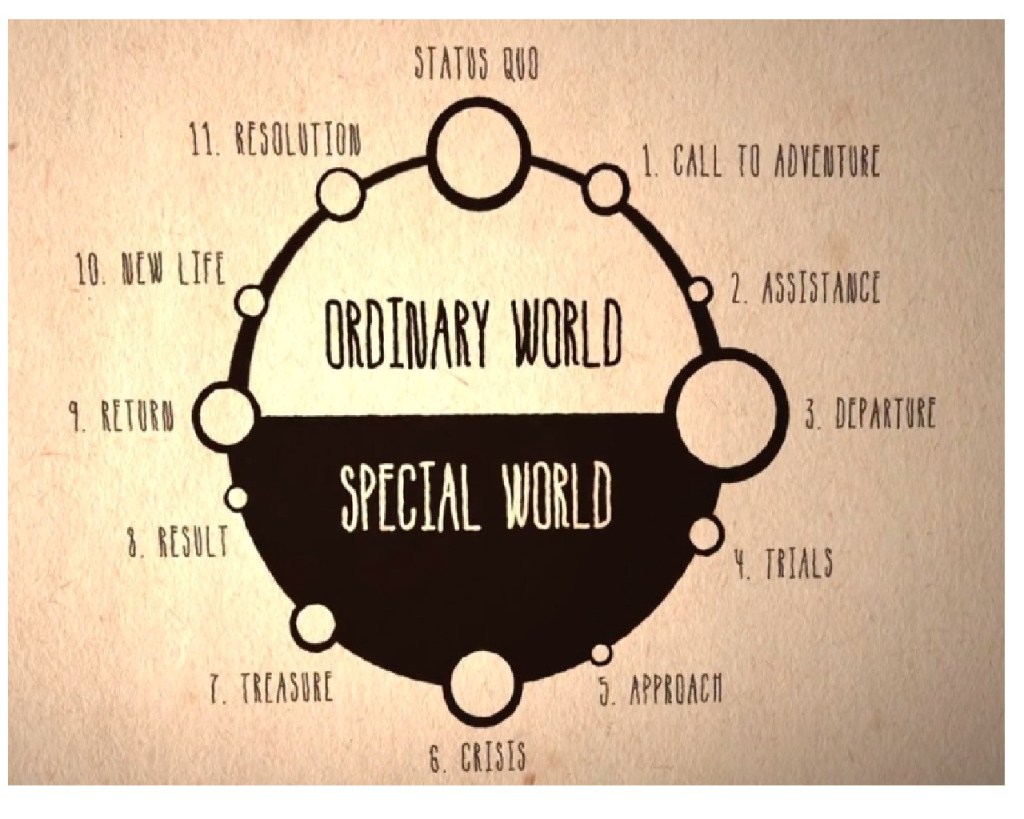
Joseph Campbell’s monomyth, the Hero’s Journey, is outlined in his 1949 book, The Hero with a Thousand Faces. Drawn from his studies of comparative mythology and Jungian psychology, the Hero’s Journey has become a foundation myth of modern culture. The hero, generally young and vigorous, sets off into the unknown to battle antagonistic forces and returns transformed, a hero and guide to his people.
As Campbell writes in The Hero with a Thousand Faces:
A hero ventures forth from the world of common day into a region of supernatural wonder: fabulous forces are there encountered and a decisive victory is won: the hero comes back from this mysterious adventure with the power to bestow boons on his fellow man.
The Hero’s Journey has served as the go-to template for Hollywood screenwriters and bestselling novelists. We see this mythic pattern of the conquering male hero played over and over again in popular culture. Think Luke Skywalker in the original 1977 Star Wars—or any protagonist in a George Lucas or Steven Spielberg movie. Creative writing teachers encourage their students to pattern their story arcs on the Hero’s Journey to give a sense of archetypal depth and resonance. But this technique has been overused to the point of becoming a cliché. A deeply sexist cliché. Continue reading “The Via Feminina: Revisioning the Heroine’s Journey by Mary Sharratt”
 *This post includes a call for stories at the end.

 This blog post is the 3rd in a series of looking for female deities in the bible who have been translated out of easy reach or otherwise hidden within its words. In my last blog post I discussed bird imagery and the bible. It is
  Read Part I of