From the Archives: Writing Through the Body: Betty Smith’s A TREE GROWS IN BROOKLYN by Joyce Zonana

This was originally posted on April 29, 2017

In her 1975 manifesto, “The Laugh of the Medusa,” French feminist Hélène Cixous urges women to write: “Writing is for you, you are for you; your body is yours, take it. . . . Women must write through their bodies, they must invent the impregnable language that will wreck partitions, classes, and rhetorics, regulations and codes . . .”

“The Laugh of the Medusa” remains a thrilling essay, challenging and inspiring women to “return to the body” and to language.  “Woman must write woman,” Cixous insists, “for, with a few rare exceptions there has not yet been any writing that inscribes femininity.”

Continue reading “From the Archives: Writing Through the Body: Betty Smith’s A TREE GROWS IN BROOKLYN by Joyce Zonana”

PATRIARCHY’S OFFSPRING by Esther Nelson

Elvis Presley (1935 – 1977) popularized the song “In the Ghetto” written by Mac Davis in 1969.  The following TikTok video, featuring an artist with whom I am not familiar, is better—in my opinion—than any other rendition I’ve heard.  Such depth!  Such raw passion!  Such strength!  Such vulnerability!

https://www.facebook.com/100064420368301/videos/1352885832113207/

Here are the lyrics:

As the snow flies
On a cold and gray Chicago mornin’
A poor little baby child is born
In the ghetto…

Continue reading “PATRIARCHY’S OFFSPRING by Esther Nelson”

¡La Vida es la Lucha! – Women in the Colombian Protests by Laura Montoya

*Trigger Warning – Reference and description of distressing violence against women at the hands of police*

Alison Melendez was 17 when she was sexually abused last week by a group of Colombian policemen. She was captured for allegedly being part of the protest groups in Popayán, a city in the south of my country Colombia, South America. The next day Alison was found dead. The official version states that she committed suicide. In the social networks, there is a video of four policemen carrying Alison to the detention center, each holding one of her extremities. One can hear Alison screaming, “Four were necessary to carry me? Four against one woman? Cowards!” The next day – before she was found dead – she posted on Instagram that she was not part of the protests that night. She was walking to a friend’s house when the police showed up. She started recording their actions, they saw her and went mad, so they captured her. When she resisted, four of them took her to the police station. In the post, Alison mentions how they groped her to the soul.” In the video, one can see how her pants came off while they were carrying her, and the policemen did not care. They just kept walking. The last time we see Alison in the video is inside the station. Then cameras were turned off.

*End Trigger Warning*

Alison is one of the 18 cases of sexual violence reported during the protests that started last April 28 in different cities of Colombia. In addition, there are 87 reports of violence and abusive behavior against women protesting. Alison’s case has been more visible, but it is easy to find several videos of police officers beating, harassing, and capturing women in the protests on social media. We have been witnessing this terrible violence full of indignation and impotence, despite protesting is our legitimate right as citizens. 

Continue reading “¡La Vida es la Lucha! – Women in the Colombian Protests by Laura Montoya”

Gardening Through the Storm by Tallessyn Zawn Grenfell-Lee

I spend a lot of time thinking about gardens. I think there might be something to them.

It seems strange to talk about gardens during such an intense time. The crucible of injustice, laid so bare during the pandemic, is overflowing all around us in a volcanic eruption of protests and retaliation. And more and more, we understand how it’s all connected – poverty, violence, choking black men, choking women, a choking planet. All connected in a huge, toxic river of greed, fear, destruction, and death.

Continue reading “Gardening Through the Storm by Tallessyn Zawn Grenfell-Lee”

When Life Hands You Lemons… by John Erickson

“When life hands you lemons, sometimes you have to make applesauce.”

I’ve been thinking a lot about something my grandmother would always tell me: “When life hands you lemons, sometimes you have to make applesauce.” I know, it sounds crazy, but life right now appears to be more on the crazy than the sane side.

We’re all in a state of uncertainty right now. The news is scary. Twitter is scary. Heck, even TikTok is losing parts of its humor. Everywhere we seem to turn, it’s more information about COVID-19, new cases, new lockdowns, and new things that we shouldn’t do for the foreseeable future. Continue reading “When Life Hands You Lemons… by John Erickson”

Poem: She Works Hard for the Money and a Working Class Dream by Marie Cartier

My neighbor gets up at 2 a.m. and is at work by 3:30 a.m.
Six days a week.
She works hard for the money*

She works at a grocery store. She has two dogs and I have two dogs.
Our dogs like each other and we talk about going to the dog beach
together, but who can plan that? We’re lucky to run into each other in our own neighborhood.
“Hey, how are you?” “Tired. You know.”
So hard for the money

I do know. I teach six classes at two universities. My wife works freelance for an overseas company
in artificial Intelligence designing for humans to be obsolescent.
In the meantime, she has no time to sleep.
My neighborhood is all plumbing trucks, gardening trucks and vehicles that go to work.
People leave in the morning to make the world turn. And they come home late at night.

So hard for it honey. Continue reading “Poem: She Works Hard for the Money and a Working Class Dream by Marie Cartier”

Letting Go by Joyce Zonana

How many objects have I clung to, how many pasts have I tried to preserve–beginning, of course, with the first loss, of Egypt where I’d been born and where my family had flourished? How many habits, feelings, fears, and beliefs continue to constrain me? The new year approaches, and my resolution today is simple: to let go. Again and again and again. As often as it takes.

temp_0218_Zonana_JoyceDuring the summer of 2005, I was living alone on Venus Street, in New Orleans’ Gentilly Terrace neighborhood, in a small Craftsman cottage I’d purchased two years earlier after breaking up with my longtime partner. I loved the house: modest yet gracious, it had a dining room with French doors that opened onto a screened porch, gleaming wood floors, cove ceilings, numerous multi-paned windows, a large bedroom, and a comfortable study looking out on royal palm trees where a flock of green parrots nested. I liked to think it resembled the home my parents had left behind in Cairo, Egypt when they emigrated to the U.S. in 1951.
For the first time ever, I’d carefully chosen and purchased furniture specially for the new space: a wide, heavy, round wooden dining table; a velvet camelback sofa; a coffee table, lamps, curtains, and a hooked rug. This was my “dream home,” the room of my own I’d always longed for, and I dwelt there in deep contentment–gardening, reading, writing, entertaining. Continue reading “Letting Go by Joyce Zonana”

Writing Through the Body: Betty Smith’s A TREE GROWS IN BROOKLYN by Joyce Zonana

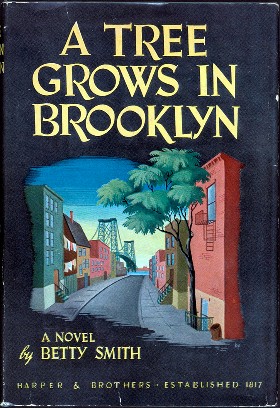
 TreeGrowsInBrooklynIn her 1975 manifesto, “The Laugh of the Medusa,” French feminist Hélène Cixous urges women to write: “Writing is for you, you are for you; your body is yours, take it. . . . Women must write through their bodies, they must invent the impregnable language that will wreck partitions, classes, and rhetorics, regulations and codes . . .”

“The Laugh of the Medusa” remains a thrilling essay, challenging and inspiring women to “return to the body” and to language.  “Woman must write woman,” Cixous insists, “for, with a few rare exceptions there has not yet been any writing that inscribes femininity.”

Although Cixous may not have been aware of it, Betty Smith’s beloved, perennially popular 1943 novel, A Tree Grows in Brooklyn is one of those “rare exceptions” that “inscribes femininity” in precisely the way she advocates. This autobiographical novel, so often dismissed as sentimental or as a children’s book, is actually written through the female body—which may explain its lasting popularity and power. Continue reading “Writing Through the Body: Betty Smith’s A TREE GROWS IN BROOKLYN by Joyce Zonana”

On Minimalism by Ivy Helman

untitledOne of the concerns of ecofeminism is the modern materialistic mindset of capitalism. Materialism in capitalism instills not just owning many possessions, but it also inculcates the “need” to own the newest innovation. In addition, materialism advocates a throw-it-away mentality. In other words, it is often cheaper to buy a new shirt or computer than to have them repaired. Similarly, it is not enough to have a cell phone. Rather, one must have the newest and best one! The environment pays the price.

One attempt to deny the hold of materialism is minimalism. The minimalist movement seems to run the spectrum. From the ideals of less is more, there seems to be some competition between mindful consumerism and extreme self-denial. Mindful consumerism suggests that minimalism is a journey of recycling, reusing and repairing combined with well-researched, well-considered, as-ethically-produced-as-possible purchases when necessary. Extreme self-denial advocates owning almost no material possessions. While I strive toward mindful consumerism, I have serious concerns about extreme minimalism. Continue reading “On Minimalism by Ivy Helman”

Intellectual Circles, Authenticity, Legibility, and Working Class Roots by Chris Ash

IMG_0754In my other writing for Feminism and Religion, I’ve discussed how a key focus of my spiritual path involves dancing within the tension of opposites, finding ways to move mindfully and freely inside the orbit of sacred circularities in which every curve leads into and out of its inverse, with infinite shades in between. Two areas of my life in which this tension has informed my lived experience are socioeconomic class and education. I’m only two generations away from factory workers and electricians, and three generations removed from a long line of poor farmers. Both of my grandparents on my mom’s side – with whom I lived as a child and whose influence on my life is felt every day – dropped out of school to work on their families’ farms.

And yet I was the little nerd in the gifted program, in two grades at once, through most of my childhood, even as my parents worked multiple jobs to make ends meet. By the time I left for college, I’d worked hard to rid myself of my Southern accent, not wanting to be flagged as uneducated or backwoods.

Whatever the markers for “poor” or working class in any given region – accent or dress or dialect – they frequently are coded as less intelligent. The impacts of these assumptions are felt early, as children from low-income or minority families are often overlooked for and underrepresented in gifted education programs, and the impacts are later reflected in graduation rates and college attendance statistics by demographic. Even as colleges work to provide opportunities for lower-income kids to attend, the dialogue typically focuses on how access to a specific, Western model of education can raise up underprivileged kids, and not on how getting smart kids from a diversity of backgrounds into the university system can expand the very boundaries of how a field understands itself and the framework within which it conducts its research. Continue reading “Intellectual Circles, Authenticity, Legibility, and Working Class Roots by Chris Ash”