What About Contraception in Pope Francis’s Promise to the Poor? by Dawn DiPrince

Pope Francis, at nearly every opportunity – including the choice of his name, has symbolically expressed a commitment to the poor. In just a little over a month, he has declined the customary gold papal cross, the ermine-trimmed red velvet cape, and the showy red loafers worn by his predecessor. He has refused the palatial papal penthouse apartment and is currently living in a two-room suite among the Vatican’s cardinals.

In additional to a more austere lifestyle, Pope Francis has spoken out about the world’s poor. His namesake is St. Francis of Assisi, who famously worked for the poor and for peace. The Pope claims he was inspired to take the name Francis when remembering a friend’s urging to “not forget the poor.” More to the point, Pope Francis has stated that he wants “a Church which is poor and for the poor!” Continue reading “What About Contraception in Pope Francis’s Promise to the Poor? by Dawn DiPrince”

(Femen)ism? by Kile Jones

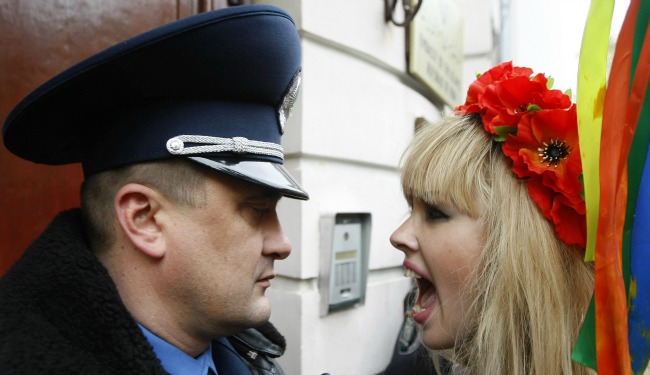
Kile Jones, atheistAs most of us are aware by now, there is a “feminist-sextremist” group from Ukraine called “Femen.”  This group has been very controversial by their public demonstrations of nudity, the words they paint on their bodies, and their explicit condemnations of political structures and organized religions.  They were started by Anna Hutsol in 2008 and have now spread throughout Europe and the Middle East.  The question I pose for this post is: Does Femen harness or hinder the power of the feminist critique?

Image from Konstantin Chernichkin/Reuters

Femen is precisely the kind of movement that pushes us in our understanding of feminism, the means by which it is best expressed, and the issues surrounding moral condemnation and religious sensitivity. Continue reading “(Femen)ism? by Kile Jones”

The Feminist Influence by Elise M. Edwards

Elise Edwards

In these past few months, as I’ve been finishing my dissertation about a theological and ethical perspective on architecture, I’ve had the pleasure of speaking often about my work.  In March, I was invited to give a talk at a symposium titled “On Christ and Architecture” at Judson University.  As they introduced me, the speakers noted that I am a black feminist.  Because of the brevity of my presentation, I didn’t speak about things that most people associate with feminism. So I was especially excited when at the end, one of the organizers complimented me by saying, “I really see the feminist influence in your work and I thank you for bringing that to us.” So exactly what does a feminist perspective bring to a theological study of architecture?

Perhaps first I should explain what my theological study of architecture is.  The purpose of architecture is sometimes understood as aesthetic or functional—to either make buildings that look nice or serve their purposes well (or both).  However, I discuss an ethical approach that expands this common understanding of architecture.  Grounding my research in philosopher Karsten Harries’ The Ethical Function of Architecture and theologian Timothy Gorringe’s A Theology of the Built Environment, I argue that architecture presents interpretations of a community ethos, or way of life, for its specific time and place.  These representations can either promote or inhibit human flourishing, and therefore, are the proper concern of Christian theology and ethics, which is concerned with questions about how Christians and those in the broader society are to live rightly in the world. Continue reading “The Feminist Influence by Elise M. Edwards”

Standing in Cautious Optimism with the Election of the First Jesuit Pope by Michele Stopera Freyhauf

Freyhauf, Feminism, Religion, Durham, Old Testament, Blogger, Bible, Gender, Violence, Ursuline, John CarrollFrom the time Benedict’s successor was revealed, I believed that we were witnessing something different – hopefully change.  Pope Francis I embraces many “firsts” – which is probably why the Cardinals chose him.  Change and reconciliation seem to be at the forefront – something the Church so desperately needs today.  Francis is the first Latin American Pope, first Jesuit Pope, first Pope to use the name of Francis after St. Francis of Assisi, a Saint held in high regard by Catholics.  When I heard his chosen name, I immediately thought of St. Francis, to whom my favorite prayer is attributed.  This is a prayer that inspires me and speaks about how I try to live my life –  as one who strives for peace, and provides love, hope, and compassion.  St. Francis’ story is a powerful story of conversion from a life of great wealth to one of voluntary poverty.  Francis received a revelation from Christ to “rebuild my Church,” in a way that embraces peace and love as well as providing protection for all of creation.  The notion of “Protector” was a major theme in Pope Francis’ homily during his inauguration mass.

As an unlikely choice for Pope, mostly due to his age and health, Francis reminds me of another unlikely advocate for the people – a man chosen to be Archbishop because of his passivity and his ill-health – Oscar Romero.  Romero surprised the people who placed him in office and stirred things up when he became a staunch advocate for the people that he served.  Romero’s “moment of conversion” revealed something spectacular that changed Latin America.  In his role as leader, he found his voice and became a defender for the poor and oppressed.  It is because of Romero that I am hopeful that Francis will provide (or at least start the wheels in motion to provide) changes to the Catholic Church. Continue reading “Standing in Cautious Optimism with the Election of the First Jesuit Pope by Michele Stopera Freyhauf”

Purim and the Value of Courage by Ivy Helman

Ivy HelmanThe Jewish Festival of Purim and the book of Esther offer us an opportunity to reflect on the value of courage from a feminist perspective. The online Webster’s Dictionary defines courage as, “mental or moral strength to venture, persevere, and withstand danger, fear, or difficulty.” In religious discourse, courage is often categorized as a virtue or a moral principle. Aristotle (384BCE – 322BCE), one of the most famous of the virtue ethicists, believed a virtue like courage should be practiced according to the mean or the right amount. Too much courage leaves one rash, possibly too reactionary and hot-headed while too little makes one cowardly and weak, but just the right amount in a given situation leads to moral behavior. Virtuous living leads to happiness, or perhaps is itself happiness, for Aristotle.  Yet, as a feminist, I understand the worth of courage differently.  To me, the value of courage lies not in individualistic gains nor in personal happiness but in its use toward achieving justice and equality in society.

In the book of Esther, we read about Queen Vashti and Esther both of whom demonstrate courage. (There are many feminist commentaries on the inherent sexism of the book of Esther. While I acknowledge the need for such critique, I am not approaching Esther from this perspective as much as I am approaching it from what we can gain from the actions of the women in the story.) As the book opens, King Achashverosh asks Queen Vashti to parade her beauty at a feast for him and his guests. She refuses to be paraded and thus objectified. Men in the king’s royal court react harshly telling the king that if he lets her get away with such disobedience other women will surely follow suit. This is surely problematic for the kingdom as well as their households. Vashti is replaced as punishment. Continue reading “Purim and the Value of Courage by Ivy Helman”

Ringing In the Lunar New Year with LGBT Activism By Grace Yia-Hei Kao

Grace Yia-Hei Kao  On Sunday, February 10, the Tet parade in Little Saigon, Westminster (CA) went on as planned. Several thousand people turned up to celebrate the Vietnamese New Year, or what Khanh Ho, Assistant Professor of English at Grinnell College, has likened to “Mardi Gras, New Years, and Christmas all rolled into one.”

Continue reading “Ringing In the Lunar New Year with LGBT Activism By Grace Yia-Hei Kao”

Second Class Rape Victims: Rape Hierarchy and Gender Conflict

Deconstructing masculinity isn’t the key to solving social, sexual, and domestic violence across the world but it is a step worth taking when attempting to engage men in affecting change to stop these violent actions since men, statistically are the perpetrators of such crimes that both cause such outcry as well as perpetual silence.

johnThe most disturbing part of the 2006 documentary Deliver Us from Evil isn’t the fact that Father Oliver O’Grady is rewarded by the Catholic Church with a new congregation in Ireland after his short stint in prison for the rape of dozens of children in the 1970s, but rather the hierarchy of gendered victimization which is often created throughout the various rape cases that are both reported and unreported throughout history.

I am often troubled by the ways in which rape cases are discussed and deconstructed via mediums such as blogs, online communities, social media networks, the news, and popular culture.  No series of events troubled me more than the Jerry Sandusky trial, but more importantly, the ways in which the young boys and adult men who were subjected to Sandusky’s abuse quickly overshadowed the other rape cases that are reported on a daily basis, specifically those involving young girls and women. Continue reading “Second Class Rape Victims: Rape Hierarchy and Gender Conflict”

The Next Liberal Prophet: What Will She Look Like? By Amy Levin

Amy2

This past Martin Luther King, Jr. day, I was privileged enough to attend the 57th presidential inauguration at the U.S. Capitol.  Spirits were high and it seemed as if we were breathing recycled air infused with the hope of four years past.  As the President approached the stage, he appeared with the confidence of a second term sage, and yet there was a newer, fresher quality about him – purified and politically born-again. As he began to speak, the religious undertones leaped out into the pews.  Beautifully crafted in diction, rhetoric, and reference, Obama pleased and inspired his dedicated supporters. Guiding us historically through Seneca, Selma, and Stonewall, we understood the meaningful tributes toward women, African Americans, and the LGBT communities. But there was an excess – another constituent represented – God had entered the stage.

Continue reading “The Next Liberal Prophet: What Will She Look Like? By Amy Levin”

Les Miserables’ Fantine, Women’s Suffering, and Female Migrant Labor by Gina Messina-Dysert

Gina Messina-Dysert profileUpon the recommendation of several friends and colleagues I decided to see the film Les Miserables.  It is rare these days that I make it to the movies.  My life is generally over scheduled and spare time is nonexistent.  So with just a few days left until the start of the semester and with a pile of work on my desk, I decided to throw caution to the wind and head to the theater last-minute to see Victor Hugo’s masterpiece on the big screen.

First, can I say what a brilliant surprise the film itself was?  I wondered if Hollywood could do justice to Hugo; from the moment of the opening scene I was in absolute awe.  I left the theater experiencing a momentary resurrection.

Anne Hathaway / Les Misérables: © Universal Pictures.

While the entire film was amazing, I would have seen it for nothing else but Anne Hathaway’s performance as Fantine.  I felt her suffering in the depths of my soul and wept along with her.  In Fantine we see the suffering of Everywoman.  She represents the thin line between those virtuous and those fallen and mirrors women’s imprisonment within this dichotomy.     Continue reading “Les Miserables’ Fantine, Women’s Suffering, and Female Migrant Labor by Gina Messina-Dysert”

A Call for Gun Control by Gina Messina-Dysert

Gina Messina-Dysert profileBut America seems to be the place the whole world thinks of when apparently ordinary people use guns for grotesque acts of violence. America stands alone in its historic and cultural attachment to guns. America stands armed. — Jonathan Mann

Reflecting on the tragedy in Connecticut, as well as the shooting in Portland earlier this week and the shooting in Colorado during the Dark Knight Rises screening in July, it is clear that gun violence is out of control. In the last six months we have had three major tragedies related to gun violence. While some argue this has nothing to do with gun control, I wonder how it could not?

Continue reading “A Call for Gun Control by Gina Messina-Dysert”