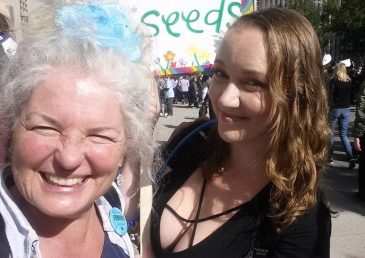
All Photos by Marie Cartier
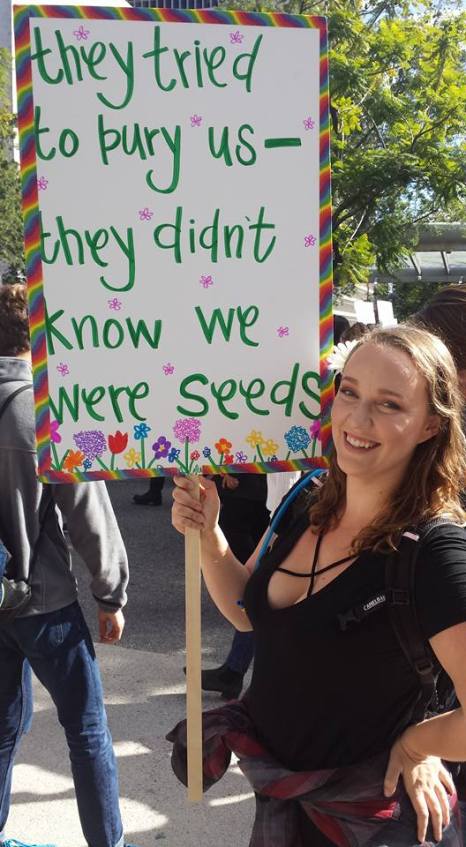
Continue reading “Photo Report from the Woman’s March, Los Angeles by Marie Cartier”

Exploring the F-word in religion at the intersection of scholarship, activism, and community.

All Photos by Marie Cartier
Continue reading “Photo Report from the Woman’s March, Los Angeles by Marie Cartier”
 This continues my reflections on the Devidasis in Part 1.
The overall picture that emerged from the documentary “Sex, Death and the Gods” was that, in its current form, there were many layers to the Devadasi system. For one, the most heartbreaking of all, there were the helpless, underage girls protesting such an existence, pleading that they would rather be in school, instead of being trapped in what was essentially a form of sexual slavery. But then we also see the older Devadasis, women who had been dedicated as children themselves.
Within this latter bracket, there were two groups.Those that viewed the practice as evil, and those that saw it as empowering – they earned their own income and they didn’t have a man or mother-in-law to lord over them; in short, they were in-charge of their own households. To them, married life was akin to a life of servitude, sex was something they enjoyed, and they may have shared a more or less equal relationship with the men who were their customers, men who enjoyed their company and preferred being with a Devadasi rather than with spouses they never chose or couldn’t get along with. In the words of one Devadasi – “I am the boss.” Continue reading “Sex, Death and the Gods (Part II) by Vibha Shetiya”
How will the world end? No, it isn’t Lucifer himself coming from hell to bring in the end times, it is someone far worse, and his name is Donald Trump.
 When I was a little boy I was terrified that I would live to experience the end of the world. Whether it was by an asteroid, Y2K, or a zombie plague, I would make myself sick by picturing these horrible things that could befall me and my family. Although I was a precocious child, the crippling fear that would lurch its way up my stomach and into my head would sometimes make it impossible to sleep at night. While I like to think I grew out of that phase, I now sit here feeling that way again. I’m crippled with fear that the end of the world is at hand and there may be nothing we can do to stop it. How will the world end? No, it isn’t Lucifer himself coming from hell to bring in the end times, it is someone far worse, and his name is Donald Trump.
By the time you’re reading this post, the first Presidential debate between Hillary Clinton and Donald Trump will have occurred and, no matter where you look, the aftermath will haunt us for weeks to come. We will either be sitting here, coaxing in the sunlight that Clinton has, in proper fashion, just goaded Trump into revealing to the 100 or so million viewers that will have chimed in to viewing how completely dangerous he truly is, or will we be scurrying to uncover decade old bunkers that were used during the 1950s and the Cold War to take shelter from the fallout to come should, Donald Trump become the next President of the United States. Continue reading “The End is Nigh by John Erickson”
 In the TV film about American suffragists “Iron Jawed Angels” Alice Paul (played by Hilary Swank) says to a psychiatrist who came to prison to assess her mental state during her hunger strike:
You asked me to explain myself. I just wonder what needs to be explained. Let me be very clear. Look into your own heart. I swear to you, mine’s no different. You want a place in the trades and professions where you can earn your bread? So do I. You want some means of self expression? Some way of satisfying your own personal ambitions? So do I. You want a voice in the government in which you live? So do I. What is there to explain? Continue reading ““Suchness” of inequality vs. the “story” of patriarchy by Oxana Poberejnaia”
 In my previous post, I wrote about my participation in planning a memorial event for the lynching of a man named Jesse Washington in Waco, Texas one hundred years ago. It prompted me to reflect on the challenge of faithfully remembering a conflicted past. It’s important that we don’t just remember past events, but that we remember them appropriately.
I’m convinced that when we remember the past, we must avoid oversimplifying the stories of what occurred to suit our present day agendas and sensibilities. We have to acknowledge the complexity, tension and conflict in what occurred, and perhaps even our own guilt and complicity in what is still occurring. As a black feminist Christian ethicist, I face this challenge when one aspect of my identity seeks to address a particular issue through a narrative that implicates or denigrates another aspect of my identity. Uncomfortable as it is, I recognize Christianity’s complicity in its defenses of chattel slavery. I recognize women’s support of patriarchy.
I went to a lecture a few weeks ago by Walter Brueggemann, a well-respected Old Testament theologian, titled “The Risks of Nostalgia.” Brueggemann warned us of the dangers of mis-remembering the past. Pointing to texts from the prophets and Psalms, he demonstrated how the people of Israel remembered a past before exile without remembering the difficulties, the exploitative conditions, and the tensions of that time. Excluding these harsher realities allowed them to gloss over the differences among them to unite in hatred and distrust in a common enemy—the one responsible of their present situation. By misremembering, they lamented a version of past that didn’t belong to all of them because it didn’t include their diverse histories. But the singular narrative served a purpose—it furthered their cause, their yearning and motivation to return to the way things were before. Did this cause really serve all those who were yearning for it? It’s a question that comes to mind when I hear women yearn for a pre-feminist era or Christians yearn for an era of Christendom.
Like the Old Testament people of exile, we are in moral danger when we remember the past with a nostalgia that sweeps over the real stories of what happened in the past. We risk buying into a narrative that harms us in its oversimplifcation. A simple solution will suffice if we believe we have a simple problem.
Lynching was not a simplistic problem and the Waco Horror is not a simplistic story. A black man was lynched for raping and murdering a white woman named Lucy Fryer. I’ll admit it. The realities of the story make me uneasy. Jesse Washington confessed to a crime and was found guilty in the court proceedings that preceded his murder. It makes sense to question whether the criminal proceedings were biased and whether his confession was coerced or illegitimate in some other manner. But even if we question his confession or conviction, we shouldn’t gloss over them as if they never occurred. To present him as a purely innocent victim would be to distort the past to serve a cause – and even a cause as noble as community unity or racial justice should not be attained through lies. People of integrity must guard against distorting the past for “the good” because the distortions themselves cause pain and harm.
Fryer’s family is still experiencing pain over her murder which precipitated the lynching. Sadly, their pain is made worse by the remembrances of Jesse Washington. Their pain does not mean we should not remember, but it does mean we cannot, as people of good conscience, romanticize violence or idealize its victims. Some people might make Washington out to be a hero or a martyr, but the organizers of the memorial service didn’t remember him that way. We didn’t cast him as a blameless victim. But we remembered him as a victim, nonetheless.
We didn’t romanticize the lynching crowds and their pursuit of justice, either. Washington was brutally tortured and killed before a crowd of thousands. If Christians are a people who embrace the love and mercy of a God who forgives the worst of sinners, they have to condemn even those crimes committed in the name of justice; crimes committed against criminals.
Noble causes, if they are just, must stand in the truth – the messy, complicated truth that resists casting all our heroes as saints, all our villains as irredeemable sinners. Real humans aren’t characters who wear the white hats and black hats of the old Westerns (or even the white hats of Olivia Pope & Associates on ABC’s Scandal).
When we resist remembering simplistic, nostalgic stories, we can begin to grapple with the reality of how difficult it really is to achieve justice. We can see humankind for who we really are. And maybe then we can ask for help.
We can ask victims to help us heal the wounds that persist. We need their help to understand their pain and the underlying causes we seek to solve.
We can ask for the help of those who study the various aspects of our world and culture—the economists, the sociologists, the historians, the artists, the theologians and ethicists, the criminologists, and the scientists. We can be humble enough to learn what we don’t know about what’s really going on.
And I hope we also ask for divine assistance. Despite their own complicated histories, wrongs, and imperfections, our faith traditions can enable us to do more than merely rightly remember, consider, and observe the problems in the world. They can embolden us with the courage of Harriet Tubman, Sojourner Truth, and Ida B. Wells-Barnett to speak a complicated truth and yet still dare to fight to make this a better world.
Elise M. Edwards, PhD is a Lecturer in Christian Ethics at Baylor University and a graduate of Claremont Graduate University. She is also a registered architect in the State of Florida. Her interdisciplinary work examines issues of civic engagement and how beliefs and commitments are expressed publicly. As a black feminist, she primarily focuses on cultural expressions by, for, and about women and marginalized communities. Follow her on twitter, google+ or academia.edu.
I’m going to do something I’d never thought I’d do: fill your newsfeed with yet another article pertaining to the 2016 United States Presidential election and yes, I’m going to talk about former Secretary of State Hillary Clinton (hint: I’m emphatically supporting her and I’m unapologetic about it.)
 I’m going to do something I’d never thought I’d do: fill your newsfeed with yet another article pertaining to the 2016 United States Presidential election and yes, I’m going to talk about former Secretary of State Hillary Clinton (hint: I’m emphatically supporting her and I’m unapologetic about it.)
Let me start off with my central point: a vote for Hillary is a vote to change history and the world. No, not because she’ll hail in some type of new economic stimulus (although I’m sure she’ll do just fine with our economy #ThanksObama) or because she’ll save us all from the evils of the GOP (looking at you Trump/Cruz/and the “moderate” Kasich) but because she’ll do one thing that’s never been done before: become the first female President of the United States, ever.
While I have tried not to get into “it” (read: online trysts with my friends on social networks who are #FeelingtheBern) the question I beg to ask is: what’s so wrong with wanting the right woman to be the President? This is one, but not my only reason, I will cast my vote for her both in the Democratic Primary in California in June as well as in November (and, if you haven’t guessed, I do not believe or promulgate the reasoning or rhetoric that Bernie Sanders will come from behind and win the Democratic Party’s nomination because I passed 5th grade level Math.)
One hundred years ago, Jesse Washington was lynched downtown in Waco, Texas. Next week, on March 20th, some of my colleagues and I are organizing a memorial service to remember this horrific event and pray for a better future for our city.
We invited submissions of original prayers, poems, spoken-word pieces, music, drama, and other pieces of liturgy for this ecumenical memorial event. We received a number of thoughtful, heartfelt submissions, but we also a question:
“Why in the world do we need a memorial for one person who was lynched?!?! In the reality of things, Jesse Washington was one of thousands of Blacks that were lynched in America during the time period.”
I thought the answer was so obvious that I initially brushed off the question. But as our group proceeded with the plans, I thought about the question and wondered whether our university community would understand why we are doing this. And honestly, in moments of exhaustion when I put off responding to emails, I wondered, too. Why am I doing this?
To remember. We memorialize one person who was lynched to remind us that every single one of the thousands who were lynched was a human being who was killed unjustly.
In the speech “Lynch Law in America,” from 1900, Ida B. Wells-Barnett describes the injustice: “Our country’s national crime is lynching. It is not the creature of an hour, the sudden outburst of uncontrolled fury, or the unspeakable brutality of an insane mob. It represents the cool, calculating deliberation of intelligent people who openly avow that there is an “unwritten law” that justifies them in putting human beings to death without complaint under oath, without trial by jury, without opportunity to make defense, and without right of appeal.”
Wells-Barnett was an African-American journalist and activist for civil rights and women’s suffrage. Her writings and activism advanced anti-lynching campaigns adopted by Black women’s clubs and the NAACP. Unsurprisingly, her work was controversial, even among women’s groups. Wells-Barnett argued that lynching began after the emancipation of slaves to repress “race riots.” When a constitutional amendment permitted black men to vote, lynching was used to violently prevent their participation in state and national elections. When fraud, intimidation, and local policy succeeded in suppressing the black vote, the brutality continued in the name of avenging or preventing rape and assault of white women.[1] For this argument, lawmakers, ministers, and women’s groups accused Wells-Barnett of defending rapists and subverting “justice” for their alleged victims.
She did not defend rapists. (Neither do I.) She condemned a system that used allegations of rape of white women to legitimate hanging, burning alive, shooting, drowning, dismembering, dragging, and displaying black men’s bodies. Some allegations may have been true. Many were false. Despite the veracity of the allegations, the vigilantes tortured and killed men, women, and children in brutal, public ways, and we must not mistake that for any form of justice. Lynching apologists explicitly valued white lives over others. Lynching was, and remains a crime against humanity.
In our own age of campaigns against the impartiality of law and law enforcement, we should remember the lynching victims and the tensions within earlier waves of feminism and the temperance movement over anti-lynching campaigns. We do not have to condone criminal behavior to call for humane law enforcement or prison reform. We can affirm the humanity of accused and convicted criminals in the pursuit of justice. So we remember Jesse Washington and the other lynching victims to engage more consciously in the activism of our time. We remember so that we don’t lose sight of the complexities of our work. We work in remembrance of the many victims of injustice.
We also gather to pray. For some people, prayer is about making requests to the divine. But in a more expansive sense, prayer is communication with the divine. In prayer, we set time aside to connect to something greater than ourselves. It’s our hope that gathering as a community to pray for the future of our city prompts us to see beyond individual concerns. In a liberation ethics framework, as explained by Miguel De La Torre[2], prayer is not limited to individual, private conversations with God in hopes of gaining wisdom and guidance. De La Torre presents prayer as a communal activity that brings together different members of the spiritual body. It involves the critical application of the biblical text to the situation at hand. This involves critical analysis of the social context that gave rise to the text or its common interpretation. So we pray to give us time to come together, to read scripture, to seek God and hear God through other members of our community.
So why are we gathering? Why do we memorialize one person when there are so many others who have been harmed, not just in my local community but all of our communities?
To remember past wrongs.
To commemorate.
To honor.
To inspire.
To call attention to persisting injustices.
To make us mindful in our work.
To provoke us to pray.
[1] This argument about the reasons for lynching is found in several of Wells-Barnett’s essays, but is quite developed in The Red Record: Tabulated Statistics and Alleged Causes of Lynching in the United States (1895).
[2] See Miguel A. De La Torre’s Doing Christian Ethics from the Margins (2nd Edition, 2014).
Elise M. Edwards, PhD is a Lecturer in Christian Ethics at Baylor University and a graduate of Claremont Graduate University. She is also a registered architect in the State of Florida. Her interdisciplinary work examines issues of civic engagement and how beliefs and commitments are expressed publicly. As a black feminist, she primarily focuses on cultural expressions by, for, and about women and marginalized communities. Follow her on twitter, google+ or academia.edu.
 In the past week, founder of Ms. Magazine Gloria Steinem, whom I have always greatly admired, stated that young women are supporting Bernie Sanders because his campaign is where the boys are. She has since recanted the comment, but I suspect she still believes that feminists ought to be supporting Hillary. I have written Gloria an open letter.
Dear Gloria,
Like you, I am no longer a young woman. Like you, I am a lifelong feminist activist. But, unlike you, I am not supporting Hillary Clinton. I am supporting Bernie Sanders because of–not in spite of–my feminist principles. I came into the feminist movement through the antiwar, antipoverty, and civil rights movements. My feminism cannot be reduced to the single issue of women’s rights. I believe that feminism can and must be intersectional and inclusive of issues of class and race. For me it must also include an analysis of the relationship between patriarchy and war, which I have discussed in a series of blogs on Feminism and Religion that I hope you will read.
I believe the future of the United States (and the world) requires us to dismantle the system in which the 1% owns more of the world’s resources than the rest of us combined. As you and I both know, poor women of color are at the bottom of this system, both in the United States and worldwide. As you and I both know, there are reasons to seriously doubt if democracy can function in a political system in which the 1% can buy candidates and fund voter suppression. Continue reading “Dear Gloria: The Feminist Candidate I Can Believe In Must Be Unbossed and Unbought by Carol P. Christ”
 I have never understood the logic behind sexism. Why is half (or so) of the human race better than the other half? Of course, patriarchy and patriarchal religious traditions offer various seemingly logical reasons, sometimes even divine explanations for the inequality between the sexes. Still, the –isms of patriarchy, whatever their “reasons” or perhaps better excuses, puzzle me.
Even more puzzling are the steps patriarchy-orientated men and women take to preserve these distorted systems. Violence usually goes hand-in-hand attempting to control others in order to preserve the status quo. Obviously if you need to resort to violence to keep people in their place, there is something horribly wrong with society. That being said – one could say that almost no society, nation or culture in our modern times doesn’t have some form of patriarchal violence within it. One would be correct to attribute some measure of the increase of violence to globalization, capitalism, fear, past colonialism and/or neocolonialism. Nonetheless one is hard pressed to find a culture without sexism, without patriarchy and without the need to keep the system in place through violence. Continue reading “Mazel Tov Tzidkaniyot of the Wall by Ivy Helman”
 Friday, January 22nd marks the 43rd anniversary of the Roe v. Wade decision of 1973 which provided all women nationwide, for the first time, the right to get a legal abortion for any reason–the right to choose. There are celebrations, and actions for visibility planned throughout the nation. Some of them are listed on the Planned Parenthood website.
On this anniversary, the stakes for women’s access to legal abortion are higher than ever. Politicians threaten to further restrict access and the U.S. Supreme Court soon will hear the biggest abortion case in decades. What was life was like for women before legal abortion–and what could it again become? Politicians threaten to continue to take women’s health backwards. Continue reading “The Right to Choose is the Right to Our Lives by Marie Cartier”
 Feminism and Religion