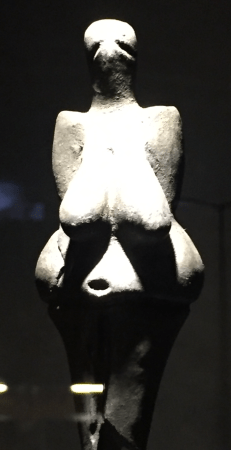
At first glance the ancient belief that bees were birthed from dead bulls seems odd. But if we delve deeply into pre-historical artifacts we discover the mythopoetic roots of this idea.
Continue reading “Are Bees Begotten from Bull? by Judith Shaw”
Exploring the F-word in religion at the intersection of scholarship, activism, and community.

At first glance the ancient belief that bees were birthed from dead bulls seems odd. But if we delve deeply into pre-historical artifacts we discover the mythopoetic roots of this idea.
Continue reading “Are Bees Begotten from Bull? by Judith Shaw”
This morning I met her by the barn sitting on a cedar fence
regarding me with one shimmering marbled eye, a little spiked crown on her head. A moment later two tiny balls of feathers exploded out of a tangled mass of blackberries below her. The fluff balls flew in between the cracks of the fence disappearing into what I knew must be a bird haven because I had recently piled a lot of brush back there. The fact that these nestlings could fly told me they were about two weeks old.
“Good morning,” I whispered as the mother continued to watch me. Behind the fence I heard a number of teeny voices peeping. Into the quiet space between the mother and I, arose the realization that this bird knew me well and had probably been watching me all spring. Normally when a human surprises a mother with chicks the adult puts on a show, taking immediate flight and then dragging a wing on the ground behaving as if it is broken. In this manner the adult desperately hopes to lure the predator away from her chicks. Even so, few nestlings make it to adulthood. The male doesn’t parent at all.
Continue reading “The Little Mother by Sara Wright”
I remember back when I worked in biology, some of the labs used animal models, like zebrafish or fruit flies, for their research. Some of my family members even worked with mice, helping to develop insulin treatments for diabetes that would mean fewer needles for children; or treatments for burn victims that directly helped the children at the Shriner’s hospital across the street. Their work really inspired me. Partly because of the ways it was helping so many people, of course. But also because of the way they talked about the mice.
I’m not here to defend or condemn experimental mouse models. What I want to talk about today is sacrifice. Because in these labs, the taking of an animal’s life is never described as killing. Every single time an animal dies, it is called a sacrifice. Every time.
Continue reading “Even In This: The Sacred Power of Radical Trust by Tallessyn Zawn Grenfell-Lee”
Summer is a time when we are surrounded by the power of Nature, the impulse to life, balance, and well being. Even small actions to align ourselves with it can create momentous changes and healing within ourselves and towards a more sustainable world. Over the past couple of years, I have noticed a decline in pollinators like bees, butterflies, and birds in the small garden behind my home. This may be part of the worldwide pollinator crisis, or the result of nearby housing developments overtaking wild land, or my own past bad gardening decisions. I decided that this year it was time for me to join the many other gardeners worldwide who are creating pollinator-friendly spaces.
So, I did some research into what native and non-native plants already growing in the garden are good for pollinators and which native plants I should acquire from gardener friends or native plant organizations. I also learned to make a better environment for pollinators by waiting to move or shred leaves until warmer weather so as not to disturb pollinators wintering over, making sure that plants on which insects are making homes are left alone, and building up berry brambles, shrubs, and brush piles for birds and butterflies to find food and shelter in.
Continue reading “When Your Garden Gardens You by Carolyn Lee Boyd”
This is the 4th in a series of work I have been doing to translate passages of the bible into poetry that strips out the patriarchal overlays. You can read the previous ones here: Part 1, Part 2, and Part 3.
In this installment I have picked out some passages I really like but that I feel their power and beauty have been deeply hidden. I seek to reveal those hidden wisdoms.
To review; my usage of the 2 main names of divinity:
YHVH or LORD, I translate as Vibration.Being
EL or god, I translate as All-Potential Powers.
I discuss my reasons for these translations in my prior posts referenced above.
Genesis 3:6
And when the woman saw that the tree was good for food,
and that it was pleasant to the eyes,
and a tree to be desired to make one wise,
she took of the fruit thereof, and did eat,
and gave also unto her husband with her; and he did eat.
KJV (King James Version)
and the woman saw that the function of the tree
is for nourishment and that he is yearning to the eyes
and the tree was a craving to make calculations
and she took from his produce and she ate
and she gave also to the man with her and he ate
Benner Mechanical Translation[i]
When the woman saw the tree, she recognized herself
She recognized and remembered beauty and wisdom
She took its seeds within her in knowing wholeness
She gifted its seeds to her husband in knowing wholeness
MPV (Mystic Pagan Version – my own translations)
Note for Genesis 3:6 – the word for “food” in the KJV version of this passage is “maakal” (Strong’s 3978). The word used for to eat is “akal” (Strong’s 398). Both are built on the root word “kl” which means complete or whole and traditionally refers to how food or nourishment makes us whole.[ii] I would add that in the context of spirit, it is that essence or element that we fill ourselves with to achieve a sense of wholeness.
Genesis 49:25
Even by the God of thy father,
who shall help thee;
and by the Almighty, who shall bless thee with blessings of heaven above,
blessings of the deep that lieth under,
blessings of the breasts, and of the womb:
KJV
from the mighty one of your father,
he will help you,
and with Shaddai [my breasts] he will respect you,
presents of the sky from upon
the presents of the deep sea stretching our underneath
presents of the breasts and bowels.
Benner
The All-Potential Powers of your ancestors
Who watches compassionately over you
With nourishment from the dripping milk of the cosmos
And blessings from the misty cauldrons of the goddess Tiamat
Blessings of the breast, and the loving womb
MPV
Notes on Genesis 49:25: this passage had to have been a very old pre-biblical blessing. We don’t often see blessings that are clearly given by female divinity figures, or in this case, a divinity that has breasts and womb. Even in the conservative, male-centric King James Version the blessing is of the breast and the womb. The word for breasts is “shad.” To take this theme a step further, the phrase El Shaddai or Shaddai appears 48 times in the Bible. In English, El Shaddai is usually translated as “God Almighty” and Shaddai as “Almighty.” Sometimes they are translated as “God, the One of the Mountain.”[iii] Both are almost always referred to in scholarly discussions with the pronoun “he.”
I have put the following two passages together because they speak to the same theme. One is a Psalm and the other a Proverb. I really like them because they both speak to the condition of our hearts. As some of you know I am an alaka’i of Aloha International. That is a spiritual guide of Huna or Hawaiian Adventure Shamanism. I love the lessons of Huna which foremost and foundationally remind us to keep a loving and open heart. Aloha not only means hello and good-bye, it means “the breath [ha] we all share,” and it means LOVE. Picture this, the Hawaiian people greet and part from each other which a statement of connection and love. The first principle of Huna is “the world is what you think it is.” The lesson behind this is that what is in our hearts will shape our experiences and ultimately our world. I believe that this is the lesson behind these biblical passages. (I have also included the New International Version for Proverb 4:23 because I think it is particularly beautiful.)
Psalm 37:4
Delight thyself also in the LORD;
and he shall give thee the desires of thine heart.
KJV
Cherish thyself in harmony with Vibration.Being
And gifts will be returned as per the radiance of thy heart.
MPV
Proverbs 4:23
Keep your heart with all diligence,
For out of it spring the issues of life.
KJV
Above all else, guard your heart,
For everything you do flows from it.
(New International Version)
Treasure your heart in lovingkindness,
For it is the wellspring of your life.
MPV
[i] https://www.ancient-hebrew.org
[ii] Benner, Lexicon; 146-147.
[iii] The Jewish Study Bible; 37.
Janet Maika’i Rudolph. “IT’S ALL ABOUT THE QUEST.” I have walked the spirit path for over 25 years traveling to sacred sites around the world including Israel to do an Ulpan (Hebrew language studies while working on a Kibbutz), Eleusis and Delphi in Greece, Avebury and Glastonbury in England, Brodgar in Scotland, Machu Picchu in Peru, Teotihuacan in Mexico, and Giza in Egypt. Within these travels, I have participated in numerous shamanic rites and rituals, attended a mystery school based on the ancient Greek model, and studied with shamans around the world. I am twice initiated. The first as a shaman practitioner of a pathway known as Divine Humanity. The second ordination in 2016 was as an Alaka’i (a Hawaiian spiritual guide with Aloha International). I have written three books: When Moses Was a Shaman, When Eve Was a Goddess, (now available in Spanish, Cuando Eva era una Diosa), and One Gods. In Ardor and Adventure, Janet.now available in Spanish. Cuando Eva era una Diosa

Women and plants have been in relationship since the dawn of humankind. Women were the Seed keepers. Women created agriculture. Women learned what herbs to use for healing. Women noticed wildflowers, loved them, grew them and painted them, created poems about them. Some women and plants still share a deep bond, and as an herbalist I am one of these women. My relationship with wildflowers stretches back to the first word I ever spoke – “cups” for the wild buttercups I loved and gathered as a toddler.
Recently, I joined a wildflower identification site online because wild flowers are so dear to my heart. Every spring I am drawn into the forest glades to meet my diminutive friends that burst unbidden, unfurling from moisture laden rotting leaves. So many are fragrant!
With the summer solstice on the horizon and abnormally high temperatures, we are living a withering drought, and my intrepid little wildflowers are fading, their annual cycle completed earlier than usual. Even in a good year this wildflower season is never long enough for me.
Continue reading “Of Women and Wildflowers by Sara Wright”
One of my former students recommended UNFOLLOW to me, a memoir written by Megan Phelps-Roper, granddaughter of Fred Phelps (1929 – 2014), the (in)famous pastor of Westboro Baptist Church, Topeka, Kansas.
Some people may not be aware that Fred Phelps began his career as a civil rights attorney—someone who, in the 1960s, took on racial discrimination cases no other lawyer would touch. Today, he is best remembered as a preacher who vociferously opposed homosexuality, spreading his message “God Hates Fags” both in the pulpit and while picketing in public spaces. He and his followers also picketed the funerals of fallen soldiers with signs that read “Thank God for Dead Soldiers.” Phelps believed soldiers’ deaths (as well as natural disasters) to be God’s punishment for the country’s “bankrupt values,” especially the “sin” of homosexuality. Hence, God unleashes calamity and catastrophe on the United States, a nation in dire need of repentance.
Continue reading “All We Have is Our Heart by Esther Nelson”
This week’s Torah portion is Chukat. It covers a lot of ground. There are the mitzvot concerning purification with a red cow, the deaths of important individuals, and the continued wanderings in the desert, which are rife with complaining Israelites, plagues of snakes and destructions of enemies. It would be impossible to cover all of these events well in the length of this post, so instead I will am going to concentrate on a theme: water. I also want to explain some of the ways Jewish feminists have enriched our connection to water.
Water is first associated with the prophetess Miriam. Miriam is first called a prophetess in Exodus 15, when she takes the women of the community out to sing about their deliverance from Egypt by way of the Re(e)d Sea. Her “Song of the Sea” is thought to be, by many scholars, one of the oldest written texts of the Torah. Yet, the connection between Miriam and water starts earlier in the Torah. Miriam is Moses’ and Aaron’s sister and the one who watches over Moses when his mother, Joheved, hides him in a reed basket on the edge of the Nile (Exodus 2:4). She approaches the Pharaoh’s daughter to secure a milkmaid for her brother (Exodus 4:7).
Continue reading “Chukat: Miriam, Feminists, and the Power of Water, by Ivy Helman.”
Throughout our long Covid crisis, our daily walk offered precious respite from the tedium of being perpetually housebound and viewing the outer world through electronic screens. Walking brought us exercise and fresh air. It cleared our heads, lifted our mood, and even gave us the rare opportunity to have socially distanced conversations with other humans, face to face.
As we come out of this pandemic year, let’s keep walking. What if we turned our daily walk into a pilgrimage? If we reframed each walk as a daily leg of a journey that will eventually lead us into a post-pandemic future? A pilgrimage in place, as it were.
A pilgrimage is a journey, traditionally taken on foot, to a sacred destination, Mecca, Jerusalem, and Rome being some of the most famous examples.
Before Covid, an estimated 300,000 pilgrims walked to the shrine of Chimayó, New Mexico each year in the week before Easter. Some pilgrims even carried heavy homemade crosses to participate in Christ’s journey to Calvary. During my visit to Chimayó some years ago, I witnessed the faithful arriving in the simple adobe church and kneeling before a round pit in the floor to take handfuls of the tierra bendita, the blessed earth, believed to have healing properties.

Pilgrims’ eyes perceived the sacred as manifest in what would mundanely be viewed as dirt. To be a pilgrim is to step into a realm of wonder and grace, where anything might happen. The Church itself won’t comment on any purported miracles, yet pilgrims leave abandoned crutches behind in the sanctuary as testimony of their experience.
Perhaps this revelation of the holy in the commonplace means that we can also be pilgrims without even leaving our neighborhood.
You don’t have to be an observant practitioner of any particular faith—not every pilgrim is religious or even spiritual. Some people walk the path to try to figure out what their spirituality even is.
When I walked the Camino, the iconic pilgrimage route to Santiago de Compostela in Galicia, Spain, I encountered people of diverse backgrounds making the pilgrimage for a variety of reasons. Some were taking a break from the stresses of their career to experience a simpler existence—sleeping in hostels and sharing communal meals with strangers. Others were walking to heal trauma and grief. I met grim-faced ex-military guys marching so fast that they wouldn’t deign to respond to other pilgrims’ cheerful greetings of, “Buen Camino!”
Each pilgrim was walking their personal Camino. There is no false reason to go on pilgrimage. Aren’t we all searching for something—some deeper meaning and sense of purpose? In a world so fractured by divisiveness and hatred, sharing the Camino with these vastly different people was an incredible experience of hospitality and spiritual homecoming that I will never forget. The pilgrim’s path is big enough to include us all.
So, what’s the difference between a pilgrimage and a walk? Your intention and your attention, which make all the difference. To have the richest possible experience, we need to be present in our physical bodies, here and now. Not staring at our smart phones or curating our experience on Instagram. Pilgrimage is a time out, a refuge from the news cycle and social media feed.
Pilgrimage doesn’t need to cover a lot of physical distance. It doesn’t even need to be linear. It can be circular. When visiting Nepal, I observed Buddhists circling for hours around the great Boudhanath Stupa in Kathmandu. All the while, they chanted mantras and fingered their mala beads. For one afternoon, I joined them, if only because I was too intimidated to walk elsewhere with the crazy traffic and air pollution. The shrine seemed like the safest and most peaceful place in the city.

This kind of Circling the Center can be practiced anywhere and gives a whole new perspective to walking round the block or your local park.
If you feel so inspired, you could even draw a labyrinth in chalk on your driveway and practice the ancient and meditative art of labyrinth walking.
Pilgrimage isn’t about the external destination as much as the journey, the inner process. The ultimate pilgrimage brings us to the shrine of loving presence within our hearts.
There are many ways to be a pilgrim, but there are still some rules to be respected. The most important is practicing open-hearted hospitality for those you meet on your way, maybe stopping to chat with lonely neighbors.
Likewise, we need to be compassionate and welcoming to all the shadowy parts of ourselves that don’t feel the least bit spiritual—all our fear and rage and despair concerning this pandemic.
We come to our pilgrimage as we are and meet ourselves with radical acceptance.
Let us embrace the street where we live as our personal Camino. The sacred is present all around us and, indeed, within us, if we only look through pilgrims’ eyes and pay attention.
Buen Camino!
Mary Sharratt is on a mission to write women back into history. Her acclaimed novel Illuminations, drawn from the dramatic life of Hildegard von Bingen, is published by Mariner. Her new novel Revelations, about the mystical pilgrim Margery Kempe and her friendship with Julian of Norwich, is now available wherever books and ebooks are sold. Visit her website.

One of the 18 characteristics of Africana Womanism is being a self-definer. This piece is a sliver of my process to do and be exactly that.
I am striving to be a whole Black woman. I have an awareness that I am a whole person and transcend the role that Amerikkkan* society has given black women. Wholeness is justice and justice/liberation is wholeness. We are unaware of the full extent that racism has impacted Black women psychologically and emotionally. I’m saying racism constricts us in exhausting ways- the results have been wearing on our mental and sexual health, senses, nerves, physical health for years. And it still is.
Continue reading “We are Not Oppressed Because We Remember Part 2 – Diaries of a young black woman by Chasity Jones”