

 Every morning I walk to the river in the velveteen hour between the vanishing blue night and the coming of the first scarlet, pink, lavender, purple or golden ribbons that stretch across the horizon. Sometimes clouds with heavy gray eyelids mute first light. Either way all my senses except that of sight are on high alert; a deep peace embraces me in the dark. My body knows the way. I murmur to the willows as I pass through the veil and under their bowed bridge. Their response is muted, a song beneath words.
At first my footsteps are barely audible on the narrow serpentine dirt path but as I pass by the river I note that she too is singing; and my senses quicken. If the Crane spirits are with me I hear the first brrring of Sandhill cranes as they take flight. “Freezing” I am crane struck; the involuntary need to stand still is overpowering. Body -mind viscerally absorbs Oneness as I breathe in a multitude of crane songs or perhaps only that of a few. Now my eyes are suddenly open, straining to see the familiar brrring materialize into startling graceful heads, necks, and stream lined bodies…. I note the shimmering waters beginning to mirror blushing pastels or the gray smoke that stains the horizon. Sometimes these hues deepen into rose, blood orange, or scarlet. Continue reading “The Portal: How Do We Know What We Know? by Sara Wright”
 Today’s blog is a sequel to:
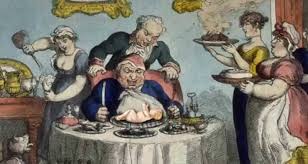
  In 1729, the Anglo-Irish author Jonathan Swift (1667-1745), who was already widely known for his political polemics and satirical pamphlets and highly ironic letters to and about the literati of Georgian England, published “A Modest Proposal for preventing the Children of Poor People from being a Burden to their Parents or the Country.” Having observed how the English conquerors and (mostly absentee) landlords of Ireland had for close to five centuries been bleeding the island dry by confiscating its crops and taxing the Irish people unto starvation, Swift suggested in “A Modest Proposal” that the poor people (nearly everyone) sell their children to the rich to be used as food. Yes, the pamphlet is outrageous. (But students of English literature generally enjoy it. I know I did. It’s lots less boring than the poetry written during the reigns of the first three Georges.) It was widely discussed (an understatement) in London.

 Just a few months ago, not long after turning seventy, I was diagnosed with mild osteoporosis. I had thought that all my yoga, my occasional forays to the gym, my daily walking, my frequently consumed leafy greens and yogurt , my calcium supplements would protect me. I had thought I was different from most other women my age, that I could avoid taking the medication that I knew was sometimes problematic. But the bone density scan revealed what I had feared, and because both of my parents declined and died shortly after hip fractures, because I had once broken an ankle, I decided to accept my doctor’s sober recommendation: that I begin a weekly dose of alendronate. It would be the first chronic medication I would ever be prescribed.

 On a cold and rainy morning in Lesbos, I ponder the advice of my intuitive friend Cristina to reflect on the spiritual dimensions of my decision to move to Crete. When asked why I am moving from Lesbos to Crete, I tend focus on the negative: I am lonely in my small village; and I am disheartened by my neighbors’ lack of compassion for the refugees who come to our island from Syria, Iraq, Iran, and Afghanistan.
 While facetiming my brother, I heard my two-year-old niece shout at the top of her lungs that she was “Queen Elsa” and was coming to save me. I had started writing about the Frozen films, when
  Daniel Deitrich, a worship leader in South Bend City Church, a “Jesus-centered community” in South Bend, Indiana, isn’t the first evangelical Christian to go up against fellow evangelical Christians who support the current U.S. president. Perhaps, though, he’s the
