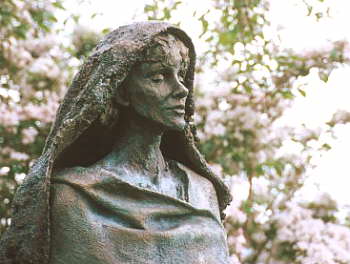
We live in a youth-obsessed culture. The cosmetic industry pushes wrinkle creams and hair dye on us while celebrities resort to Botox and surgery to preserve an illusion of eternal girlhood. We live longer than ever before, yet advancing age, once a mark of honour, has become a source of shame.
But what happens when women embrace midlife as an inner awakening and call to power?
One such woman was Saint Hildegard von Bingen (1098-1179), powerfrau and late bloomer par excellence.
Her youth was dire. Offered to the Church at the age of eight, she was entombed in an anchorage. Though she had been haunted by luminous visions since earliest childhood, she didn’t dare speak of them. Her entire existence was bent on silent submission to her superior, Jutta von Sponheim, an ascetic whose regime of fasting and mortification of the flesh eventually killed her.
Only after Jutta’s demise could Hildegard step out of the shadows and carve out a spiritual life based not on suffering but on celebrating life in all its burgeoning green beauty. Even so she might have remained obscure, lost to history.
But when she was forty-two, everything changed.
“When I was forty-two years and seven months old,” she wrote, “Heaven was opened and a fiery light of exceeding brilliance came and permeated my whole brain, and inflamed my whole heart and my whole breast, not like a burning but like a warming flame, as the sun warms anything its rays touch.”
Dazzling visionary experiences descended upon Hildegard, along with the divine summons to write and speak of her revelations. Reluctantly at first she embarked on her first book of theology, Scivias, or Know the Ways. After putting quill to parchment, she could never go back.
Hildegard went on to found two monasteries, go on four preaching tours, compose an entire corpus of sacred music, and write nine books on subjects as diverse as cosmology, botany, medicine, and human sexuality, thus leaving her indelible mark on history.
Most of us believe we live in a more enlightened age than Hildegard’s—after all, children are no longer offered as tithes to monasteries. Yet many young women find themselves in modern and secular forms of servitude—dead end relationships, soul-crippling jobs, credit card debt, a life of junk food and junk television—all the sadness and waste of an unexamined life.
We don’t need to be visionaries to break free. We just need to remember who we are, that we all serve some higher purpose. Each of us has our own unique gift to give the world.
In youth, it’s easy to be beguiled by the glamour of the surface of things—if we get the right job, the right partner, the right clothes we’ll be happy forever.
But in midlife we are gifted with the maturity to see through the false scripts consumer society hands to us. After a certain age we can see just how absurd it is to kill ourselves to emulate airbrushed supermodels. We realize that the greatest lover in the world can’t fulfill us until we are at peace with ourselves. And so we can let ourselves go. Paint the pictures we’ve always longed to paint. Learn French and travel the world. Dance under the stars. Play the saxophone. Offer our own song to the vast symphony of life.
Remember, it’s never too early or too late to embrace your inner powerfrau.
Mary Sharratt’s book Illuminations: A Novel of Hildegard von Bingen won the 2013 Nautilus Gold Award: Better Books for a Better World and was a 2012 Kirkus Book of the Year. Her forthcoming novel, The Dark Lady’s Mask, will be published by Houghton MIfflin Harcourt in Spring 2016. Visit her website.


 So, again, you, the most holy and enlightened man of the mosque have pointed your finger at me to declare, noisy and hysterical, that I am an “Enemy of Islam.” Then you, who preaches and recites best, have gone out there slandering me, “eating my flesh,” devotedly.
 The story of the woman from Timnah, Samson’s first wife – found in the Hebrew Bible, Judges 14:1-15:6 – is often interpreted as yet another wickedly seductive woman who distracts and confuses the heroic judge, preventing him from enacting the deity’s will. I remember the first time I questioned this interpretation: I was an undergraduate student teaching a youth bible study.I asked the high school students in the room what they thought about the Timnah woman and how we might understand the story differently if we read it from her perspective. Neither the students nor I had any idea how to answer these questions because we did not know how to see Samson as anything but a hero.
 Deborah is one of the few women in scripture depicted as a strong leader who does not need the help of a man. The start to Deborah’s story appears bland, a mere introduction to a narrative that will later become juicy, surprising, and even a bit gory. Judges chapter four merely introduces us to a woman named Deborah, a judge over Israel. Judges is a book that records a time when Israel was without a king, so judges had to arbitrate justice, command, lead, and settle disputes. The book of Judges involves a constant downward spiral in which the people of Israel experience God’s grace; they forget God and do evil; they get into trouble and cry out for help; a judge arrives to help; the people get better; the judge dies and the people repeat the cycle.

 Last year I got my ashes at the airport. As I sat in that airport chapel, I halfheartedly listened to a (mostly terrible) litany that was proclaimed in between announcements for gate changes. I was leaving for another campus interview after having been home for only 24 hours since the previous one. The Christian season of Lent came during a time of stress and chaos in my life. That year, when I contemplated what I might give up for Lent, I could think of nothing. So much had been taken away that I had nothing left to give.
 Feminism and Religion