The image from an ancient Cretan bowl (c.1700 BCE) from the Sacred Center of Phaistos pictured here has often been interpreted as an early depiction of Persephone’s descent or rising. But are clues from later Greek mythology pointing in the right direction in this case?
The beauty and the power of the Earth are all around us. Even in the poorest and most blighted urban environments trees, hollyhocks, sunflowers and other sturdy plants grow up through the concrete. We are children of the Earth, of the Goddess, who in Her many forms, is the manifest symbol of the sacred Earth.
Most of us love the space we find ourselves in when spending time with nature – hiking, walking, camping, birdwatching, swimming in the sea, riding a bike, working in our gardens – all activities that help us feel connected to this Earth we walk upon; that help us find an inner peaceful place.
If you thought that all I could do in regards to feminism and religion is challenge Patriarchy and tease around ladies and gentlemen of good temper and better reputation with my corrosive comments, this post may change your mind.
As I said in a previous article, this year I started, with a small group of people, a social project called Imaan, whose goal is centered on inter-faith dialogue and better visibility of the actions and contributions of women in Islam (and religion in general,) plus critical thinking on religion from a feminist and progressive perspective.
As part of the activities of Imaan, we are developing “A Women’s Mosque” project; an initiative that aims to create a meeting place for women and our spirituality. The idea came after a reunion to talk on Islam and inter-faith dialogue with women from different denominations. At one point in the discussion, they asked me about sex segregation in mosques, which led us to a broader reflection on the position of women in the religious space, both material and symbolic, and how uncomfortable we were with that.
We realized that, in a variety of ways, places of worship displace women. Whether they relegate us to separate rooms, or refuse to allow us to speak, limiting our participation to “strictly female” issues such as maternity, caregiving, the role of wife and – of course- clothing, these prohibitions are always from a patriarchal “canonical” perspective.
I was staying with a friend who (luckily for me) owns a home in Puerto Rico. I saw more of Puerto Rico in four days then I believe many might see on a two week vacation! I saw the ocean, swam in the ocean, walked all over Old San Juan with its blue streets, gambled and danced salsa at the famous Hotel San Juan, ate amazing food (especially at my friend’s sister’s restaurant Mom and Dad’s Café) —and of course went to the conference.
And I went to an “old school” lesbian bar. A bar where women loving women gather who were diverse in age—ranging from women in their twenties to women in their fifties and sixties.
My friend said this is the best lesbian bar in Puerto Rico. I brought three friends of mine with me from the conference—wanting to share the wealth of experience that my Puerto Rican friend was allowing me to have with others.
For those who are unaware of my research focus and methodology, I try to use history to reconstruct or reclaim the feminine voice through more of an exegetical lens rather than an eisegetical or ideological lens. When it comes to Thanksgiving, I have yet another opportunity to restore credit to or at least bring visibility back to a woman who fought for Thanksgiving to be recognized as a national holiday on the last Thursday of November. Her works, though plentiful and sometimes known only by title, are largely forgotten to history; Sarah Josepha Buell Hale (1788-1879) is responsible for Thanksgiving becoming a national holiday in the United States.
Certainly, I do not have to go into the disparity that befell women during the 1800’s when it came to education and overall fundamental rights – that is a history with which we are all well familiar. Hale was educated through her brother, Horatio Gates Buell, who shared his education while attending Dartmouth College and “seemed very unwilling that [Hale] should be deprived of all his collegiate advantages,” and through her husband, David Hale, a lawyer who helped her cultivate her writing skills in the evenings. They even established a small literary club with their friends that allowed her to write. Hale was left a widow at a very young age with five children, the oldest age 7. Hale, like so many women during that time period, had to find a way to support herself and her family.
Sarah Josepha Buell Hale
After authoring a book of poems with her sister-in-law, The Genius of Oblivion and Other Original Poems, Hale, in 1827, published her first novel called Northwood – a book published the same year as Uncle Tom’s Cabin that also challenged slavery. From fame gained through this novel, Hale obtained a job as an editor of a women’s magazine, Ladies Book (later Godey’s Ladies Book then American Ladies Magazine), where she worked for about 40 years. She wrote about half of the material contained in the magazines, as a means of helping to educated women. Hale helped to discover and promote such authors as Edger Allen Poe, Nathaniel Hawthorne, Harriet Beecher Stowe, Lydia Maria Child, Catherine Sedgwick, Lucretia Mott, Emma Willard, Susan B. Anthony, Henry David Longfellow, Ralph Waldo Emerson, and Oliver Wendell Holmes.
She is credited for helping to establish Vassar College for women and wrote the familiar child’s poem “Mary had a Little Lamb” in 1830 (Poems for Our Children, republished in Juvenile Miscellany), Traits of American Life, which contained the story of “The Thanksgiving of the Heart:”
I was born the year the Supreme Court of the United States of America began to hear Brown v. Board of Education of Topeka; a case that ought to be known to all as a matter of US history. Here is a precise, but telling history of how that case came into being. This historical account lacks hyperbole, perhaps because one feature of legal-eeze carries the technical title (and appropriately so) of being a brief.
In case blog readers don’t do background research or follow footnotes, I raise these salient points: The Declaration of Independence states “all men (sic) are created equal.” At the same time as it was written and signed into law, the legal enslavement of Africans was in full practice. This incongruence required further legal action to change that in the form of 13th Amendment to the US Constitution which made slavery illegal.
It should be no surprise that “equality” did not result from this and thus the 14th and 15th Amendments attempted to address inequities in more specific terminology. All of these Amendments were ratified the 19th century.
The last decade of the 19th century, Plessy v. Ferguson reached the Supreme Court. Plessy was an unsuccessful challenge, attempting to point out how manifest inequality– the “separate but equal” doctrine in practice across the United States– violated the constitutional notion of equality before the law. Judge Brown sums up the majority opinion which went against Plessy:
The object of the 14th Amendment was undoubtedly to enforce equality of the two races before the law, but in the nature of things it could not have been intended to abolish distinctions based upon color, or to endorse social as distinguished from political, equality..if one race be inferior to the other socially, the Constitution of the United States cannot put them upon the same plane
It would take more than half a century before Brown v. Board of Education brought out the many subtle ways, over the century since the legal end of slavery, that the racial divide had been enforced. It started very early in life, in the form of separate educational systems that only perpetuated the impossibility of constitutional consistency and equality before the law.
Should women (or men) maintain a religious identity within a patriarchal tradition? Is it a feminist act to stay? Or is it only a feminist act to leave? These are questions that regularly surface in conversations related to religion and are often the center of dialogue here on Feminism and Religion.
rape in the military rape in war rape in sports rape in the university rape in fraternities rape at parties rape on the way home rape in the car rape on the street rape in the park rape in the home rape on the couch rape on the bed rape on the floor rape in a closed room rape in the dark rape in the light rape in marriage rape on the job rape in the bible rape on tv rape in great works of art rape by a friend rape by a neighbor rape by a friend of the family rape by a member of the family rape by men with power rape by men without power rape by someone you know rape by someone you do not know rape as power rape as domination rape as humiliation rape as violation
Here’s how my mind leaps around. I was mooning about and trying to figure out what I wanted to write for this blog when I picked up one of the books in the stack at the other end of the couch. I bought The Mythology of Eden by Arthur George and Elena George because I’d read the thoughtful review by Judith Laura, a Goddess scholar I know and respect.
In their introduction, the Georges present a paragraph by biblical scholar Millar Burrows that explains that myth is:
a symbolic, approximate expression of truth which the human mind cannot perceive sharply and completely, but can only glimpse vaguely, and therefore cannot adequately or accurately express. … It implies not falsehood, but truth; not primitive, naïve misunderstanding, but insight more profound than scientific description and logical analysis can ever achieve. The language of myth in this sense is consciously inadequate, being simply the nearest we can come to a formulation of what we can see very darkly. … The procedure is quite legitimate if [we] understand what is being done (p. xii). (Burrows’ book is An Outline of Biblical Theology, published in 1946.)
Mind leap: Wow, I said to myself, does this describe the revisionist fairy tales I write? I try to see through that dark glass more clearly and recast old ideas in new ways. (I hope this doesn’t sound too pretentious. I don’t mean it to.)
Mind leap: And, I further said to myself, we scholars who write for Feminism and Religion often write about myth, though we don’t always acknowledge that our religious stories are indeed myths. It’s like the old joke—“If I believe it, it’s religion. If you (or they) believe it, it’s myth.” Even though we sometimes call our myths the inerrant word of this god or that goddess, the stories in all of our holy books are our instructive myths. Read Burrows’ definition again. Continue reading “Scholars of Mythology by Barbara Ardinger “
It seems to me that the goal of most people is to be happy. We seek it ourselves and hope that those we love find it as well. Happy is an elusive state. At best it is hard to define – what is happy anyway?
As young adults we may seek happiness in alcohol and parties, perhaps even in drugs. We hope to find it in our careers and certainly in the unions we make and partners we choose. Happy is to be pleased, or glad, over a particular thing. The dictionary associates a state of happiness with contentment as well as with the experience of joy. And it also says that happiness is associated with good fortune or luck. Continue reading “One Small Red Leaf by Deanne Quarrie”


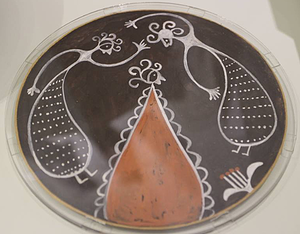 The image from an ancient Cretan bowl (c.1700 BCE) from the Sacred Center of Phaistos pictured here has often been interpreted as an early depiction of Persephone’s descent or rising. But are clues from later Greek mythology pointing in the right direction in this case?
 While attending the recent

 I was born the year the Supreme Court of the United States of America began to hear Brown v. Board of Education of Topeka; a case that ought to be known to all as a matter of US history.
  Here’s how my mind leaps around. I was mooning about and trying to figure out what I wanted to write for this blog when I picked up one of the books in the stack at the other end of the couch. I bought