The Great Goddess and Divine Mother of Us All manifests where and to whom She chooses, no matter what faith we hold. In the 12th century, She manifested to a German nun named Hildegard. Hildegard’s story has been told in many places, including a highly detailed entry in the Catholic Encyclopedia, which is a wonderful resource for stories about saints. I’ve just finished reading Illuminations (Houghton Mifflin Harcourt, 2012), a splendid new novel about Hildegard by Mary Sharratt, who is the author of other excellent novels, including Daughters of the Witching Hill.
 Hildegard, who lived from 1092 to 1179, was the tenth child of a family of minor nobility in the Holy Roman Empire. She’s a sturdy child who loves the outdoors and enjoys running through the forest with her brother. But early in the novel, she learns that she is to be her family’s tithe to the church. Her mother has already arranged for this bright and curious eight-year-old child to be the companion to Jutta von Sponheim, a “holy virgin” who yearns to be bricked up as an anchorite in the Abby of Disibodenberg. Being an anchorite means that, like Julian of Norwich (about 250 years later), this girl and her magistra are bricked in. There is a screened opening in the wall through which their meager meals are passed and through which they can witness mass and speak to Abbott Cuno, the other monks, and visiting pilgrims, but they can never go out. Never. In the Afterword, Sharratt writes that “Disibodenberg Abbey is now in ruins and it’s impossible to precisely pinpoint where the anchorage was, but the suggested location is two suffocatingly narrow rooms and a narrow courtyard built on to the back of the church” (p. 272). As Sharratt vividly shows us, Hildegard survived in that awful place for thirty years. Continue reading “Illuminations: A Novel of Hildegard von Bingen By Barbara Ardinger”

 In 2007, I had a conversation with a professor who felt that change was in the air for the Roman Catholic Church. The basis of this opinion was based on language. The words and the context used in writings that emerged from the Vatican were changing and somehow different – a difference that went beyond personal writing styles of Pope John Paul II and Pope Benedict XVI. This professor was hopeful that positive change for women could be coming. He was right about change in the Church, however, the changes surrounding women that emerged have not been positive.

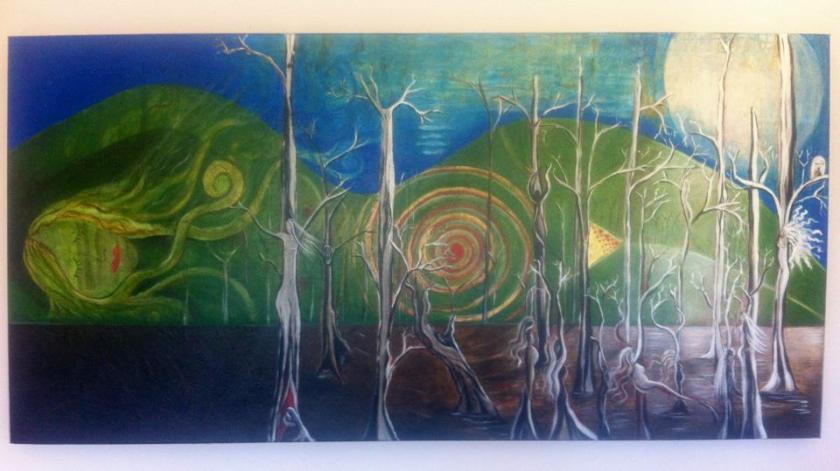
 This “Mountain Mother” painting is an ode to women’s earth wisdom and is my prayer for reclaiming of that wisdom to heal the earth and all her beings.