This poem was written modeled on a Hebrew understanding of the world and God. In contrast to an Occidental or Western understanding of God, which elevates the noun of a sentence, a Semitic understanding of God highlights the “verb” of a sentence. In this way, God is a more active presence in the creation of a more just world.
M’rahemet Shel Olam: The Emwomber of the Universe
In the beginning the primal womb gave birth to all living creatures . . .
She gave birth to us . . . her daughters and her sons.
In Relational Reality, Spretnak explains that we have “missed the way the world works” as a result of our cultural tendencies. “The failure to notice that reality is inherently dynamic and interrelated at all levels – including substance and functioning – has caused a vast range of suffering” (1). Spretnak offers “snapshots” of the various crises we face within education and parenting, health and healthcare, community design and architecture, and the economy with purpose; to name the suffering and hardship endured within the world and demonstrate that these crises are the result of anti-relational thinking. She states these problems cannot be corrected until they are acknowledged; “Only then can we grasp the significance of the relational breakthroughs and solutions that are emerging” (20). Continue reading “Charlene Spretnak’s “Relational Reality”: An Illuminating Read By Gina Messina-Dysert”
On the whole, I like the Mormon concept of immortality. I like the idea of being with my family forever. I like the idea of being able to love and live with a child or spouse or parent that might have died too young. I like the idea of being eternally engaged in learning and working with others. I do fully admit, I am put off by the idea that I as woman might be eternally giving birth to spirit babies, and the status of Heavenly Mother – my immortal role model – is angst inducing if I sit down and think about it for very long. But in my positive moments, I have some hope that my husband and I would actually be equals in the next life – that the patriarchy of our Church and of our world is just a natural consequence of the fall and of human fallibility.
Some years ago when I was speaking on ecofeminism, womanist theologian Karen Baker-Fletcher posed a question that went something like this: What I am missing in your presentation is reference to ancestors. For black women, this issue is critical.
Baker-Fletcher’s question provoked a process of thinking that continues to this day. For example, I began to notice that when black women spoke at the American Academy of Religion, they often began by thanking their foremothers Delores Williams and Katie Cannon for beginning the womanist dialogue. It is far rarer to hear a white woman thank Valerie Saiving, Mary Daly, Rosemary Radford Ruether, or Marija Gimbutas before her talk.
To the contrary, many white women take great pains to distance themselves from feminist foresisters. I once heard a white woman Biblical scholar tell women students to do work on women in the Bible or other areas of religion without using the word feminist or placing their work in a female or feminist train of thought– if they wanted to get it published. She was very proud that she had used this method and succeeded. In other words, she was following in the footsteps of Mary Daly, Phyllis Trible, and Elisabeth Schüssler Fiorenza but acting as if she had invented the study of women and the Bible herself. The reason for this, she freely admitted, was that male scholars who held power in her field would not respect her work if she used the “f” word. Continue reading “Do White Feminists Have Ancestors? By Carol P. Christ”
The following is a guest post written by Rev. Kittredge Cherry, lesbian Christian author and art historian who blogs about LGBT spirituality and the arts at the Jesus in Love Blog. Her books include “Equal Rites” and “Art That Dares: Gay Jesus, Woman Christ, and More“.
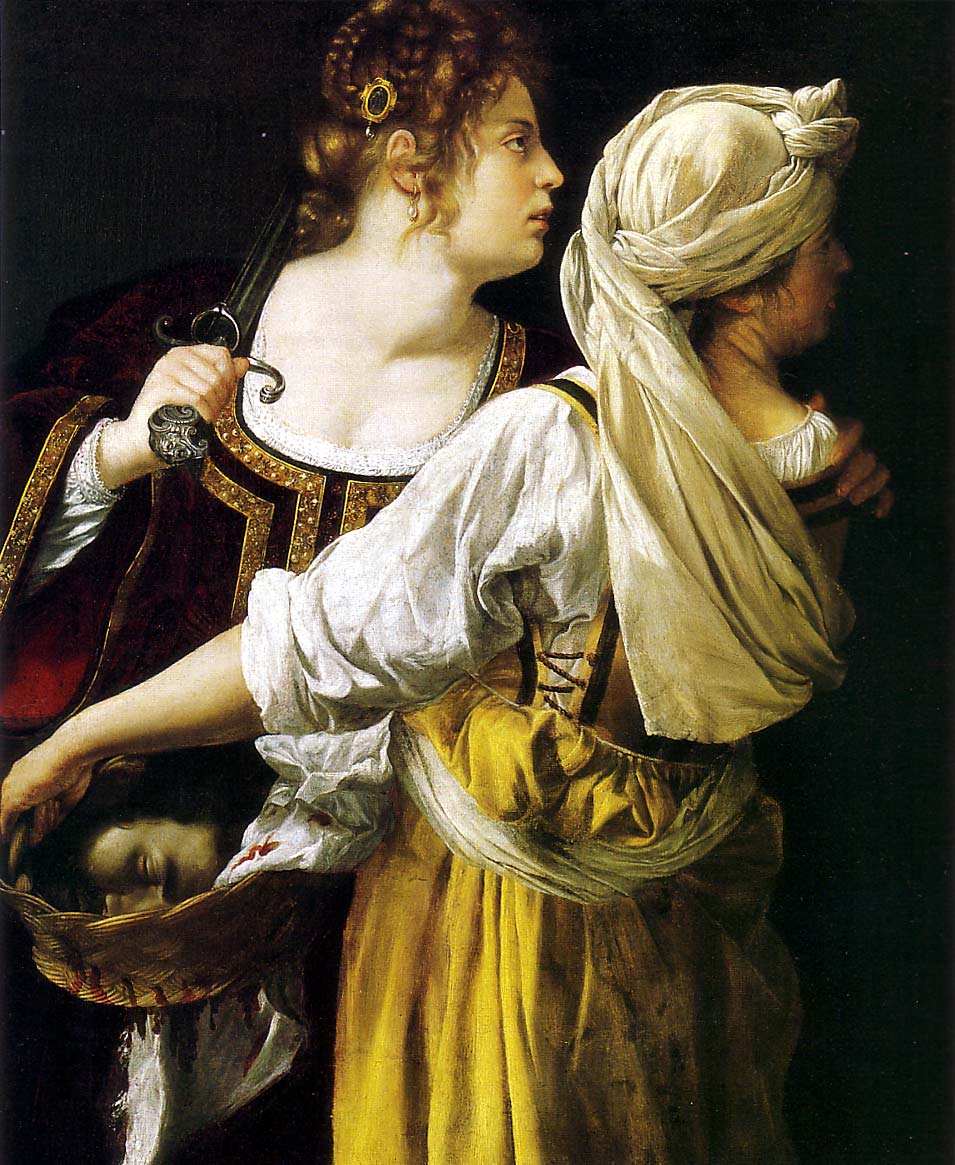
Baroque artist Artemisia Gentileschi inspires many with her paintings of strong Biblical women — created despite the discrimination and sexual violence that she faced as a woman in 17th-century Italy.
Gentileschi (1593–1652) was successful in her own day, but was mostly written out of art history until the 1970s, when feminist scholars rediscovered her work. Now she is celebrated in many books, films and plays, and her work is widely reproduced. Her greatest paintings include “Judith Beheading Holofernes” and “Susanna and the Elders.”
Many women and queer people can relate to her battles against prejudice and sexual violence, documented in her rape trial in 1612. She could be considered the patron saint of women artists.
"Judith and Her Maidservant" by Artemisia Gentileschi
Although Gentileschi was apparently heterosexual, lesbians have drawn energy from her life and art.
Lesbians who have created tributes to Gentileschi include painter Becki Jayne Harrelson and playwright Carolyn Gage. In the play “Artemisia and Hildegard,” Gage has two of history’s great women artists debate their contrasting survival strategies: Gentileschi battled to achieve in the male-dominated art world while Hildegard of Bingen found support for her art in the women-only community of a medieval German nunnery.
The daughter of a painter, Gentileschi was born in Rome and trained as a painter in her father’s workshop there. She was refused admission to the art academy because she was a woman, so her father arranged for her to have a private painting teacher — who raped her when she was about 19. Gentileschi herself was tortured by thumbscrews during the seven-month rape trial, but she stuck to her testimony. The teacher was convicted, but received a suspended sentence. Continue reading “Artemisia Gentileschi: Baroque artist and rape survivor painted strong Biblical women, By Kittredge Cherry”
Fr. Roy Bourgeois has many titles: Nobel Peace Prize winner, purple heart recipient, former missionary, member of the Maryknoll Fathers for 44 years, and ordained priest for 38 years. He has long been associated with social justice and helping the oppressed and marginalized. He was a peace activist during the Vietnam War and founded the School of Americas Watch. He is found often marching and protesting in front of the School of Americas (now WHINSEC ), a terror training camp at Ft. Benning where soldiers are trained in devices of torture. This is where soldiers that were members of the death squads that existed in Latin America, especially in El Salvadorwere trained. This is also where the soldiers who killed the Jesuits, their maid, and her child as well as Monsignor Romero were trained.
It has been said time heals all wounds, I do not agree. The wounds remain, in time the mind, protecting its sanity, covers them with scar tissue and the pain lessens, but it is never gone. Rose Kennedy
This past Saturday, August 6, would have been my 34th wedding anniversary. Next Saturday, August 13 will be the wedding of my once fiancé. The former lasted 20 years, the latter 10. I have recently begun the delicate dance of getting to know another man; continuing to second-guess myself as if I’m a schoolgirl with her first crush, only I’m not. I’m a woman drawing upon 30 years of the good, the bad, and the ugly. Without sounding like Carrie Bradshaw from Sex and The City, I am asking myself what does a feminist relationship look like as it unfolds? How do I trust another with a heart that is held together by Elmer’s glue? And more importantly, how do I make myself present to another without past wounds surfacing and then projected onto the innocent?
In a recent post, XochitlAlvizo wrote on the difference, as she understands it, between sacrifice and love. All too often, argues Xochitl, we confuse the two, believing our sacrifice is what redeems us and others, when in reality, it is always love. The distinction, while at times difficult to discern, is what can bring life to a healthy, loving relationship. I can’t imagine not being steeped in a committed relationship without some sacrifice on my part. But when does this practice of sacrifice become the support system for sustaining love? How do I hold the balance of love and at times sacrifice for another without losing love of self? Continue reading “Love, Loss and Longing: The Rebooting of a Feminist Heart By Cynthia Garrity-Bond”
The following is a guest post written by Jeremy Fackenthal, Ph.D. candidate in the philosophy of religion program at Claremont Graduate University. His work focuses on process theology and philosophy, critical theory, and post-Holocaust thought.
One of my good friends taught an undergrad course on feminism in religion several years ago and assigned a book of John Cobb’s. The class read it, loved it, and began a conversation about whether or not men could be feminists. They decided that they could and that John Cobb surely must be a feminist. And so they sent him one of the “This is what a feminist looks like” t-shirts, which he happily received and reportedly still has to this day. I tell this story not only to demonstrate that John Cobb is a feminist and cares deeply about feminist issues, but also as a way of pointing out that the process theology that Cobb has been so instrumental in developing and that has become his academic trademark is itself strongly supportive of and compatible with feminist thought.
The following is a guest post written by Carol Christ, Ph.D., a pioneer and founding mother of the Goddess, women’s spirituality, and feminist theology movements, and director of the Ariadne Institute. She is also the author of multiple books including Rebirth of the Goddess.
Although there are some of us who disagree, the “party line” in the fields of Religious Studies and Archaeology—even among feminists– is that there never were any matriarchies and that claims about peaceful, matrifocal, sedentary, agricultural, Goddess-worshipping societies in Old Europe or elsewhere have been manufactured out of utopian longing.
I myself and most other English-speaking scholars defending Marija Gimbutas’s theories about Old Europe have studiously avoided the word “matriarchy” (speaking rather of “matrifocal, matrilineal, and matrilocal” societies) because the very word “matriarchy” conjures up the image of female-dominated societies where women ruled, waged wars, held men as slaves, and raped and abused men and boys. In fact, this fantasy tells us far more about patriarchy than about it does about matriarchy. Continue reading “Exciting New Research on Matriarchal Societies By Carol P. Christ”
Names provoke opinions, responses, and even controversy. Lady Gaga’s song “Judas” is a perfect example of this. Before this song was released, the title “Judas” stirred controversy throughout the nation just because of its name. If one takes the time to read the lyrics, you find a human struggle summed up with the phrase, “Jesus is my virtue but Judas is the demon I cling to.” To look beyond the name, a deep theological fight that is relevant to every one of us emerges; struggling between what you know is right but being drawn to what you know is wrong. Within this song lays a fundamental dichotomy of betrayal and forgiveness that is overlooked because of a name, Judas, or what Mary Elizabeth Williams calls a “Christian taboo.”
The word “taboo” refers to something that is inappropriate or unacceptable by society , and can also indicate ostracizing. It seems strange to apply this word to female scholars in the field of Religion and Biblical Studies; but it fits. Scholarship that is identifiably authored as female brings about scrutiny and opinions of inferior quality or lack of creditability; after all “what does a woman know?” Women and scholarship, especially in the male-dominated fields of Religion, Biblical Studies, and Archaeology, are in fact “taboo;” unaccepted, improper, ignored, and shunned. This issue was first brought to my attention at a Women’s Luncheon at the annual meeting of the Society of Biblical Literature (“SBL”) in 2008. Carol Meyers, a professor of Religion at Duke University, was being honored for her mentorship to women in the field of biblical studies. Amy-Jill Levine, an earlier recipient of this award, introduced Meyers. Continue reading ““I’m in love with Judas”: Names and Taboos within the Scholarly Arena of Religion and Biblical Studies By Michele Stopera Freyhauf”


 The following is a guest post written by Theresa A. Yugar, Ph.D. Candidate in women studies in religion at Claremont Graduate University.