

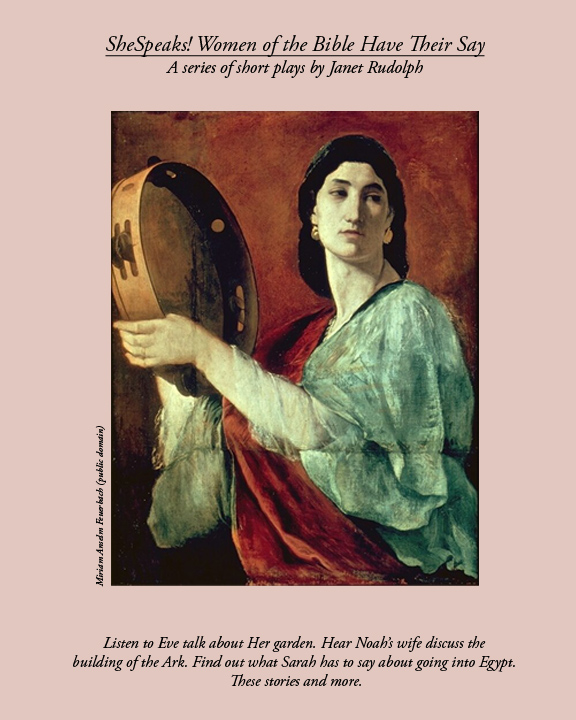
Author’s Note: I have been working on this project for about 3 years now. It is based on almost 30 years of research. I have written about some of the vignettes here on FAR before. With each re-telling and each performance the story deepens and comes more alive. On Thursday, Sept. 24th at 11:00 am NY time, the SheSpeaks!Ensemble will be doing a one hour live/zoom, free performance of the arc called EveSpeaks! You can access the zoom link on the 24th through this webpage. (Scroll to the bottom of the page for the link.)
The storyteller holds great power to both reflect the culture and to give it further shape and form. This is especially true for stories of the Bible which are foundational to our world. Whether we see them as mythological, historical, divinely inspired, wisdom teachings or simple folktales, they have shaped our beliefs and values. People see all different faces of God. If we look to the movies, God has looked like George Burns (Oh God, 1977), a vengeful John Huston (The Bible, 1966), Morgan Freeman (Bruce Almighty, 2003) and even Groucho Marks (Skidoo, 1968). There aren’t a lot of women although Alanis Morrisette did play a silent God (Dogma, 1999). If most people were asked to describe God, they would most likely picture a Charlton Heston-like figure (The Ten Commandments, 1956) when he played Moses reflecting the vehemence of God’s anger.
But . . . alas . . .biblical women’s history is most like Alanis – mute. Women’s voices have been diminished and even silenced. Female deities, female voices have either been translated out of reach or turned into purveyors of “evil” or curses.
This has created a rent in the fabric of humanity that not even the humor of George Burns or Groucho Marx can heal. This is a rent that can only be made whole by reclaiming the voices of women. But first we need to find their voices. Who were the women of the Bible and what did they have to say?
In the course of these scenes, some poetic license has been taken but never in the service of something that couldn’t be true. For example, in EveSpeaks!, Miriam goes to Midian with Moses when he experiences the Burning Bush. That was never part of the Biblical story, but she had to have been somewhere during those years and this script says, “why not Midian?” Naamah, Noah’s wife, discusses the building of the arc. She is not in the Bible but she is known by tradition.
Our culture tells us that Eve messed up, gave in to temptation and created “The Curse” that continues to resonate. Even now, there is a sense that women as crime or rape victims have “asked for it” or deserved it. In the US, it seems that a woman can’t be president. In today’s belief paradigms, Eve’s “sin” still belongs to us all. But what if giving into temptation isn’t Eve’s true story?
What if there were deeper meanings and context that, once uncovered, would turn our world upside down? What if these meanings extended past Eve, to other biblical heroes and heroines? What could we learn? What different values would our society cherish?
Eve, whose name translates to LIFE, was a Great Goddess connected with trees. As you can see, it was common in the Middle East for Tree Goddesses to nurture and feed humanity. Truly a blessing, not a curse at all.
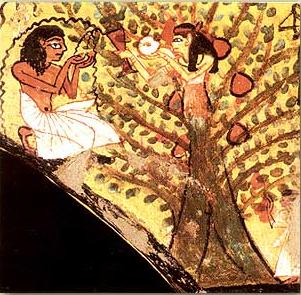
How would our culture be different if this vision of Eve had been our birthright?
Eve, whose name translates to LIFE, was a Great Goddess connected with trees. As you can see, it was common in the Middle East for Tree Goddesses to nurture and feed humanity. Truly a blessing, not a curse at all.
Eve and Naamah are characters shrouded in the mists of mythology. Both stories are about seeds. By eating the seed-bearing fruit from the Tree of Life, Adam and Eve brought seeds to earth within their own bodies. Naamah and her husband Noah protected those seeds.
The story of Miriam, Moses’ sister, which still shrouded in myth, borders on historical times. As this knowledge and understanding of Eve and Noah’s work receded further into the mists, it was left to women to protect the knowledge for future generations.
Miriam was known as a prophet in her own right. Even as Moses’ life story is told in loving detail in the Bible, hers is sparse and little known. In my telling, Miriam studies with Egyptian priestesses in temples dedicated to Isis who tell her that she was prophesied to become the keeper of sacred knowledge.
Miriam saw that when Moses would lead the Hebrew people to their freedom it would also foreshadow a time where women would lose their voices and their agency. For this she needed to learn just what it meant to be a keeper of sacred knowledge. In this telling she and her sister-in-law Zipporah (Moses’ wife) discuss ways to keep the sacred knowledge alive but hidden for future generations.
Discover more from Feminism and Religion
Subscribe to get the latest posts sent to your email.


Ohhh that’s a treat, a live performance! I’d love to join if it’s okay I leave 15 minutes early…
LikeLiked by 1 person
Absolutely!
LikeLike
wonderful, see you Thursday :-)
LikeLiked by 1 person
This is wonderful, Janet! I love the association of Eve with trees. This is such important work. I’ll look forward to the performance.
LikeLiked by 1 person
Thank you Beth
LikeLike
What an excellent piece, Janet! This is so true: “Whether we see them [Biblical stories] as mythological, historical, divinely inspired, wisdom teachings or simple folktales, they have shaped our beliefs and values.” So important and freeing to understand that concept. When we do, it leads to questioning our beliefs and values which is when creativity can come into play! Thanks for this.
LikeLiked by 1 person
Thank you Esther. This is pretty much what you say as well, isn’t it?
LikeLiked by 1 person
“As you can see, it was common in the Middle East for Tree Goddesses to nurture and feed humanity”.I’d go further than that Janet. The Tree of Life is sacred in all cultures in some form and in all Ki feeds and nurtures humanity. This story carries a resonance like no other and this story has shaped every culture on earth. In Christianity we do something weird – We forget about the Tree of Life – focus on the seed/apple/etc, and force Eve to take the ‘fall’ – what a ridiculous/ frightening story with horrific consequences for all because the christian ethic seems to have overtaken the world…. I hope I can make this Zoom thing on Thursday.
LikeLiked by 1 person
I agree Sara, the Tree of Life is one of those symbols/resonances/actualities that is seen throughout the entire world. And I also agree that the Bible upends the original story, perhaps with an agenda?
LikeLiked by 1 person
Yes Christianity certainly has its agenda but so does everyone else – we need to be discerning so that we can focus on commonalities and not differences – yes?
LikeLiked by 1 person
True, true, everyone has an agenda. I am not sure commonalities so much as shared values – for example, love of the earth, calling out racism, misogyny, genocide, loving the tapestry that is other cultures, and peoples and ways of living, sharing the treasures of the earth rather than hoarding them. I don’t know if I am expressing well but I don’t see much of the above and I don’t know if we can survive without those qualities.
LikeLike
You nail it – differences yes – but shared values are necessity and like you I don’t see much of the above examples being demonstrated by some…. and we both know that we cannot survive without these qualities – if we were ever in doubt all we have to do is listen to one set of news….
LikeLike
Ugh, 11 AM – I have a commitment – need to see if I can play with this a bit
LikeLike
Hope you can make it. But there is talk of taping it if you can’t. I’m not 100% sure of that though.
LikeLike
Oh boy I hope so – I really want to hear this
LikeLiked by 1 person
On my calendar!
LikeLiked by 1 person
oh my, putting on the app now! <3 Caryn
LikeLike
lol Long Day. It is of course, already there! I hope I can make it!
LikeLiked by 1 person