This morning I read an article about a woman who ‘forgot’ to light one of the candles on the Menorah or what I would call the ‘Tree of Life’ for the Jewish celebration of Hanukkah which takes place over a period of eight nights beginning in December. I was struck by her concern because she had forgotten one of the ‘rules’ and missed a night. Twice over a period of years…
While reading her reflection I noted that she seemed to get close to the underlying meaning behind the lighting of candles (present in every extant tradition) at the darkest time of year – she believed that she was bringing light into the literal darkness of night and kindling the divine spark within herself.
Watching the last episode of the Australian series Brides of Christ in which Catherine leaves the sisterhood of the convent because of her disagreement with Humanae Vitae brought me right back to the Yale Roman Catholic chapel and the folk mass I attended regularly. In 1968 just after the publication of Humanae Vitae, priest and co-graduate student Bob Imbelli preached a sermon on the doctrine of conscience, arguing that though it was incumbent on Catholics to think carefully about the papal encyclical on birth control, it was also the responsibility of every Catholic to follow her or his conscience on the matter. In the episode, Sister Catherine encourages a Roman Catholic mother of six who has already self-induced more than one abortion to take the pill, but the woman decides she cannot go against the church’s teachings. Catherine allows an editorial against Humanae Vitae to be published in the school newspaper even though she knows it will probably lead to the expulsion of one of her favorite students.
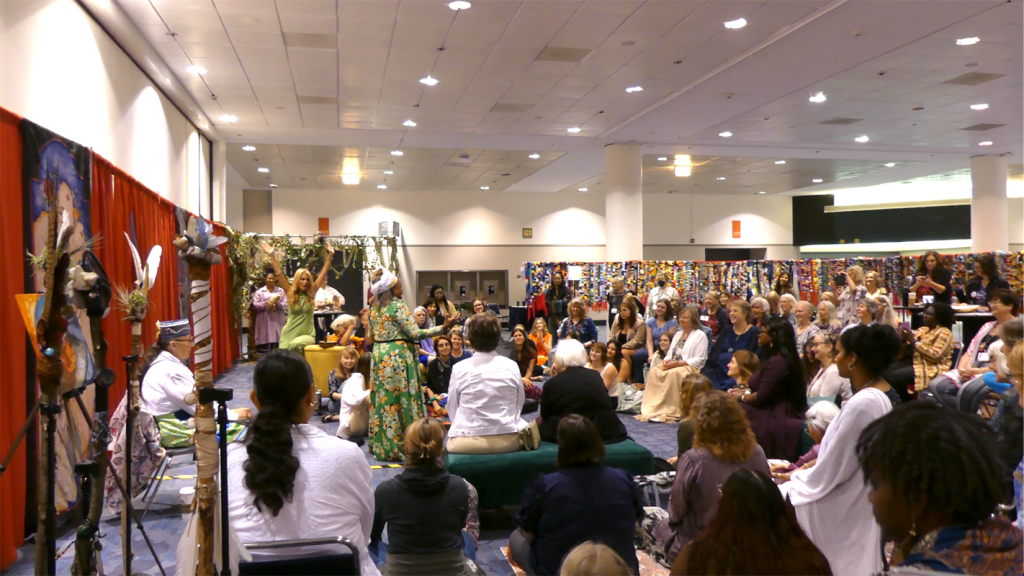
I was honored to be a part of a special project for the Parliament of the World’s Religions Women’s Task Force: conducting interviews inside the first-ever Women’s Village in Chicago at the Parliament Convening. I had been on a team of women led by Sande Hart with Pat Fero. We met online over the course of nearly a year to plan the Women’s Village. It was a very special endeavor, and our group efforts produced a beautiful, calming, nurturing, sacred and inspiring space.
The McCormick Center is America’s largest convention center, and yet we were able to create serenity. The tapestries of Women’s Woven Voices provided a colorful and meaningful enclosure for our space. A fountain cascaded a peaceful hum. Majestic staffs created by Erin Beatty stood as sentries; keepers of ancient feminine power. A great Mother Tree crafted by Elisa Guyton and Leah Myers spread her paper branches outward and received the written prayers and blessing posted there by attendees. The crown-making table was always busy with women talking and crafting exquisite headpieces. The Red Tent room was a tranquil place of mediation, rest, and a variety of spirit-nourishing workshops and presentations.
The Great Mother Tree crafted by Elisa Guyton and Leah Myers, close up with written prayers and blessings.
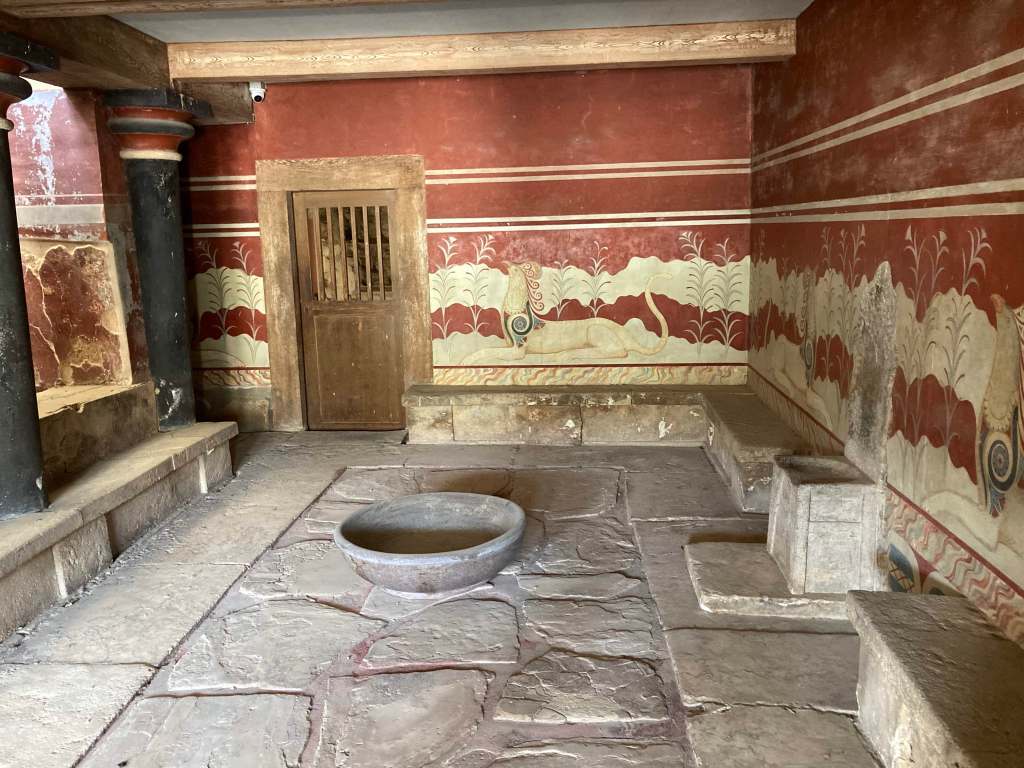
Knossos Throne Room showing edge of lustral basin at left. Photo: Laura Shannon
A few weeks ago I was on Crete, having coffee with an archaeologist friend. She happened to mention something strange. Crete has always been a seismic zone, with lots of earthquakes, yet remarkably, in Minoan times, no one was killed in collapsing buildings; they were never taken by surprise.
We pondered this – it seems astounding. They must have had some means of warning. Perhaps the serpents sacred to them could have given them some sign?
Goddess Prominence & Nature Participation through time
Today I reflect on the presence or absence of the goddess in religion and society, and how we view humanity and participate in nature as a result.
This post is inspired by “The Myth of the Goddess. Evolution of an Image” by Anne Baring and Jules Cashford, and especially by its final chapter “The Sacred Marriage of Goddess and God: the Reunion of Nature and Spirit.” This dance of integration of apparent opposites is essential to my work.
In my practice working in rehabilitative exercise, addressing minor injuries as well as traumatic ones – from brain injuries to falls, I see a lot of women over 60 who have a history of not training or challenging their upper body. The lack of upper body strength in women is, in some part, a result of culture. The historic role for women molds them to avoid muscles – to look thin, small, or frail in the upper body. A message emerges: “Let the man do it.” These roles are not benign, a fact reflected by changes in cultural views of sex and gender roles/expectations. While hewing to the feminine idea of the past might be easier, there is a price to pay later in life.
Anecdotally, men concern themselves with larger pecs, big biceps, and successful arm wrestling. Incidentally, when they can no longer do what they did as young men, some men give up doing much of anything. In my experience, women usually don’t surrender to age, but they traditionally resist both the look of a strong upper body and the labor necessary to achieve such strength. I have one client who feels afraid every time she has a weight over 10 pounds in her hands. Furthermore, women often defer to men: observe the next time you travel who lifts luggage in an airplane or brings baggage to the car. Life gets easier when someone else can grab the bags…but this ultimately makes later life harder – strength in the upper body is critical to the ability to break a fall, recover from injuries, and longevity.
Our interstate move of 325 miles due east on U.S. Highway 40, formerly Route 66, that iconic highway through the American Southwest, took us from one rental home to another. A month later, I sat in a closed graduate seminar, having received a coveted “yellow card.” By some stroke of magic, the professor had read my master’s thesis.
“I know your work,” he said, signing the over-enrollment waiver.
For the next several years, I studied, wrote, taught, ate, slept, and moved through marriage and motherhood (and one more rental)—all toward the goal of completing the PhD in English while my then-husband cycled through professional jobs and both of us recovered from eight years of cross-cultural Christian ministry.
In September I was patient. My beloved birds were having a good year seeking food in natural places like my field I reminded myself over and over as they remained absent from my feeders until I fell and was hospitalized for weeks.
After November’s first snow storm the grouse arrived and I had high hopes that she would stay. I occasionally flushed her in thickets but did not see grouse’s plump brown body feasting on the remainder of the berries from the crabapple or see her hieroglyphs in the snow.
The turkeys remained absent. When I walked through my young pine forest where chickadees chirp even on windy days, the musical whirring wings of mourning doves tore into the grief I felt and didn’t want to own. Sometimes I called out “I love you” to those birds who chose to converse with me because I know they know.
In late November when the snow piled up bowing trees to the ground it also brought in the first winter cold; this time the brook almost froze solid. A few birds did visit the feeder for a day or so: titmice, chickadees, one female cardinal, a few juncos, goldfinches, but the absence of abundance was overwhelming. Two days later nothing.
May we remember Brigid on her day in the fullness of her connection to bountiful and life-giving earth by setting a bowl of milk on an altar or special place in the garden on her holy day. Who knows, a snake just might come to drink from it.
The Christian Feast Day of St. Brigid of Kildare, one of the two patron saints of Ireland, is held on February 1, the pre-Christian holiday known as Imbolc. It is well known that St. Brigid has the same name as a pre-Christian Goddess of Ireland, variously known as Brighid (pronounced “Breed”), Brigid, Brigit, Bride, or Bridie. The name Brigid is from the Celtic “Brig” meaning “High One” or “Exalted One.” Brigid like other Irish Goddesses was originally associated with a Mountain Mother, protectress of the people who lived within sight of her and of the flocks nurtured on her slopes.
Imbolc marked the day that cows and ewes give birth and begin to produce milk. It was also said to be the day when hibernating snakes (like groundhogs) first come out of their holes. In northern countries, Imbloc signals the beginning of the ending of winter. The days have begun to lengthen perceptibly after the winter solstice when the sun stands still and it seems that winter will never end. At Imbloc spring is not yet in full blossom. But if hibernating snakes come out of their holes, it is a sure sign that the processes of transformation will continue and warmer days will not be far off. As Marija Gimbutas says, “The awakening of the snakes meant the awakening of all of nature, the beginning of the life of the new year.”
My first post of 2024 is still celebrating women who are not celebrated enough. This post sees us in the Hawaiian Islands. A leader, visionary, and pillar of the community; Queen Lili’uokalani was the last reigning monarch of the unified Hawaiian Kingdom. She spent her entire adult life trying to improve the lives of her people. Her legacy is one of beauty and of heartbreak for she would be forced to abdicate and live under house arrest when the United States illegally seized the Hawaiian Islands. Yet it is one of her many hymns, Aloha ‘Oe that continues to remind us of her unbreakable spirit, her legacy, and her dedication to duty and service.
Queen Lili’uokalani (1838-1917), born Lydia Lili‘u Loloku Walania Wewehi Kamaka‘eha would be hānai (honorarily adopted) into the Kamehameha royal family. She was baptized into the Christian faith at an incredibly early age and was educated at the Royal School which would make her eligible to become one of King Kamehameha III’s heirs. She married John Owen Dominis in 1862 who would later become the Governor of O’ahu. Both Lydia and John Owen would become high ranking Free Masons. When her brother David Kalākaua become King, Lili was announced as his immediate heir, became Princess, adopted her royal name Lili’uokalani, and the Official Envoy for the Hawaiian Kingdom. In 1878, Lili’uokalani would pen one of the most famous songs of the Hawaiian Islands, Aloha ‘Oe. *