

 The Torah parshah Ki Teitzei, Deutornomy 21:10 to 25:19, contains 74 of the 613 commandments/mitzvot found in the Torah. These mitzvot cover a wide range of topics and concerns. For example, there are mitzvot about how to sow and harvest your fields and others about aiding those in need, including animals. Some of the mitzvot describe how and why divorces can be decreed, to whom can one charge interest, and the punishments for various crimes. There is a mitzvah concerning the requirement to erect a fence on one’s roof to prevent people from falling off, one about not wearing clothes of the opposite gender, one about returning and/or caring for lost property and another detailing from what type of material one’s clothes can be made.
The parshah is literally one mitzvah/commandment/rule after another. Some of the mitzvot seem logical and good for the community. For example, help an animal whose been given a load too heavy for it to carry. Hold onto someone’s property if you find it, so you can give it to them the next time you see them. Build a fence on your roof so that no one falls off. Continue reading “On Ki Teitzei: Rules and the Importance of Religion by Ivy Helman”
 In “Time Telling in Feminist Theory,” Rita Felski suggests that there are four main ways feminists discuss and use time: redemption, regression, repetition and rupture. They are aptly named as they behave similar to their labels. Redemption is the linear march of time, hopefully progressing step by step towards a redeemed, or at least better, future even if sometimes things get momentarily worse. Regression is the want to go back in time or at least return to idyllic and/or imagined pasts: to matriarchy or to a time before patriarchy’s violent arrival. Repetition is a focus on the cyclical nature of time in bodies, in daily chores, in seasons and so on. Rupture posits a break in time in a way what was before no longer makes sense or doesn’t exist. Think utopia or dystopia.
 For almost four years, I’ve been living with the long-term effects of an inner ear lesion. The lesion is long gone but its side effects are not. Throughout the day, I feel a combination of unsteadiness and sudden, unpredictable sensations of movement. On better days, the unsteadiness is almost non-existent and the feelings of movement are minimal. On worse days, I’m troubled with a type of brain fog that makes it hard to concentrate as well as disrupting unpredictable sensations of being on a boat that can’t pick one direction in which to move. It’s frustrating, tiring and demoralizing.
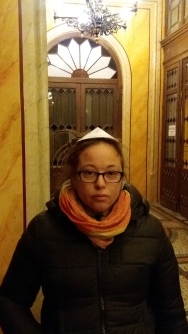 Last week Sunday, my partner and I were in Budapest, Hungary. We stopped at the Dohany Street Synagogue, the second largest synagogue in the world and the largest in Europe. After we bought our tickets and proceeded through security, we decided to go into the synagogue first and then the museum.
 My partner and I are getting married in a little over a month. She, a lawyer, and I, a professor, live in the Czech Republic. Technically, we aren’t getting married because the Czech Republic doesn’t have marriage equality. Our relationship will not be recognized in the U.S. For that, we need to be married in a state or nation that has marriage equality. Germany might soon. Other options would be a number of EU countries or the United States, but that doesn’t affect our status in the Czech Republic. Finally, our marriage will also not be recognized by some in Jewish circles as well since the
  Kavannah is a Jewish concept meaning intention or motivation, perhaps most associated with Hasidism. Hassidism teaches that prayer and the fulfillment of mitzvot connects one more with the Holy One if the right state of mind is cultivated before participating in said activity. While going through the motions (prayer, mitzvot, etc.) is important and still technically fulfills the mitzvot, it is not as spiritually beneficial to the individual as is doing those tasks with kavannah. Praying and fulfilling mitzvot within a certain mental space more fully connects you to the divine. Judaism is not alone regarding this religious insight. Clearly there is something to it.
 It is, I think, quite common knowledge that most Jewish holidays relate to the seasonal cycles of the Earth. Sukkot celebrates the fall harvest. Chanukah sheds light on the winter darkness. Tu B’Shevat marks the end of the dry season and so begin the prayers for rain in Israel. For Purim, we throw off our winter doldrums and let off a little steam to settle our cabin fever. Pesach is no exception: welcome spring: birth, renewal and even creation. The leaves return to the trees, baby animals are born, flowers bloom, warmer weather arrives and somehow the possibilities of the coming summer are endless.
