When Your Garden Gardens You by Carolyn Lee Boyd

Fleabane

Summer is a time when we are surrounded by the power of Nature, the impulse to life, balance, and well being. Even small actions to align ourselves with it can create momentous changes and healing within ourselves and towards a more sustainable world. Over the past couple of years, I have noticed a decline in pollinators like bees, butterflies, and birds in the small garden behind my home. This may be part of the worldwide pollinator crisis, or the result of nearby housing developments overtaking wild land, or my own past bad gardening decisions. I decided that this year it was time for me to join the many other gardeners worldwide who are creating pollinator-friendly spaces.

So, I did some research into what native and non-native plants already growing in the garden are good for pollinators and which native plants I should acquire from gardener friends or native plant organizations. I also learned to make a better environment for pollinators by waiting to move or shred leaves until warmer weather so as not to disturb pollinators wintering over, making sure that plants on which insects are making homes are left alone, and building up berry brambles, shrubs, and brush piles for birds and butterflies to find food and shelter in.

Continue reading “When Your Garden Gardens You by Carolyn Lee Boyd”

What is Natural? The Wooden Chair Discussion by Ivy Helman

When I begin my class discussion about defining nature, I often start with a wooden chair or table.  I point to it and ask the students, “Is this chair natural?”  I pause.  

They have already been introduced to the idea that humans are embodied and embedded beings, and therefore dependent on and interconnected to nature.  I remind them of those ideas.  Then, I ask again, “Is this chair natural?”  I continue, “Humans are part of nature and humans made the chair, so would that mean the chair is natural?  The chair is made from wood, a natural material.  Does that make it natural?  I could just as easily sit on a rock or a stump if those were here.  They are natural, right?”  The discussion begins.  

At some point in the discussion, we pause to define what nature is according to the ecofeminists we read for class that day.  Mary Mellor, in Feminism and Ecology: An Introduction, defines nature as “the non-human natural world,” (8).  It is probably the simplest definition out there.  I quite like its simplicity.

Continue reading “What is Natural? The Wooden Chair Discussion by Ivy Helman”

May – A Time of Becoming by Sara Wright

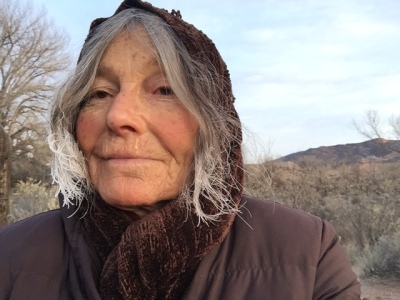
Picture of Sara Wright standing outside in natureReturning home to Maine in April has allowed me to experience winter turning her ancient wisdom filled face towards the maiden of spring. Although the month has been chilly, and until two days ago snow covered tree stripped mountains still held a dusting of snow, all nature is celebrating renewal.
In the woods the maples are turning a deep rose red. Here in the yard all my fruit trees are waiting for May’s rain and the warmth of a waxing solar sun to set fragrant bursting blossoms as are the lilacs. Blood red cardinals sing love songs in my pine forest, whistling up the dawn. Wood frogs croak in the vernal pools, laying jellied egg masses, young foxes race through oak groves crackling leaves in their wake. The goose stands watch over his nesting mate at the pond, a loon does the same, haunting the sky with his song. Continue reading “May – A Time of Becoming by Sara Wright”

Winter Solstice Drama by Sara Wright

Last year I attended a bonfire on the night of the winter solstice at a friend’s house. As my companion and I walked towards the ledge where the fire had been the year before we were both astonished. Where was everybody? We stood in the dark confused. Minutes passed.

After suggesting we leave, my companion remarked with annoyance, “What the hell is going on here?” A Rhetorical question. I sure didn’t know.

Sudden hooting split the night and some dissonant musical sounds seemed to be coming from out of the bushes below us.

Following the sounds we descended the steep hill and discovered that the fire was at the river’s edge, and that a few people were already gathered there.

Unbeknownst to either of us the location had changed, and from our vantage point on the hill we couldn’t see the fire or hear any sounds. I had been looking forward to this celebratory turning, and liked the idea of sharing it with friends. Yet, now I felt uneasy.

Continue reading “Winter Solstice Drama by Sara Wright”

Becoming Scrub by Sara Wright

In the precious hour before dawn I walk down to a river that no longer empties into the sea – the circle of life has been broken – the earth’s veins and arteries are hopelessly clogged by human interference (stupidity) – the birds and animals that used to be able to rely on the river waters for food and resting places can no longer do so because dams control the water flow and westerners “own” the water. This morning black stone sculptures appeared overnight because the water level has been dropped another foot. And yet, acknowledging the flowing waters in their death throws seems like an important thing to do. For now, at least, the river turns crimson, reflecting the raging beauty of a pre dawn sky, and I am soothed by water rippling quietly over round stone.

I open the rusty gate to enter the Bosque, a place of refuge, for the cottonwoods and for me. Now I am surrounded by desert scrub and graceful matriarchs arc over my head. As I traverse the well  – trodden path I enter a meditative state without effort. Soon I am walking in circle after circle passing through the same trees and desert scrub hearing voices.

Continue reading “Becoming Scrub by Sara Wright”

The Caves Beneath My Roots or Psychological Spelunking by Darla Graves Palmer

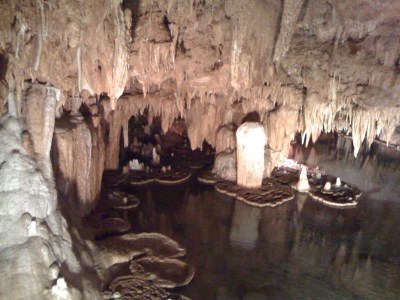
I’ve spent much of the past four years – since returning to the state of my birth after more than forty years’ intentional absence – trying to understand and make peace with a particular slice of southern culture that I avoided most of my adult life. Part of that process was a deep dive into my family roots which led me to also consider the caverns further below those roots. If landscape contributes to shaping our human nature, what might that mean for my family?

Here in the Missouri Ozarks, my roots extend a hundred and fifty years deep; my ancestors on both sides of my family are buried in the karst of the Ozark Plateau, and their bones have leached into the thousands of caves that honeycomb the area, mixing with the limestone and other minerals through the abundance of flowing water. I grew up being cautioned to watch out for sinkholes, often a sign that there was a cave system below.

Continue reading “The Caves Beneath My Roots or Psychological Spelunking by Darla Graves Palmer”

The Man with the Hat by Sara Wright

I met a man on a rumbling train who had hooks in his hat.

A fisherman, I thought with the usual dismay – brutal images of dying fish gasping for air exploded in thin air. Memories of my grandmother who took her eight year old granddaughter fly fishing also flooded my mind (my grandmother was a professional fly fisherwoman). I caught my first fish in the brook – a six inch trout. After landing the desperate creature my grandmother said, “ now we must kill it so the fish does not suffer.” And she looked for a stone.

“Hit it over the head” she instructed handing me a rock she picked up nearby, and I did.  Tears welled up. It broke my child’s heart to murder such a shimmering rainbowed creature.

When we got home that day, my grandmother praised me lavishly for my catch, promptly gutted the fish and fried it in a pan for me to eat. I forgot the anguish I had experienced, basking in my grandmother’s approval. The fish tasted delicious, and to this day I eat fish and other seafood.

As a lobsterman’s wife I learned quickly how to cook crustaceans by sticking their heads in boiling water so they would die almost instantly.

Continue reading “The Man with the Hat by Sara Wright”

Ant Hill by Sara Wright

Yesterday I gave a poetry reading at a local library beginning and ending with thoughts about how Climate Change is affecting all living things. I am a naturalist who holds the radical belief that all living things are sentient. I also argue that we must not equate animal intelligence with that of humans.

Almost every poem I read was about my intimate relationship with some aspect of the natural world, for example, the changing seasons, my friendship with sagebrush lizards, steadfast trees, Sandhill cranes, beloved Black bears. Intimacy and inter –relationship are part of every experience I have with nature and by sharing these poems I hoped might draw others in to new ways of perceiving the earth and her creatures.

The whole point of my focusing on non – human species was to raise awareness that these animals and plants desperately need our help. Perhaps I wasn’t clear enough about how critical it is to bring animals, plants, trees, mushrooms into the picture in this age of the Anthropocene, that is, the period in which we live where a few men with power rule. Today, it is not an exaggeration to say that humans control every aspect of our fragile planet.

I repeat: Perhaps I wasn’t clear enough or perhaps almost no one was capable of listening? Maybe both. As soon as I concluded my reading one woman did actually bring up an incident involving a very difficult child who became attached to a lizard, so she at least, was on the track I hoped I had laid….

Continue reading “Ant Hill by Sara Wright”

A Place Below the Cattails by Sara Wright

As a woman with Passamaquoddy roots when I first came to Abiquiu I was invited to participate in the six pueblo celebrations along the Rio Grande which made me feel blessed, grateful, included, and at “home.”

My own people’s lives and traditions were  destroyed by colonial peoples centuries ago.

Yesterday I was invited to attend a river blessing on what I call Red Willow River a tributary of the Rio Grande by folks of Spanish and Indigenous descent who live here in Abiquiu on the mesa. These people, although local, are of mixed descent and do not follow the seasons and cycles of the year as the surrounding pueblos do. There is a heavy overlay of Spanish colonialism along with a restrictive (to me) Catholicism that sets this village apart from the pueblos.

Still, I was looking forward to this celebration

That was supposed to be led by Tewa Women United from the neighboring pueblos. It was a beautiful day, and of course we were all on “Indian Time” which means practically that ceremonies start when the time was right.

However, this blessing of the river didn’t come together at all. People milled around aimlessly. Some left. The children some of whom were dressed in regalia played for a while and eventually got hungry. Some complained they had to get back to school for a game.

Continue reading “A Place Below the Cattails by Sara Wright”

THREE POEMS OF LIFE by Janet Maika’i Rudolph

As Above So Below

Yes, I believe we are made in god’s image.

If god is the wild, passionate, loud, sexual, sizzling, dancing fires of creation.

And should I ever forget my fiery, heavenly vision, the sun comes out every day to remind me.


And I ask myself, which is more miraculous? Our local star feeding earthly life?

Or me, reflecting the sun, feeling the passion, sizzling in response?

Jacob Dreams and So Do We

(inspired by Genesis 28:12)

As darkness slips into light,

dawn,

with its unique melody,

grows brighter.

As light slips into darkness,

dusk,

with its mysterious possibilities,

settles softly upon the land.


Creation is oneness, but we need duality to experience sex, symphonies, hot fudge sundaes.

Creation is pure love, but it is to the passions of the human heart that we owe our earthwalk


Dawn and dusk hold open the thresholds of mystery inviting our human hearts to experience . . .

The sacred dance where one becomes two becomes three.

The sacred song where three becomes two becomes one.


Pele’s Birth Dance

Twinkling stars ignite waves of fire that explode into a tumultuous, joyful noise:

“EH YEH, EH YEH, EH YEH.”


And Mother Earth awakens.


Matter bathed in Pele’s cauldron flares up, erupting into waves of baby earth while roaring:

“EH YEH, I AM, EH YEH.”


As seeds rise from great watery oceans of fire, my heart swells, breathing air into newly forged matter and causing my breath to become song:

“I AM, EH YEH, I AM.”


Fire,

that reflects flame-drenched stars,

that reflects Pele’s dance,

that reflects the passionate seed,

echoes within my belly until I glow with waves of love which burst forth to sing:

“I AM, I AM, I AM.”


And then . . .

Riding a watery wave that gushes forth new life, my newborn erupts from my body, then twinkles, then cries tumultuous joyful noise:

“EH YEH, EH YEH, WAHHHHhhhhhh.”

(Note: “Eh yeh” is God’s name in phonetic Hebrew as given to Moses in Genesis 3:14. “I am” is its traditional translation into English)


Janet Rudolph has written three books on the subject of ancient Biblical Teachings.  One Gods: The Mystic Pagan’s Guide to the Bible, When Eve Was a Goddess: A Shamanic Look at the Bible, and the just recently released book, When Moses Was a Shaman. For more information visit her website at /www.mysticpagan.com/