Bans are Bandages not Solutions by Ivy Helman

meandmini1I’m heartbroken by yet another shooting in the United States.  I want to believe that all humans are, deep-down, intrinsically good.  I want to trust humans to act in the best interests of others.  I want peace between and inside human beings.  I want animals to be cared for, respected and deemed inherently valuable.  I want humanity to live in harmony with nature.  And, I want human societies that are just, equal and fair.

Even though I’m certain this world is achievable, it does not exist.  In fact, it often feels like we take one step forward, but something changes and we go back again.  This type of existence is no way to live.  In fact, Las Vegas was yet another example of how our way of life is worse than that.  It’s quite literally killing us.  And, I’m beyond any sort of ability to articulate just how upset I am. Continue reading “Bans are Bandages not Solutions by Ivy Helman”

Reflections on Marriage by Ivy Helman

studyMy partner and I are getting married in a little over a month.  She, a lawyer, and I, a professor, live in the Czech Republic.  Technically, we aren’t getting married because the Czech Republic doesn’t have marriage equality.  Our relationship will not be recognized in the U.S.  For that, we need to be married in a state or nation that has marriage equality.  Germany might soon.  Other options would be a number of EU countries or the United States, but that doesn’t affect our status in the Czech Republic.  Finally, our marriage will also not be recognized by some in Jewish circles as well since the ketubah, the Jewish marriage document which possesses legal status in Jewish courts, is between two women.

There is nothing legal about our Jewish wedding except one could argue its Jewishness. So, the day after our wedding our relationship will have the same recognition as it had the day before and the day before that.   This would not be the case if we were a heterosexual couple.  It reminds me of the countless commitment ceremonies that took place before marriage equality in the United States.  They were not prohibited (like the marriages that slaves had because slaves weren’t considered people under the law or eligible to enter into legal contracts while in bondage (see pages 301-302).  Yet, similar to the “contubernal relationships” of slaves performed by their masters or other slaves (page 302), they weren’t particularly legal either.  Despite the ceremony, there was no change in status of the couple within society.  Yet, recognition was and still is an important component of both struggles for rights.  In fact, according to Darlene Goring in “The History of Slave Marriage in the United States,” (345-346), the process of gaining legal recognition was very similar for both ex-slaves and the marriage equality community in the United States. Continue reading “Reflections on Marriage by Ivy Helman”

Resisting Shame and Choosing to Live through the Loving Eye by Stephanie N. Arel

This week, I finished reading The Politics of Reality: Essays in Feminist Theory by Marilyn Frye, a text I had not encountered in my studies of feminism (in literary theory, psychology, philosophy, or theology) until now. In some ways, I wish I would have read it sooner. In other ways, I am grateful for this more recent rendezvous. From my current position and perspective – theoretical and personal – I was, I think, more able to hear the core message Frye conveys than I would have been years ago. I have less to protect now, and my ego is less fragile. In the text, she names the mechanisms around which Western – and patriarchal – cultures are founded. Her argument is fluent and cogent, even as it threatens the stability this culture offers. Our lives are embedded in it, even if our personal ethics point to alternative, feminist ways of living. Frye pushes her readers to live alternatively, so that we can recognize the times that we conspire/feed into/comply with patriarchal messages and clean the residue of servitude off of our skin.


For the purposes of this post, I engage two opposing concepts Frye presents in the text: the arrogant eye and the loving eye. Located in the chapter entitled “In and out of Harm’s Way: Arrogance and Love,” Frye investigates how men in phallocentric culture exploit and enslave women. The opposing, contradictory eyes of arrogance and love directly relate to the experience of shame which effectively serves to subjugate women in patriarchal culture.


Shame functions within what I call a logic of exposure. Shame relates intimately to the concept of being seen.  Affectively, shame results from our interest/excitement being partially truncated. For instance, we are drawn to someone (real or imagined); we are interested in their response to us, and somehow something interferes with the desire to connect. Contact is cut off, and interest/excitement partially halted. Shame ensues. We experience that someone (real or imagined) seeing us as other, different, foreign, maligned, wrong, or worthless. We are seen wrongly. This misperception alleviates joy and relates to the gaze of the arrogant eye under which (as the default gaze of phallocentric culture) we often find ourselves seeking approval.

Continue reading “Resisting Shame and Choosing to Live through the Loving Eye by Stephanie N. Arel”

Sirens, Thunderstorms, and Bowling: The Divine on this Mother’s Day by Ivy Helman

untitledLet’s see if the following course of events makes sense.  A few Wednesdays ago, I was thinking about possible topics for this post considering it would be Mother’s Day.  In the midst of thought, the warning sirens in Prague began.  They were only being tested but, nontheless, I immediately thought of tornados.  You see tornados, as awful and devastating as they are, make me think of thunderstorms and lightning.  I love a good thunderstorm, the louder the better.

A Wisconsin childhood supplies plenty of thunderstorms.  I cannot tell you the number of times as I was growing up that I stood outside watching the sky turn into that distinctive greenish-purple and smelling the storm on the breeze.  Nor could I count the umpteen times we gathered in the basement as the tornado sirens blared and the radio advised its listeners in no uncertain terms to seek shelter.  Nor could I recall how many times I sat with my mom during more recent summers watching the storms come in or the lightning blaze across the sky like a spider’s web.  We’ve been lucky.  Never once did a tornado hit our neighborhood although a house or two has been hit by lightning. Continue reading “Sirens, Thunderstorms, and Bowling: The Divine on this Mother’s Day by Ivy Helman”

Was There a “Golden Age” before Patriarchy and War? by Carol P. Christ

Marija Gimbutas coined the term “Old Europe” c.6500-3500 BCE to describe peaceful, sedentary, artistic, matrifocal, matrilineal and probably matrilocal agricultural societies that worshipped the Goddess as the power of birth, death, and regeneration in all of life. Gimbutas argued that Old Europe was overthrown by Indo-European speaking invaders who began to enter Europe from the steppes north of the Black Sea beginning about 4400 BCE.  The Indo-Europeans were patrilineal and patriarchal, mobile and warlike, having domesticated the horse, were not highly artistic and worshiped the shining Gods of the sky reflected in their bronze weapons.

In the fields of classics and archaeology, Gimbutas’s work is often dismissed as nothing more than a fantasy of a “golden age.” In contrast, scholars of Indo-European languages, Gimbutas’s original specialty, are much more likely to accept the general outlines of her hypothesis. The German linguist and cultural scientist Harald Haarmann is one of them. Continue reading “Was There a “Golden Age” before Patriarchy and War? by Carol P. Christ”

On Difference by Ivy Helman.

untitled.pngThere is no correlation between difference and danger.  Yet, differences are regularly considered threatening.  In fact, much of Western society’s patriarchal energy is spent categorizing, controlling, managing and fighting difference.  Difference is so ingrained within the psyche that most differences are understood to be antithetical, perhaps even unbridgeable, opposites.  Good/bad, black/white, rich/poor, women/men and human/animal are just a few examples.  To further amplify this distinction, patriarchy considers one aspect of the difference more valuable than the other.  

Feminism seeks to end this value-laden, polarization of difference.  In its earliest days, many feminists were convinced that advocating sameness was the best solution.  Abolition, the Equal Rights Amendment (ERA) and the right to vote were parts of this liberal agenda.  While sameness worked in some respects especially in terms of ending slavery and gaining the right to vote, the sameness platform also, albeit perhaps unknowingly and considerably to a lesser degree, bought into patriarchal views of the dangers of difference.  For example, ending slavery did not end racism nor did gaining the right to vote mean that women were equipped or allowed to think independently of their husbands.  Other first-wave feminists who advocated women as pure and moral persons and elevated motherhood fared little better playing into the patriarchal ideals of biological determinism and essentialism.       Continue reading “On Difference by Ivy Helman.”

On Minimalism by Ivy Helman

untitledOne of the concerns of ecofeminism is the modern materialistic mindset of capitalism. Materialism in capitalism instills not just owning many possessions, but it also inculcates the “need” to own the newest innovation. In addition, materialism advocates a throw-it-away mentality. In other words, it is often cheaper to buy a new shirt or computer than to have them repaired. Similarly, it is not enough to have a cell phone. Rather, one must have the newest and best one! The environment pays the price.

One attempt to deny the hold of materialism is minimalism. The minimalist movement seems to run the spectrum. From the ideals of less is more, there seems to be some competition between mindful consumerism and extreme self-denial. Mindful consumerism suggests that minimalism is a journey of recycling, reusing and repairing combined with well-researched, well-considered, as-ethically-produced-as-possible purchases when necessary. Extreme self-denial advocates owning almost no material possessions. While I strive toward mindful consumerism, I have serious concerns about extreme minimalism. Continue reading “On Minimalism by Ivy Helman”

The Importance of Religion for Eco-Feminism by Ivy Helman

untitled.png“Why is religion important to ecofeminism?”  A student, in the Master’s course I teach at Charles University, asked this as we began the class session dedicated to the topic.  Given the overwhelming presence of atheism in the Czech Republic, I wasn’t too surprised by the inquiry.  Nonetheless, the idea has been at the back of my mind ever since: what does religion have to do with ending patriarchy and bolstering the health of the planet?  While I may take the connection as obvious, it is clearly not for many feminists out there.  Here is how I understand it.

First, it is true: many of our inherited religious traditions have been and still are considerably patriarchal.  Because of that, some feminists outright reject religion.  In fact, some feminists even consider religion dangerous and threatening, as it is often utilized to contradict many feminist aims.  Yet, there are many, many feminists who find, within their given or chosen tradition, non-patriarchal elements that can be recovered, remembered and/or (re)created.   Religious feminists work tirelessly to transform religions in life-sustaining and post-patriarchal ways not just for themselves but also for those women and men who belong to the same communities.   Continue reading “The Importance of Religion for Eco-Feminism by Ivy Helman”

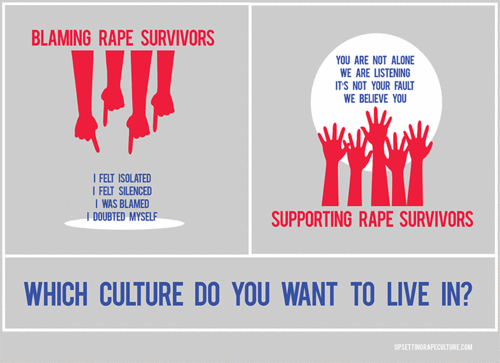
Why Is The Abuser Still Among Us? by Vanessa Rivera de la Fuente

They say that men cannot control themselves.

So, when they see a woman, the body overcomes the mind. If you have to rape, you rape. I have heard it many times, the same argument to justify cheating. “I am a man, I can’t control it, I HAD to do it, I DID NOT KNOW what I was doing”. Sure, they can control themselves. Sure, they DO KNOW what they are doing. Because they control themselves with other men. They can and know how to maintain alliances with other men so none of them will reveal their secrets. Secrets called women abuse. They are so updated in what they do, that if you call their machismo out, they organize a cold strategy to silence you. They will have a Masters in mind games and gaslighting to leave you full of bumps without touching you, and you will have to put up with the wall of silence from his friends defending the abuser. Continue reading “Why Is The Abuser Still Among Us? by Vanessa Rivera de la Fuente”

Two Lives, a Marriage and a Plate of Samosas by Vibha Shetiya

VibahRecently, a commercial made by the clothing line, BIBA, hit the Indian market. Its significance lay in its “Change the Convention, Change is Beautiful” tag. The message was straightforward – we need to change Indian attitudes regarding gender roles. At the outset, let me say there are many things wrong with the ad, especially when one stops to think how it could possibly bring about a change when the young woman in question is voiceless. In fact, when I first watched it, my own reaction was: “And just what change are we talking about here?” Upon deeper reflection, however, I realized why the commercial may indeed be a step forward, albeit a tiny one. Continue reading “Two Lives, a Marriage and a Plate of Samosas by Vibha Shetiya”