Women’s Ritual Dances and the Nine Touchstones of Goddess Spirituality-Part Three by Laura Shannon

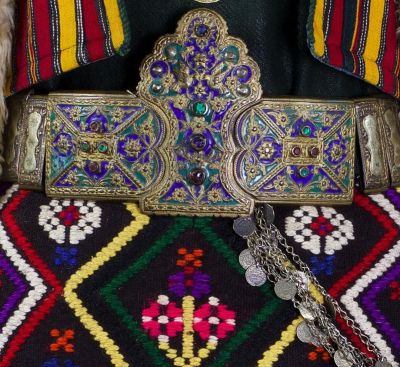
Women’s apron from Pentalofos, Greek Thrace

In Rebirth of the Goddess, Carol P Christ offered Nine Touchstones of Goddess Spirituality as an alternative to the Ten Commandments. The Nine Touchstones are intended to inform all our relationships, whether personal, communal, social, or political.[1] In this series of blogs I am exploring ways in which these Nine Touchstones are embodied in the traditional women’s ritual dances of the Balkans, which I have studied as a spiritual practice for more than thirty years.

Carol P Christ’s Second Touchstone is: ‘Walk in love and beauty.’ As she says, ‘love and beauty are the great gifts of bounteous earth’.[2] Dancing women of the Balkans walk in love and beauty each time they put on their festive dress to dance together in the courtyard or the village square. Their ceremonial costumes are created from the bounty of the earth – just a couple of generations ago, this was literally the case, as the women tended the sheep, prepared and spun the wool, wove, sewed, embroidered and ornamented their garments with the work of their own hands. Even now, the cloth they buy is purchased with money they have earned from working and harvesting the land.

Continue reading “Women’s Ritual Dances and the Nine Touchstones of Goddess Spirituality-Part Three by Laura Shannon”

Women’s Ritual Dances and the Nine Touchstones of Goddess Spirituality-Part Two by Laura Shannon

In the first part of this article, I looked at how Carol P Christ’s Nine Touchstones of Goddess Spirituality from Rebirth of the Goddess are related to traditional women’s ritual dances of the Balkans. After more than thirty years of researching and teaching these dances and the way that they pass on information in encoded symbolic ways, I have come to see them as an educational system, a women’s mystery school.[1] The main message which the dances convey is an ethic of community, partnership, mutual support, and other life-enhancing values aligned with the Nine Touchstones, which can be directly experienced in the dance.

We know from the research of Marija Gimbutas that these values were central to the Old European civilizations which honoured the Goddess, while Yosef Garfinkel and Elizabeth Wayland Barber show that circle dances have their roots in these same early Neolithic cultures of Eastern Europe and the Near East. This leads me to suggest that Balkan women’s circle dances surviving today may have their origin in early egalitarian matriarchal cultures of Neolithic Europe. The Nine Touchstones of Goddess Spirituality provide an perfect template through which to explore the ethics of women’s ritual dances.

Continue reading “Women’s Ritual Dances and the Nine Touchstones of Goddess Spirituality-Part Two by Laura Shannon”

Queen of Pentacles: Sensual Materiality by Elisabeth Schilling

Most of us are trying to make it to a place of material comfort where we are living in a way that feels honorable. Some of us feel we could have made better decisions in the past so that we might have figured out how to do such before the age we are now. I recently did a tarot card reading that I interpreted as mainly positive or neutrally-revelatory. But one of the cards stood out from the rest, and I really didn’t understand it. I was feeling positive that day, and, even though I have often felt unsure and longing in my recent travels despite all I have accomplished materially and psychologically, I have to say it wasn’t a card I was expecting: the III of Swords, which symbolizes disappointment and heartache, especially due to mental happenings. What could I feel heartache at? Perhaps I am disappointed that creating that place of safety and material comfort seems a long way down the road.

Continue reading “Queen of Pentacles: Sensual Materiality by Elisabeth Schilling”

La Llorona by Sara Wright

The legend of La Llorona has been a part of Hispanic culture in the Southwest since the days of the conquistadores. Though the tales vary from source to source, the one common thread is that La Llorona is a woman named Maria who is always dressed in a white gown, the spirit of a young Mexican mother who drowned her children in the river in a moment of rage or abandonment by her lover and then took her own life in her deep shame and sorrow. La Llorona’s disembodied spirit is said to haunt the rivers at night – especially the Rio Grande – where she can be heard weeping in remorse for her dead children. Children are cautioned not to go out after dark because La Llorona might murder or drown them too. Because the tale of the Weeping Woman originated with the Patriarchal Spanish conquest I have always been suspicious of the various versions of this story believing that its meaning has been distorted.

Immediately what comes to mind is the Mater Dolorosa, Our Lady of Sorrows, or Mother of Sorrows. All refer to the Virgin Mary, the only goddess left in Christianity. Our Lady of the Seven Sorrows is another name used to refer to this goddess. The Mater Dolorosa is also a key subject for Marian art in the Catholic Church.

Continue reading “La Llorona by Sara Wright”

Emergence: Poem to a Plant Goddess by Sara Wright


Her name is Datura.

Delicate fluted deep-throated trumpets open to

humming honey bees and summer rains.

She communicates through scent.


 In the fall I collect her sharp-needled pods.

They rattle like dry bones.

I chill them.

In the spring I coax seeds to sprout

wrapping each in papery white cloth,

sing love songs  –  siren calls

to rouse each root from winter’s sleep.


I am patient…

 a woman in waiting for the heat of the sun

to unfurl the mystery of becoming

 that is re-acted in spring.


Only seeds know when to swell and burst.

Continue reading “Emergence: Poem to a Plant Goddess by Sara Wright”

Spiritual Ideas, Existential and Eastern, in Jonathan Livingston Seagull by Elisabeth Schilling

Peaceful Solitude

After my year of teaching high school students, I found a kinship with them in their frustrations, longing, apathy, hopelessness, and hope. Fortunately, we studied together Jean Paul Sartre, whom I want to get to know more intimately, but we, the teens and myself, could take the spiritual answer to our questions about the meaning of life (is there one? What is it?): The meaning of life is to give it meaning.

I am not sure about their generation, but adolescence for me, in mine, was about discovering, not necessarily creating. Of course, now I think it is a little of both.

Sometimes I wonder if there is also a lesson. Being an academic, perhaps I love learning and teaching. I demonstrate my love as Jonathan Livingston Seagull does, by offering to others, perhaps a specific community of others, those who have chosen or must be in a state of learning (easily found in institutions of high school and college), the truths I have gathered (59). Of course ‘truth’ is a word that tastes a bit tannic, for it needs to be rolled around by the tongue a bit to be cleansed; perhaps to mitigate its toxic potential, we can never consume it undigested, but must gestate it and transform it within our warm bodies, just at the cliff, before we allow it to permeate our organs in a chemical structure that serves us.

Continue reading “Spiritual Ideas, Existential and Eastern, in Jonathan Livingston Seagull by Elisabeth Schilling”

When Spirit Speaks by Katey Zeh

photo-1496449903678-68ddcb189a24

Though I couldn’t call myself a skeptic in general, I’m always a bit dubious when someone claims to have an audible connection with the divine. I’ve found sacred guidance to be more subtle than that, revealed slowly over time through snippets of conversations and on the pages journals and during walks in the woods with my dog. Revelations are rarely sudden for me. They tend to emerge piece by piece, like clues to a puzzle, until the clarity eventually comes.  

Imagine my surprise and subsequent doubt when I heard a voice say recently, “You are already doing the work you want to do.” Continue reading “When Spirit Speaks by Katey Zeh”

The Practices of Forgiveness and Yoga by Vanessa Soriano

Forgiveness and yoga require consistent practice.  As we engage in each, healing unfolds in the body, mind, and soul.  Forgiveness and yoga exist in a symbiotic relationship: forgiveness allows us to release emotional blockages that affect the body/mind, and yoga delivers us to more empowered and peaceful states within the body/mind that encourage the release.  Yoga and forgiveness illuminate the body-mind connection.

All world religions and spiritual traditions emphasize the practice of forgiveness.  Sages, prophets, rishis, shamans, medicine women—figures who have helped shape religion and spirituality—understood that resentment and anger depress the body and mind, which hinders our connection to the soul and Divine.

Being angry diminishes the quality of life and can incite violence against our self and others.  Forgiveness helps us function at fuller capacity from a healthy internal state.

Just as forgiveness promotes healing in the body/mind, yoga accomplishes the same effect.  Scientific studies from Harvard show that yoga increases body awareness, relieves stress, improves mood and behavior, and calms and centers the nervous system.  Since yoga decreases the stress response in the body, it creates space in the psyche to journey into the practice of forgiveness.

Continue reading “The Practices of Forgiveness and Yoga by Vanessa Soriano”

Priestessing the Priestesses by Chris Ash

Christy CroftLast week, I had the incredible privilege of sitting vigil with a friend in hospice in her final hours on this earth. She slept for most of the time I was there, but her waking moments were lucid, if brief. She whispered how good the fresh juice tasted (it had been made for her by a friend), and she seemed to prefer having my hands on her back to pain medication. In the last hour I was with her before leaving, a mutual friend joined us and played gentle, lullaby-style music for her on the kalimba and guitar. As he sang softly to her, I could barely make out his words; the intention was pure, the moment was intimate, and I felt honored to be present for such a profoundly sacred moment.

Speaking with another mutual friend who had held space for Maria in her final days, I mentioned that as I was at hospice I had felt an awareness of priestessing the priestess. Our friend agreed, and said she’d had a similar sensation. “That’s who Maria has been for many of us, whether she claimed that title or not.”

Maria and I were not part of a shared formal congregation or spiritual community in the traditional sense. We were both part of an informal network of friends in a variety of communities whose membership and interests overlap – sacred movement, ecstatic dance, ancestral healing, sound healing, and alternative spiritualities. It’s a network that is both leaderless and full of leaders, as its inherent diversity of beliefs and practices lends itself to members who are specialists in one tradition, students in another, and generalists in deep compassion, holy presence, and unconditional love. Continue reading “Priestessing the Priestesses by Chris Ash”

Hooray! The Holiday Season Is At Hand! by Barbara Ardinger

December seems to have more holidays than the rest of the year put together. Days to honor Ix Chel, the Virgin of Guadalupe, St. Lucy (aka Santa Lucia), the Declaration of Human Rights, and the publication of the Rider-Waite Tarot. Saturnalia. Hanukkah. Christmas. Kwanza. Yule. Innumerable reasons to go shopping for gifts and banquets. Here, to help you survive the holiday season, are two Found Goddesses.

Who, you may ask, is a Found Goddess? The term comes from Found Goddesses, published in 1988 by Morgan Grey and Julia Penelope. Found Goddesses are modern ones that we invent to deal with modern issues that the classical pantheons can probably not cope with. Like going to the mall and cleaning our houses before our guests arrive. (Note that I’ve rewritten these pieces a bit to bring them more or less up to date.)

Continue reading “Hooray! The Holiday Season Is At Hand! by Barbara Ardinger”