

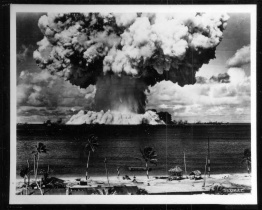
 I wish that in our pursuit of finding cures for illnesses we would do more as a collective species to prevent the causes, sometimes environmental ones. Why do we vote for people to make decisions that represent us but that we would never in a million years agree to? Bombs and the consequences of them raise questions of health and power. In the Yoga Sutras, 2.30, we read that “Yama consists of non-violence, non-lying, non-stealing, appropriate use of vital energy, and non-possessiveness.” The yamas are our social restraints. They are a negation of behaviors we might usually partake in.
Ahimsā, or non-violence, is listed first. It is the first element of the first limb of yoga; it is the basis for every other ethical aspect of our lives. Bombs are an example of a common and frequent behavior of violence that make the land, water, and sky increasingly uninhabitable. According to Micah Zenko of the Council on Foreign Relations, in 2016 alone, the U.S. is estimated to have dropped 26,172 bombs. Zenko says that this estimate is “undoubtedly low.” (1) This is one year and the bombs from one nation. (2) What is the environmental impact of all of the bombs dropped from every nation since the beginning of bombing history?
When a bomb is detonated, there is not only harm to the immediate life in that vicinity but life in the future and far away. According to the International Campaign to Abolish Weapons (ICAN) website, “the International Physicians for the Prevention of Nuclear War has estimated that roughly 2.4 million people will eventually die as a result of the atmospheric nuclear tests conducted between 1945 and 1980, which were equal in force to 29,000 Hiroshima bombs.” (5)
According to a statistic updated March 2016 on the Ploughshares Fund website, nine countries in the world have a total of 14,900 nuclear weapons, the U.S. and Russia holding 93% of them. (3) They have been used twice, both times by the United States, in war, but additionally they have been used in tests over 2,000 times in more than 60 locations over the globe, according to ICAN. (4) There are already unavoidable consequences to the earth and humans because of this irresponsible behavior that is ongoing. These tests occur in the atmosphere, under the earth, and under water. (6) Continue reading “The Trees and We Breathe Bombs Long Gone by Elisabeth Schilling”
 While I am sure this articulation is on an “inspirational” meme somewhere, my thoughts coalesced to form it while I was looking at the mid-afternoon blue sky in a moment of rare optimism. Too often can I become confused and despondent about the situation of our earth and humanity, myself. “We want healing too,” it whispered. If we are for the sustainable restoration and support of our earth, then we have a whole universe on our side that moves toward this direction as well. Our bodies, one with the universe, join in this want of healing.
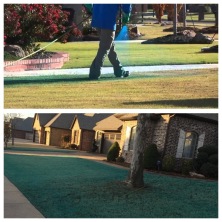 If Gaia is a living body, why are we painting her blue? Whether it is public parks or residential lawns, when there is that special odor in the air, I know to look down and there it is, an endless dye job on the grass indicating treatment. My city is concrete and blue dye for miles. Furthermore, I have sales people knocking at my door monthly asking if I want to spray pesticide around the house to decimate wasps, ants and spiders.
  Since the U.S. has elected a reality TV show billionaire to represent our nation, we should be no longer be able to shy away from the ignorance, violence, and frivolity that is within us. Happiness and peace in humanity seem to be in short supply. How many of us experience continuing bliss, or do we only fantasize and find brief reprieves in our suffering? Even the more extreme privileged among us most likely share the same emotional landscape.
 Much of our lives lack the rich culture of ritual that I think would help us repair the relationships we have with our own bodies and with the earth. The Rg Veda is one of the oldest collection of hymns from India. In them, I find a playful and introspective expression of desires and fears that, at first, did not seem to me to hold much wisdom for a modern contemplative. But lately, I have been noticing how the speakers communicate to or about the earth, and how their lives seem centered around trying to take a part in creation. Mostly, these hymns are stories and supplications for rain, cows, victory in battle, and a long life. But there is a deep understanding of the power and divinity in the universe that is the very earth-based wisdom that our humanity-in- crisis needs. If the Qur’an is God calling for humanity to be grateful, the Rg Veda is a model of a humanity that could be nothing else.
 There are quite a few post-apocalyptic shows out these days.
  Sometimes there are tricky s
 There is some very helpful guidance in the Qur’an for how we should and should not treat the earth. In my exploration of Qur’anic verse
 I have been thinking about deserts lately, what places are desired, which ones are deserted, and by whom. Cabo de Gata of Andalusia is one of the four deserts in Spain. In 2010, it became public knowledge that the Ministry of Development planned to locate a nuclear waste dump there. The last I have heard was that they had ordered a feasibility survey with nuclear scientists, but I can find no other updates. Why would the government and academic institutions penetrate a protected region, sacred for its ecological richness and beauty? The dump would be created 1,000 meters below the surface where the radiation would be dissolved (so they said) and then carried into the sea. Whether we hide waste inside the earth or shoot it up into space or keep it in someone else’s backyard, when will we pause?
 Back in August when I was applying for yoga certification, I discovered, in my search for our textbooks, the
