Let’s Begin With Compassion by Esther Nelson

esther-nelsonEvery year, several churches in my area set aside a Sunday morning service to celebrate “The Blessing of the Animals.”  Parishioners bring animals (mostly dogs) with them to church.  The service centers around St. Francis, a Catholic friar and preacher (1181-1226), known for giving us the Christmas crèche, an artistic display prominently figuring Mary, Joseph, shepherds, and angels.  St. Francis soon added cows, donkeys, and sheep to his art.  He said, “Surely the animals praised the new Messiah just as the shepherds and angels did.”  The bulletin of one of the local churches participating in the celebration said, “In honor of this blessed saint [St. Francis] of the church we gather today with our animals, here and in spirit–our pets, our service animals, police dogs and horses, zoo animals and all God’s creatures and give thanks for what they do for us and for what they mean to us.”

The collective prayers that followed thanked God for “animals that comfort us, delight us and give us companionship.”  Also, “thank you, Lord, for animals that give us wool and feathers to keep us warm.  We thank you for animals that give us milk, cheese and eggs to help us grow and to keep us healthy.  We thank you for horses, donkeys and oxen that work hard on farms around the world.”  True enough, we do delight in an animal’s companionship.  We also benefit from animal products and their labor.  However, it seems to me that today, in industrialized societies (especially), we view animals predominately for their instrumental use, ignoring their intrinsic value.  In other words, our concerns center around how we can use animals to further our own wealth and well-being.  Isn’t that called exploitation? Continue reading “Let’s Begin With Compassion by Esther Nelson”
Painting “Unknown” Holy Women: Commissions, Gifts, and the Unsung Stories of “Ordinary” Women by Angela Yarber

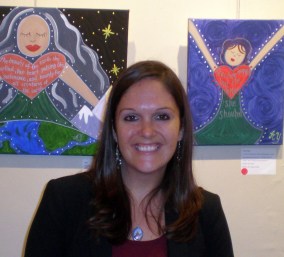
angelaEach month on Feminism and Religion, I feature a Holy Women Icon with a folk feminist twist. The painting is accompanied by an essay describing the holy woman’s life and the ways she stood for justice and peace, the ways in which she embodied feminism. Thus far, we have explored the stories of holy women that are well-known, perhaps not by the wider public, but by feminists seeking to uncover the forgotten truths of holy women throughout history. They are goddesses, saints, artists, dancers, scholars, clergy, and pillars of the faith: Virginia Woolf , the Shulamite, Mary Daly, Baby Suggs, Pachamama and Gaia, Frida Kahlo, Salome, Guadalupe and Mary, Fatima, Sojourner Truth, Saraswati, Jarena Lee, Isadora Duncan, Miriam, Lilith, Georgia O’Keeffe, Guanyin, Dorothy Day, Sappho, Jephthah’s daughter, Anna Julia Cooper, the Holy Woman Icon archetype, Maya Angelou, Martha Graham, Pauli Murray, La Negrita, Tiamat/tehom, and Mother Teresa, just to name a few.
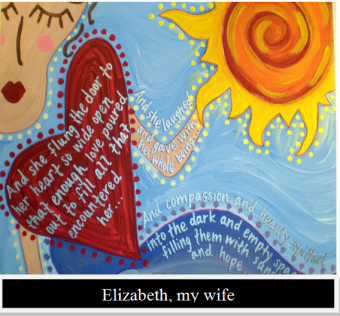
We tell their stories in our classrooms. Other artists paint them. Many have biographies or autobiographies recounting their lives. Their stories embolden us to stay strong, and continue working for justice and equality. But what of the women whose songs really are unsung, whose stories never grace the pages of our textbooks? What about the “unknown” women who have, indeed, emboldened us, paved the way for us to be who we are, but who most people have never heard of? Many such women are also holy, thus deserving of canonization as Holy Woman Icons.

ElizabethI would like to dedicate this post to all the holy women who fill our lives, yet whose stories we never hear. Because it is not only these seemingly famous women—these heroines of feminism—who are holy and whose stories matter.   Continue reading “Painting “Unknown” Holy Women: Commissions, Gifts, and the Unsung Stories of “Ordinary” Women by Angela Yarber”

Max Dashu: Feminist Scholar, Author, Historian, Artist by Jassy Watson

JassyI had the honour of hosting Max Dashu, Feminist Scholar, Historian and Artist here at Goddesses Studio this weekend past. Max is currently on her second Australian tour and we were blessed for her to come on quite the journey to present to an intimate group of Wide bay Goddesses, “Rebel Woman Shamans: Women Confront Empire” and “Deasophy: Goddess Wisdom” with a little “Female Iconography” thrown in.

Max’s knowledge and gift of story-telling is inspirational. “Rebel Woman Shamans: Woman Confront Empire” looked at holy women and female prophets who led many rebellions to resist conquest, slavery, and colonization. These women visionaries, priestesses, diviners and medicine women challenged systems of domination on multiple levels and drew on their cultural traditions to resist empire. It was their direct access to transformative power that these women had, that makes the spiritual political, as they act to lead, defend, and protect their peoples. Continue reading “Max Dashu: Feminist Scholar, Author, Historian, Artist by Jassy Watson”

Voting Day by Sara Frykenberg

Sara FrykenbergCan we think of the voting place as an altar where we hole-punch a prayer to the honored dead?

This past Sunday, Barbara Adinger wrote a beautiful blog entitled “November, a Silent Month?” While welcoming the November darkness and a “delicious melancholy composed of silence and rest” settling over her home, Adinger reminds us that: no, we are not silent.

As human beings protesting invisibility and the erasure of the history of the marginalized, we are not silent. Given special command(ment)s to be silent in far too many patriarchal and kyriarchal religions, we cannot silently accept the violence, abuse and invisibility forced upon us or upon those whose struggle is different than our own.

At times, silence is a survival strategy. But this year and last, I am striving to thrive instead.

At times, silence is an important place of meditation: a spiritual necessity, an oasis and praxis in the creation of peace. But, today, my meditations lead me to speak.

When first reading “a silent month,” in the title above, I thought to myself: “I hope not.” I am glad that Barbara agrees. Today—November 4th, aka, “voting day”—those of us living with the privilege of citizenship in the United States have a responsibility to speak. As a woman, I also have a responsibility to my feminist sisters and brothers who won me this right—an inheritance that has become increasingly important to me. Continue reading “Voting Day by Sara Frykenberg”

Thinking about Global Activism and Social Change, Personal Intentions and Spiritual Consciousness by Jameelah X. Medina

Jameelah MedinaThe events in this world begin with the individual. The world’s occupations trace back to the individuals who create them and those who ignore or support them. The world’s genocides trace back to the individuals who create them and those who ignore or support them. The world’s offensive wars trace back to those who create them and those who support them through action or inaction. Daring to exclude Divine Decree from this discussion, the events that take place in the world are due to the malice within mankind. This malice can be direct and intentional, or it may be malice by default due to the absence of benevolence. These atrocious events begin with the individual because unjust rulers, dictators, invaders, executioners and occupiers, only have the power to rule, dictate to, invade, execute and occupy because they have subordinates who give their obedience and acquiescence. We are those subordinates as a group and as individuals. The question is: Why do we obey and acquiesce?
The reasons for our obedience, acquiescence is in part due to political ignorance, fear and a sense of powerlessness, but also due to a lack of self-consciousness, soul-consciousness, a finely-tuned conscience, purpose, and intention.

Acquaintance with One’s Soul

The soul or spiritual heart of the individual determines either positive or negative, good or bad thoughts, action and chain reactions. Individual spiritual illness and disease is at the root of what we see occurring on this earth, from the rape of Mother Earth, who has sustained us in her womb with perfect balance since before our collective memory can recall, to the complete disregard for human life and its intrinsic value through legal, illegal and unchallenged annihilations and genocides under the guise of “national security,” “liberations” and “democracy,” and in the form of wars, prisons, miseducation, and unnatural natural disasters.  Because the root cause of these events is at the individual level, we are each and all accountable and responsible for correcting it. This correction begins with our intention. Continue reading “Thinking about Global Activism and Social Change, Personal Intentions and Spiritual Consciousness by Jameelah X. Medina”

In Memory of Margot Adler (1946-2014) Priestess, Journalist, Skeptic, Mystic by Elizabeth Cunningham

Elizabeth Cunningham headshot jpeg“Ritual has the power to end our alienation from the earth and from each other. It allows us to enter a world where we are at home with the trees and the stars and other beings, and even with the carefully hidden and protected parts of ourselves that we sometime contact in dreams or in art.” –Margot Adler
Margot Adler died of cancer on July 28, 2014. A Pagan priestess, she asked for memorial events to be held in the season of Samhain, also known as Halloween.  At this time of year, the rituals of many religious traditions remind us that we are all connected, the living, the dead, and those to come, one continuous communion.  In this spirit, I offer a tribute to the late Margot Adler.

Though I must have heard her distinctive voice on National Public Radio where she served as an innovative and eclectic journalist for thirty years, I encountered Margot Adler’s work more intimately by accident—or synchronicity—as countless others have.  I had recently found myself face to face with the goddess.  As if in answer to my question: “Who are you and what do you want from my life?” a hefty book literally fell off a shelf in a small-town bookstore: Margot Adler’s ovarian work Drawing Down the Moon: Witches, Druids, Goddess-Worshippers, and other Pagans. Writing as both observer and participant, Margot brought into fruitful union the spiritual seeker and the fact-finding reporter, the social activist and the ecstatic celebrant.  I had found a trustworthy guide for my own explorations. Continue reading “In Memory of Margot Adler (1946-2014) Priestess, Journalist, Skeptic, Mystic by Elizabeth Cunningham”

Thinking Out Loud About Protecting Our Borders and the Ebola Crisis by Kelly Brown Douglas

Rev.-Dr.-Kelly-Brown-DouglasJust as crises can reveal the strengths of our infrastructure, so too can they reveal the weaknesses.  At the same time, a crisis can disclose the enormity as well as the limitations of our humanity.  Even as the current Ebola crisis may have shown forth the strong points of the U.S. healthcare infrastructure, it clearly exposed some of its vulnerabilities.
The same can be said in relation to our humanity. From the time that Mr. Thomas Eric Duncan was diagnosed with the Ebola virus, cries to close “the borders” to those traveling from West Africa began. As two of Mr. Duncan’s caretakers contracted the virus, the cries to close “the borders” between the “United States” and West Africa became shrill.

The futility and impracticality of such a measure seems to make little difference to those who call for closed borders.  At stake, they say, is the health and wellbeing of our U.S. citizenry.  Even when marked by sincere concern, I find the call to close U.S. borders a troubling indication of the limitations of our humanity.   A story in the life of Jesus makes this plain.

In the social-religious context of Jesus’ day, there was a long history of conflict between Jews and Samaritans. Jews had constructed images of Samaritans as an indecent and ritually impure people. Samaritan women were considered the most impure of them all. Multiple narratives of power intersected on the bodies of Samaritan women—ethnic, gender, and cultural. Put simply, they represented at once an inferior “race,” gender and religion.  Thus, the social spaces of Jewish men and Samaritan women were to remain separate.  Jewish men in particular had to protect themselves from the contamination of Samaritan women.  Generally speaking, Samaritans were a feared and thus demonized people.

By most accounts, Jesus did not have to pass through Samaria on his journey from Judea to Galilee. This was considered a circuitous route.  It was also considered a dangerous route given the antagonism between Jews and Samaritans.  Again, Samaritans were considered dangerous enemies to the Jews, and most certainly ritually impure. However, Jesus crossed the borders into Samaritan space anyway. By going into Samaria, Jesus placed himself in the midst of those most feared, if not demonized, in the Jewish world.  He ignored all the prevailing animus directed toward the Samaritans and dismissed notions of them as an unclean and dangerous people. He flagrantly rejected the social-religious hysteria about Samaritans by going out of his way to enter their space.  He refused to let the “madness” of his times to blind him to the divine humanity of the Samaritans, or to overwhelm his own divine humanity.  He, therefore, crossed the constructed human borders to bring healing and salvation to the Samaritan woman. This story is of course only representative of a ministry that consistently crossed borders of fear and stereotypes to affirm the humanity of those who were lepers in Jesus’ day.  Simply put, Jesus’ compassion was no respecter of borders. Continue reading “Thinking Out Loud About Protecting Our Borders and the Ebola Crisis by Kelly Brown Douglas”

Casa Coatlicue by Erica Granados De La Rosa

Erica GDLR 2On a corner adjacent to a cantina, across the street from a home full of barefoot children running through open doorways, and a few houses down from a paleteria y fruteria in San Antonio, Texas, sits a bright white house dressed up in orange trimmings – Casa Coatlicue[1]. Before you walk through the gate you notice a raised bed of herbs, a garden, a large collection of potted succulents, and a metate[2] on the ground. Walking inside you can’t help but smell the sage, copal, and other herbs and incense that have left their smoky traces on the walls of the living room, the kitchen, and then the bedroom. As the house begins to introduce itself, you notice altars in corners and crevices of each room. Your curiosity begins to churn as you notice pictures and canvasses on the walls of ancient and present day cultural symbols, including one poster that reads “This land was Mexican once, and indigenous always,” and a large picture of Selena Quintanilla that captures her warm smile and beautiful black hair. As soon as you begin to take in the colors and ancient smells, the house is introduced to you by name, Casa Coatlicue, the home of four queer young healers, dreamers, lovers, artists, scholars, and spiritual activists who are reclaiming the life-giving traditions of their ancestors.
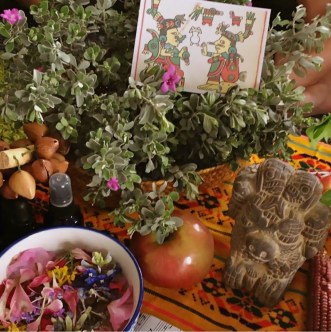
Community altar from  workshop
Community altar from workshop

Earlier this year, I was invited to a curanderismo workshop hosted at Casa Coatlicue. The word curanderismo had an air of secrecy, power, and nostalgia of home for me. I understood curanderismo as the medicine and magic of our grandmothers, and increasingly the forgotten inheritance of our communities. As I spoke with the residents of Casa Coatlicue, we began to identify the chronic erasure and appropriation of brown folks’ spiritual traditions, food, art, and customs by predominantly white, new age culture. Saddened by the loss and the historical disconnect of our people, we collectively affirmed the urgency and importance of relearning and reclaiming our own spiritual traditions not only to tap back into our cultural identity as native and mestizo people but also to tap into a powerful tool for the transformation of our current realities. In the midst of historic and present day manifestations of systemic violence against us – young brown bodies being gunned down in our streets, whole communities being persecuted, incarcerated, and displaced, as well as forced sterilization and assimilation- there is a critical need to tap into radical and sustainable ways to not only resist but to heal. Continue reading “Casa Coatlicue by Erica Granados De La Rosa”

Writing: Changing the World and Ourselves. By Ivy Helman

I still remember the first tim20140903_180423e I read Mary Daly’s Gyn/Ecology. It awoke something within me. Her use of language, the power of her writing and the ease with which she created new words taught me so much about the world around me and about the way the language, and subsequently its use in writing, shapes lives, choices, abilities and destinies. She also taught me about myself.

I was hooked, but not just on Mary Daly. Shortly after I finished her book, I moved onto other feminists writing about religion like Katie Cannon, Judith Plaskow, Alice Walker, Carol Christ, Rita Gross, Gloria Anzaldua, Audre Lorde, Adrienne Rich, Margaret Farley and Starhawk to name just a few. All of them, in fact every feminist I’ve ever read, has shown me the way in which words have power and how words speak truth to power. Ever since, I’ve wanted to be the kind of writer whose words carry a power that not only affects people but also inspires a more just, more equal, more compassionate and more humane world. In other words, I wanted to be a writer activist.

Yet, I’ve always carried around with me a sneaky suspicion that people don’t consider writers true activists. If you aren’t holding a sign, screaming or participating in some sort of public demonstration or civil disobedience, then you have no right to call yourself an activist. Is that really true? Continue reading “Writing: Changing the World and Ourselves. By Ivy Helman”

Right to Life vs Right to A Life: Abortion & The Death Penalty by Marie Cartier

MarieCartierforKCETa-thumb-300x448-72405Earlier this week I went to hear Sr. Helen Prejean speak about the death penalty. You will remember, if the name does not immediately ring a bell, that the amazing movie Dead Man Walking (dir. Tim Robbins, 1995) was about her and her ministry to provide solace and closure with God to those inmates on Death Row. In the film, Sr. Prejean was played by Susan Sarandon. Dead Man Walking, a phenomenal hit, chronicled her first attempt at this ministry—her trials and limited success—in helping Matthew Poncelet come to grips with what he had done, ask forgiveness of the victims’ parents (because he was complicit in the murder of two teenagers) and face his death with dignity.

dead man walkingIn addition to teaching Gender and Women’s Studies, I have also been the screenwriting professor at University of California Irvine since 1992. I have used the screenplay for this movie (adapted from Prejean’s book and direct interviews) almost since it was published. It’s a great example of how research, interview, and authenticity can make a movie work—rather than “making it up.” Even the title was new to most of America- “Dead man walking!” refers to the last walk an inmate makes as he (or she) walks to his (or her) death.

So, I was enthusiastic when I heard that Sr. Helen was speaking at a local church very close to my house. Although I’ve used the screenplay for well over a decade, I had never met her or read the actual memoir she wrote. It seemed the perfect opportunity to meet her and get a signed copy—and also something my students would love to hear about when we discuss the film in the winter. Continue reading “Right to Life vs Right to A Life: Abortion & The Death Penalty by Marie Cartier”