Who Sits at the Center of this Story? By Elise M. Edwards

Elise EdwardsHave you ever heard of the Vitruvian Man? It’s an image from 1490 inked by Leonardo da Vinci that came to symbolize the centrality of the individual in the Renaissance. It is quite clearly a depiction of a muscular, European male. His body is perfectly proportionate and thus simultaneously represents ideal humanity and a microcosm of the universe. The Vitruvian Man is so named after the ancient Roman architect Vitruvius who describes the proportions and symmetry of a temple as being analogous to the proportions of a man.

As an architect and scholar in the humanities, I’ve been acquainted with the Vitruvian Man for many years now. I even had a da Vinci theme on my PC’s Windows software about 15 years ago, meaning that the image of the Vitruvian Man appeared regularly on my desktop and screen saver. There was nothing problematic to me about his presence until a few days ago, when I took part in a discussion about teaching philosophies with some new friends and academic colleagues.

I was listening to Tamara Lewis, an assistant professor in religion whose research and teaching addresses the medieval and Renaissance periods. When she described a metaphor for her teaching philosophy, she discussed replacing the symbol of Vitruvian Man with the “woman at the well.” The woman at the well is a figure in Christian stories about Jesus and his teachings. Her narrative in the Bible is placed in chapter 4 of the Gospel according to John. Int eh story, Jesus encounters a Samaritan woman at a well. He asks her for a drink, which begins a meaningful exchange about spiritual teachings. Jesus’ male disciples and surprised to witness this exchange, presumably because she is a woman and a Samaritan, as the text tells us that Jews do not associate with Samaritans. The woman goes back to her town, tells people about her encounter with Jesus, whom she believes is the Messiah, which prompts many of them to come to him and also believe.

Dr. Lewis described how her presence in the historical study of medieval or Renaissance periods is sometimes questioned and how the woman at the well represents this presumed misplacement. Her metaphor caught my attention not just because of its profound coherence within her own career trajectory and narrative, but its coherence within mine. As a black feminist, religion scholar, and practicing Christian, I often wrestle with questions of belonging and being in or out of place.

This summer, I’m taking the time to think about broad questions and do some vision casting. This past December, Grace Kao wrote about using sabbatical time differently, and I’ve connected this to my own practice of Sabbath keeping as a ritual. I dedicate specific times to cease work.  I am engaging in some productive activity this summer, but I’m also honoring one of the truest blessings and privileges of full-time employment in my profession, which is break time to rest, reflect, and plan for the seasons ahead.  The metaphor of woman at the well who intentionally replaces the Vitruvian Man provokes these questions in my reflection:

Who is the default person around which the places we inhabit are constructed? Who sits at the center of our stories about the places we will go? 

As the little bio that follows my posts says, in my professional career I examine issues of civic engagement and how beliefs and commitments are expressed publicly through aesthetic and artistic practices. I’m currently writing a book-length project about theological ethics and architectural design. So these days I’m thinking a lot about the way public spaces and built environments communicate the values of those who build them and inhabit them. One of the questions I’m wrestling with is the way “common” spaces are defined by the narratives of only some people in the community. What does it mean to be literally “out of place”? What exists as a “safe space” in a public park for a man may not feel safe at all for me as a black woman. A public bench upon which I can rest in the middle of an afternoon jog may not be so uncontested for a homeless man at night.

As I think about my future, I have to ask who sits at the center of my story.   I’m approaching a milestone birthday, and I don’t want to fall victim to someone else’s vision of what a 40 year old woman should be. What does the story look like with me at the center? What happens when I replace an idealized image of perfection, vitality, and beauty with an imperfect but gloriously alive and wonderfully formed vision of who I already am?

As I plan for a new academic year, who do I imagine in my classes? As I engage students in discourse about the history of Christianity, the development of its theology, and the ethical issues of today’s world, who do I place at the center? As the US becomes enmeshed in presidential election politics and ongoing racial tensions, what image to we present as the archetypal American?

I’m so grateful that I was brought to see the woman at the well as a metaphor of intentional displacement. Even in a religion that places a male Savior (Jesus) at its center, there are women who sit with him. Although they confound some of Jesus’ other followers by their presence, they remain meaningful conversation partners and witnesses to their faith.

Elise M. Edwards, PhD is a Lecturer in Christian Ethics at Baylor University and a graduate of Claremont Graduate University. She is also a registered architect in the State of Florida. Her interdisciplinary work examines issues of civic engagement and how beliefs and commitments are expressed publicly. As a black feminist, she primarily focuses on cultural expressions by, for, and about women and marginalized communities. Follow her on twitter, google+ or academia.edu.

What’s Wrong with this Picture? by Elise M. Edwards

Elise EdwardsOn Monday, the picture was on my Facebook feed again: The picture of a girl lying face down in the grass under a police officer pressing his knee in her back. It was from the video of an African-American teenager being pinned to the ground by Eric Casebolt, the police officer in McKinney, Texas who was responding to calls about a pool party. When I saw the picture this time, it was in a screenshot with these words below it:

“Funny how a 14 year old bikini-clad black girl being publicly assaulted by an adult male does not accrue mainstream feminist outrage.” – Yohanna

The screenshot was taken of a post to Yohanna’s Twitter account (@maarnayeri). I don’t know her, but she troubled me.

If you haven’t seen the images we’re talking about, you can view the video here with a description of what is concurring or below from YouTube. I was reluctant to watch the video. It seems voyeuristic to view this young woman’s suffering and screaming. And, if I am honest with myself, it also seems useless. Viewing this from my computer screen, I’m in no position to help her. I hear her cries and it make me cry too. But I can’t push him off of her. When other teens tried to come to her defense, Casebolt pulled a gun on them and chased them. I don’t even have the power to get him fired from his position of authority immediately. No, we must have the investigations and inquiries and due process that seems so indiscriminately afforded to the privileged. Casebolt was put on administrative leave on Friday, and on Tuesday June 9, he resigned.

So how should I respond?

I had a conversation with one of my closest friends a couple days ago that provoked me to reflect on what to do when I’m conflicted about how to respond. Her background is in acting and theatre, and now she is a pastor and artistic director of a Christian church and arts initiative who believes in supporting arts, imagination and creativity. In our conversation about discerning the next steps in our lives, she was reminded of a book by Samuel Wells that proposes “theatrical improvisation as a model for Christian ethics.” That reminded me of books I’ve read that talk about musical improvisation or call-and-response as model for living, and some pieces I’ve written about that. Inspired by ethicists and theologians including Emilie M. Townes and H. Richard Niebuhr, I believe that to answer the question of how I should respond, I must first answer ‘What’s going on?” An improvised response or a fitting response is the response to what is already occurring. We must look at the situation critically to respond appropriately.

What’s going on in this video and the controversy surrounding it? I am certainly not an impartial or all-knowing observer, but here’s what I see:

  • A white man forcibly throws an unarmed, African-American teenager to the ground yelling “On your face!” We can see that she is unarmed because she is wearing a bikini.
  • The man is a police officer. He is upset that his authority is being challenged. Other officers are present and seem to be asking questions, but the violent one seems out of control and frantic, running around and yelling. He escalates the situation when he throws the girl to the sidewalk, which causes an outcry in the crowd.
  • As the video went viral, there were many protests and online statements against this violent event, but also statements of support for the officer. And sadly, I agree with Yohanna’s assessment. I may have missed it (and I hope I did), but I didn’t see a broad, mainstream feminist response against this violence.

I’m a feminist. I’m a black feminist. I’m a Christian feminist. I may not be a mainstream feminist (depending on your definition), but I’ll express my outrage anyway. It is sickening to watch his treatment of this teenage girl. This man’s mistreatment of a young black girl’s body is chilling. It is wrong and he should be held accountable for it.

I don’t think outrage is enough. But outrage does express that our moral sensibilities have been awakened and that we recognize that something profoundly wrong has occurred. In the face of comments that say she deserved this treatment, we as feminists must insist on the officer’s wrongdoing. “She had it coming.” “She incited him.” As feminists, we know that these kinds of statements are used in cases of rape and intimate partner violence to explain away violent actions and to shift the guilt from perpetrator to victim. The backlash against feminists and others who oppose these explanations argues that we ignore the victim’s responsibility or agency.

Bloggers and social media users know all too well the horrific statements that often appear in the comments section of online posts, videos, and articles. One comment I saw about the McKinney video says that the girl was “sassing back” at the police and that “if she wants to talk like adult then she’s going to be treated like an adult.” This kind of justification makes my blood boil! Sassing back is speaking up and saying something to an authority figure when you are expected to be silent.  While the term sassing back doesn’t exclusively apply to women and girls, it is nonetheless a phrase with gendered connotations. How many boys are called “sassy”? Is it that no one had the right to say anything to this officer running around yelling at black teen boys to sit on the ground, or is it that this black female should have kept quiet? Regardless, throwing an unarmed person to the sidewalk for supposedly saying something disrespectful is not justifiable behavior to adults or children.

I wish I knew more about what’s going on and how to respond to the violence I see in the world. I know these perennial questions subvert easy answers. I only have a partial response. I am responding with outrage and questioning and take this to my feminist community and into my spiritual practice. “What’s going on?” and “How should I respond?” are questions I ask God. I pray for justice. I pray for God’s presence in the outrage and in the investigations, and in the lives of those children who were violated.

Elise M. Edwards, PhD is a Lecturer in Christian Ethics at Baylor University and a graduate of Claremont Graduate University. She is also a registered architect in the State of Florida. Her interdisciplinary work examines issues of civic engagement and how beliefs and commitments are expressed publicly. As a black feminist, she primarily focuses on cultural expressions by, for, and about women and marginalized communities. Follow her on twitter, google+ or academia.edu.

The Religiosity of Silence by John Erickson

In a repetitive culture of abuse and silence, is it really shocking to find out that an individual who preached such hate and discontent for others actually perpetuated other forms of heinous abuse against others?

John Erickson, sports, coming out.In 2013, I wrote an article about the then latest reality TV scandal featuring A&E’s Duck Dynasty’s Phil Robertson and his rampant foot-in-mouth disease that caused him to express, in the pages of GQ, his true distaste for the LGBT community and specifically for the sexual proclivities of gay men.

Now, two years later in another reality TV show, TLC’s ’19 Kids and Counting’, it isn’t star Josh Duggar’s anti-LGBT statements getting him into trouble but rather his sexual assault and molestation of 5 girls, including two of his sisters. However, while the Internet explodes with attacks against Josh Duggar and his Quiverfull background, it is vital to remember that the silence that he and his family inflicted upon his victims since 2006 has not only been ongoing since then but is also being reemphasized today with each keystroke focusing on the assailant rather than the victims. Continue reading “The Religiosity of Silence by John Erickson”

Miley Cyrus and the Happy Hippie Foundation by Deanne Quarrie

Deanne Quarrie, D.Min.I almost got in a big fight with my son on Facebook yesterday. I posted a link to an article talking about the work that Miley Cyrus is doing for homeless teenagers. He immediately responded to my post by calling her a “skanky-ho.” Whoa!

I feel I need to do some qualifying here for a moment. I am not always a comfortable when I watch her performances. I am sure it is my age (73) and coming up in a far different time and mindset from what we have now. I feel a bit embarrassed watching some of her movements that have been labeled lewd by many and clearly so by my son on Facebook. I try very hard to not be judgmental or to place negative labels on anyone just because I may not always enjoy what they do. I do recognize that our perceptions are driven by our religious beliefs, our cultural backgrounds and our own inhibitions. I have to confess, I am even a bit jealous that she can be so open with her own sexuality in such a public way. I can tell you, however, I really like her voice and see her as an amazing performer! Continue reading “Miley Cyrus and the Happy Hippie Foundation by Deanne Quarrie”

Hildegard the Healer by Mary Sharratt

mary sharrattSaint Hildegard von Bingen (1098–1179) was not only a visionary Benedictine abbess, composer, and Powerfrau extraordinaire. She was also a physician and healer who developed her own highly original system of medical treatment and holistic dietary philosophy.
Saint Benedict of Nursia (480-543), the founder of her order, expressly forbade the study of medicine, which in his era derived solely from texts written by Pagans such as Hippocrates and Galen. Benedict believed that prayer alone must suffice in healing Christians.

But by Hildegard’s time, monasteries had become centers of healing that embraced the medical knowledge of both the Classical Pagan world and the pioneering work of Arab and Persian physicians. Nearly every monastic house had its own infirmary, hospice, apothecary, and medicinal garden. Hildegard would have had ample opportunity to train as a physician and apothecarer at Disibodenberg Monastery, a double monastery housing both monks and nuns, where she lived for most of the first half of her life.

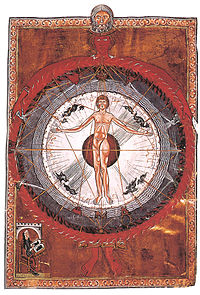
hildegard universal human 200px-Hildegard_von_Bingen_Liber_Divinorum_Operum
Illumination based on Hildegard’s vision of the human body as the microcosm within the sacred macrocosm.

Continue reading “Hildegard the Healer by Mary Sharratt”

Sappho’s Prescription For A Healthy Heart & the Taoist/Buddhist Concept of Forget (忘)

Stuart WordPress photoA two line fragment of Sappho’s poetry (S.120) reads:

But I am not one to keep venting my anger:
Rather I let some things in my heart go unspoken

Sappho’s word choices here make this as difficult as any of her fragments to appreciate in translation.  Yet, not only do those choices make attribution of this fragment to Sappho secure, they also manifest her importance in an area for which she rarely receives attention: early Greek medical thinking.  One reason her importance in that regard is largely unnoticed is that Western medicine in general has abandoned its own tradition, retaining only the nomenclature and some of the symbolism of early Greek medicine. Continue reading “Sappho’s Prescription For A Healthy Heart & the Taoist/Buddhist Concept of Forget (忘)”

Bodies of More and Less Value by Oxana Poberejnaia

oxanaThere is a story in the collection called Avadanasataka (One Hundred Legends) of the Sarvastivadin school, one of the schools of early Indian Buddhism that did not survive to present day, relating one episode from the Buddha’s previous lives. The story is about king Padmaka who sacrificed his life to cure his subjects of a disease. Here is an academic article about this episode.

The Buddha was prompted to tell this story of his previous life in order to illustrate to his monks, once again, the workings of karma. All of the monks in the Buddha’s milieu were sick with a digestive disorder, while he remained well. The Buddha presented the story of king Padmaka as a proof that no good deed is ever lost and that what he had done then has an effect now in that the Buddha has good digestion.

Continue reading “Bodies of More and Less Value by Oxana Poberejnaia”

Mother of All Buddhas by Oxana Poberejnaia

oxanaQueen Maya, the Mother of the Buddha of our age, who before his Enlightenment was known as Siddhartha Gautama, died shortly after his birth. So the future Buddha was raised by his aunt and stepmother. It is said that the womb of the Buddha’s Mother needed to remain unsullied by further pregnancies. This is similar to the belief that Mary Mother of Christ did not bear any more children after Jesus, which is held by some Christian traditions.

280px-Dream_Queen_Maya_BM_OA_1932.7-9.1In addition, the Buddha’s conception and birth were both miraculous, according to the legend and some Mahayana texts (such as the 44th chapter of the Gandavyuha Sutra). The Buddha was conceived when a white elephant entered Queen Maya’s right side, or, in the Sutra, light entered the Queen’s body. The Buddha was born from his Mother’s right side. The light was emanating from every pore of the body of the Bodhisattva Buddha, while he resided in the Tusita (joyous) heaven before descending to earth. This light reminds us of the golden rain form that Zeus took to reach Danaë in her cell to conceive Perseus, and links these two Indo-European patriarchal discourses. Continue reading “Mother of All Buddhas by Oxana Poberejnaia”

Islamic Feminism, Body Autonomy and Spiritual Liberation by Vanessa Rivera de la Fuente

Vanessa Rivera de la Fuente. Women and Body AutonomyWomen’s bodies are the preferred territory in which religious oppression becomes cruelly evident. Misogynist narratives in religions are always addressed to them: decency, honor, virtue, holiness, discretion, and shame are embodied in us, We pay for the absence of these patriarchal principles of control, on our bodies too: imprisonment, slut-shamming, bullying, rape, punishment, mutilation, and death.

Feminism makes sense in this world because women allow their struggles to push the boundaries that have been imposed on us by patriarchy, on our minds, spirits and bodies. The right to decide issues concerning our bodies is not only linked to reproductive rights and planning parenthood, but also to the experience of sexuality on the terms we freely decide and the way we interact with our body and relate to it. Freeing women from the traditions’ narratives of oppression accumulated over hundreds of years and designed to indoctrinate a hatred against our bodies is one of the purposes of feminism, including the work of feminists inside those religious traditions. If I have no right to my body, then I have no right to anything. A God who considers me free and worthy, but allows others to decide how I should embody that worth and that freedom is not a God of justice and equality at all.

Continue reading “Islamic Feminism, Body Autonomy and Spiritual Liberation by Vanessa Rivera de la Fuente”

Body through Buddhist Lens by Oxana Poberejnaia

oxana

One of my concerns with the philosophy of contemporary women’s spirituality movement is what I see as uncritical adoption of views about body from patriarchal culture.

I feel that often the seemingly “new” and radical ideas about women’s bodies that originate from contemporary Sacred Feminine movement are simply reversals and counter statements to dominant patriarchal notions.

menstruationTent I myself have been working with my menstrual cycle. However, I also can say that this is one of the classic examples of a “reversal”. While patriarchy says that menstruation is something hidden, dirty and corrupt, the new view is that menstruation is something worthy of open discussion, sacred and a source of spiritual power.

Continue reading “Body through Buddhist Lens by Oxana Poberejnaia”