The word liminal comes from the Latin word limen, meaning “a threshold.” The word threshold has several definitions. It can be the sill of a doorway or the entrance of a building. Ultimately, it means any place of point of entering or beginning. In psychology the term limen means the point at which a stimulus is of sufficient intensity to begin to produce an effect.
Liminal time therefore, is that moment when something changes from one state to another. Examples would be dawn, the morning sun rising high enough in the sky to bring daylight. Another is dusk, the evening sun sinking into the horizon bringing nightfall. Continue reading “Liminal Time and Space by Deanne Quarrie”
There are standard depictions of Jesus that show a Caucasian male with blue eyes (some pictures have the occasional brown eyes), shoulder length brown hair, and usually wearing a tunic with sandals. Jesus’ demeanor is usually victorious, prayerful, inviting, and even reflects humility. Our culture creates an unrealistic depiction of Jesus so that in the United States (at least), we see a savior as a white male representative of the power structures that permeate every facet of life.
There are some variations of this image. The most common is this same image with dark skin. A depiction that makes Jesus more tangible to people of color. If we can accept this variation of Jesus, then why would we be upset when images become more culturally tangible, send a message that encapsulates Jesus’ ministry, or make us stop and think – challenging us to take our rose colored glasses off. When an artist creates an image of Jesus that is different than the standard described above, controversy occurs at varying levels. The artwork is removed or de-commissioned, protests occur, and in extreme cases, the artist will even receive death threats. Here is a small sampling of images:
In my last post, “Feminism and Religion: Where Do I stand?” I talked about how I support an atheistic, secular, and liberal feminism that criticizes organized religion and certain religious beliefs. After reading the comments and responding to them, I figured that having a brief interview with a woman who holds these sorts of views would be a good way to introduce them to this blog. I met Anondah Saide at a course at Claremont Graduate University titled, “Evolution, Economics, and the Brain,” taught by the Executive Director of the Skeptics Society and Founding Publisher of Skeptic Magazine, Dr. Michael Shermer. Anondah was the TA for the course, and I found her comments in class to promote science, reason, and skepticism towards religious and spiritual claims of all kinds. So without further ado, here is the interview: Continue reading “A Pro-Science, Skeptical Woman Speaks by Kile Jones”
Carol Christ’s post yesterday has gotten me thinking about the differences between Christianity and earth-based spiritualities. Of course, there are many differences, that goes without saying. However, being someone who comfortably stands at the intersection of them both I am usually more aware of the ways in which they seem to intersect in life-changing and inspiring ways for me. Nonetheless, Carol has me thinking…
Over the course of the last year here on Feminism and Religion, Carol has written a lot about the importance of ancestors – how when speaking about embodiment and interdependence it is crucial we acknowledge all the ways in which ancestors make us who we are. Mothers literally give us our bodies and our ancestors’ genes, connecting us to a long line of people both materially/biologically as well as historically. Ancestors give us a sense of connection to places and ground us to lands that were meaningful to them and thus become meaningful to us. And Carol also reminds us that our family and ancestors transmit to us memories that impact us psychically and in powerful ways. These emphases on connection, interdependence, rootedness, and embodiment flow from her earth-based Goddess practice and thealogy. Her spirituality leads her to a greater sense of appreciation and gratitude for the Source of Life and for all the sources of life, and she affirms that because of this deep awareness of interdependence and relationality people who practice earth-based spiritualities are “moved to share what has been given to [them] with others.” Continue reading “Blessed By Gratitude and Sharing by Xochitl Alvizo”
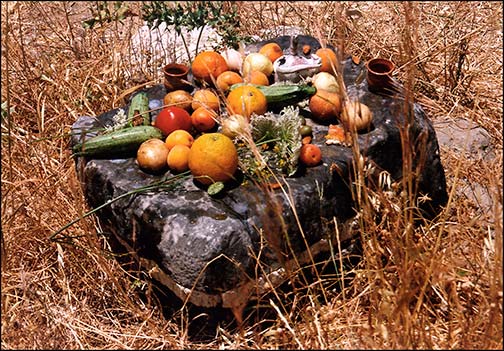
When I first began to lead Goddess Pilgrimages in Crete, I was inspired by a line in Homer to begin a pilgrimage tradition of pouring libations of milk, honey, water, and wine on ancient stones. At first I knew the form, but not its deeper meaning. It gradually dawned on me as I thought about the large number of pouring vessels in the museums, the altar stones, and the Procession Fresco from Knossos, that an important part of Minoan rituals involved processions in which people offered first fruits back to the Mother whose body had produced them, and poured libations on altars.