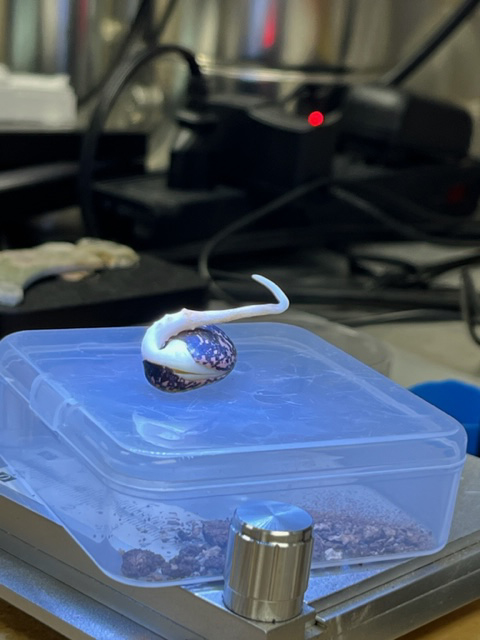
Seeds of Promise, by Molly Remer

Imbolc brings an invitation into change,
to step into the forge of transformation,
to sink into the holy well of healing,
to open ourselves up to an evolving path
of growth and discovery.
It is now that we remember
we are our own seeds of promise
and while there is time yet
to stay in the waiting place
biding our time
and strengthening our resources
so we have what we need to grow,
soon we will feel the wheel
urging us onward,
the call to set forth
becoming unmistakable and strong.
Let us settle ourselves into center,
nestle into trust and determination,
and extend outward from here
feeling the sweet wind caress us
and the fiery forge beckon us
as we heed the summons to roll on,
the path opening up before us as we move.

Continue reading “Seeds of Promise, by Molly Remer”

A Womanist’s Perspective by Sara Wright

Last night I was listening to plant scientist Monica Gagliano who is pushing the boundaries of what we know about plants. She proved that plants respond to the sound of water by moving toward it and cannot be tricked. Bio-acoustics is the study of sound and Monica is researching other ways that plants communicate. We know they use chemical messengers to warn each other above ground and below through the mycelial network thanks to the work of Suzanne Simard who I shall discuss in a moment. We have learned that plants emit electrical impulses. But Monica is studying another way that plants communicate. She says they listen to all the plants around them and learn from each other so that they do not have to re-invent the wheel with each generation. In one amazing memory experiment mimosa plants taught her that plants remember what happened to them previously and don’t repeat their mistakes. The Mind of Plants was her first book. She also studied with Indigenous healers in the Amazon and discusses this mysterious and compelling journey in her latest book Thus Spoke the Plants.

Continue reading “A Womanist’s Perspective by Sara Wright”

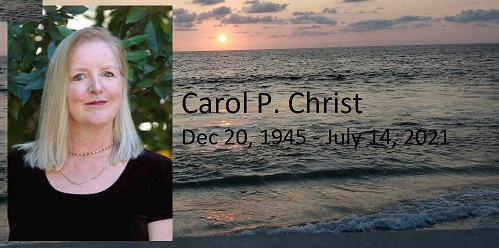
Legacy of Carol P. Christ: Mountain Mother, I Hear You Calling

This was originally posted on July 7, 2014

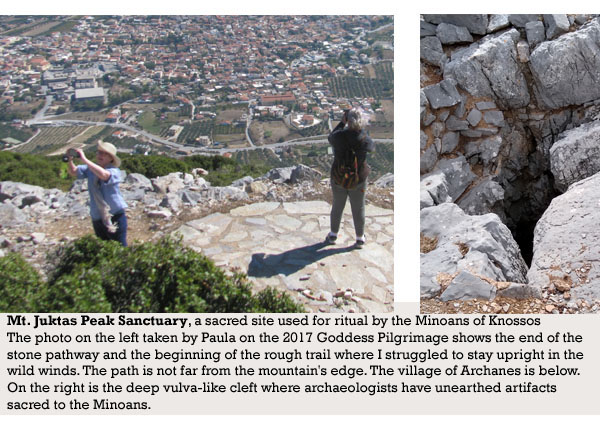
The mountaintop shrines of Mount Juctas in Archanes, Crete are situated on twin peaks, which may have symbolized breasts. Ancient shrines on the northern peak date from 2200 BCE until at least the end of the Ariadnian (Minoan) period in 1450 BCE. A crevice in the rock was filled with offerings of pottery, clay images of women and men in ritual dress, diseased bodies and body parts, sheep and cattle, and other objects. Excavations to a depth of 13 meters did not reach the bottom layers. Many offerings had been burned, suggesting that the objects were first thrown into fire and then dropped into the crevice. People who climbed the mountain for the festivals would have spilled over both peaks and there may have been shrines as well as fires on both of them.

Continue reading “Legacy of Carol P. Christ: Mountain Mother, I Hear You Calling”

From the Archives: “The Importance of Religion for Ecofeminism,” by Ivy Helman.

Author’s note: Originally published on January 8, 2017, this post still speaks to me 6 years-to-the-day later. Now, when I teach ecofeminism, I dedicate a week to religion as we cannot deny the way in which Western patriarchy and religion have coexisted and often fed off each other. The only distinction I would add to this original post is that not all religions are equal when it comes to patriarchy and its misdeeds. Christianity has had more power and influence than others. However, Christianity is not the only religion to hold patriarchal views. That needs to change. May the New Year bring more of that needed change.

“Why is religion important to ecofeminism?” A student, in the Master’s course I teach at Charles University, asked this as we began the class session dedicated to the topic. Given the overwhelming presence of atheism in the Czech Republic, I wasn’t too surprised by the inquiry.  Nonetheless, the idea has been at the back of my mind ever since: what does religion have to do with ending patriarchy and bolstering the health of the planet? While I may take the connection as obvious, it is clearly not for many feminists out there. Here is how I understand it.

Continue reading “From the Archives: “The Importance of Religion for Ecofeminism,” by Ivy Helman.”

Saying Goodbye (Refuge), Part 2 by Sara Wright

Part 1 was posted last week. You can read it here.

When I first came to this area 40 years ago I was ‘called’ to land about 15 minutes from here. That first summer I was out in the field picking blueberries when the field rose up around me and held me like a mother. For the first time in my life I felt loved. Shortly afterwards I visited an area that had been brutally logged. I had never seen anything like this and just the scent of weeping pines sickened me. That night I had a dream: the terrifying picture of dying trees and slash and then superimposed over it the image of my beautiful land. When I awakened I thought that the dream was telling me that loving my land was somehow helping the ravaged forest I had seen the day before.

 Soon after this experience frightening tree dreams began… whole forests were being slaughtered all around me. The waters were receding in my brook and destructive uncaring neighbors moved in. Two were already living here.

Continue reading “Saying Goodbye (Refuge), Part 2 by Sara Wright”

Ode to Seeds by Janet Maika’i Rudolph

“In this is all that is.” 

Julian of Norwich (while purportedly holding a seed in her hand) – 14th century

“Even if I knew that the world would end tomorrow,

I would plant an apple tree today.”

Martin Luther

Have you ever had bedbugs or lice? If not, you’re lucky. If so, you understand just how hard they are to get rid of. Why is that? Because they are essentially seeds with legs.

Seeds need to be able to travel in order to be successful spreaders of life. For example, when an acorn falls from an oak tree, it probably can’t germinate right where it falls. The mama tree has already taken up all the earth/soil space as well as the water sources for its own roots. And the mama tree’s own leafy branches will block out access to the sun. So the innate goal of the seed is to move to find a more friendly space. Evolution has created all sorts of ways for seeds to use motion in the service of finding their own place to germinate. In the case of the acorn, there are squirrels. Because they are a food source, many of the acorns get taken to dens under the earth. Many of those are not eaten. Either they are forgotten or the squirrel in question meets another demise. An acorn that is nestled in a den under the earth, can have a potentially perfect environment to sprout far from its origins.

Continue reading “Ode to Seeds by Janet Maika’i Rudolph”

The Legacy of Carol P. Christ: Meeting the Windigo

Towards the end of Braiding Sweetgrass, mother, biologist, and member of the Citizen Potawami Nation Robin Wall Kimmerer sets out at the end of winter to visit a forest area near her home that she considers hers not in name but in virtue of her love and care for it. On arriving, she discovers that the forest is no more, having been clear-cut by the owner. The wildflowers and the plants she has harvested over the years have sprouted up, but Kimmerer knows that without the forest cover they will be burned by the sun and their places taken by brambles.

Kimmerer is overcome by anger and despair, her feelings for the land she loves merging with her knowledge that not only her forest, but the earth itself is being treated as nothing more than a product by so many—without second thought for all that is lost.

Continue reading “The Legacy of Carol P. Christ: Meeting the Windigo”

When Earth Meets the Son by Sara Wright

As I curl up

in my hatchback

open to sky

I am a snail

loving her shell
sun warms

me from behind
Autumn light
shimmers, leaves
a testament
to breeze

 some withered

by a freeze.
Burnt umber
Gold
Salmon
the understory
in full glory
Bare hardwoods 

peer down

 sentries stationed
Overhead
Acorn browned oak 
leaves smudge

 sage greens

dark crimson

bleeds
geese fly by

haunting goodbye
A dragonfly lands
on my foot
Not a grouse 
in sight
Hunted
in thickets
too thorny
for stealth
She’ll
live to see
another dawning
Scarlet pockmarked palms
lie face up

on the ground.

Warning.

 Signs are everywhere.
Insect ridden leaves –
puncture marks
deform once

smooth hands
some shriveled

beyond recognition.

Continue reading “When Earth Meets the Son by Sara Wright”

The Mixed Bag that is Toldot by Ivy Helman.

The parshah for November 26th is Toldot, Genesis 25:19-28:9.  In it, we have the struggles of Isaac and Rebecca to conceive, the relations between Abimelech and Isaac’s family, the birth of Esau and Jacob, and the loss of Esau’s birthright and his father’s blessing.  As we will see, this is a tricky portion from a feminist perspective because of Rebecca, yet, from an ecofeminist perspective, I find the way in which the portion discusses the interconnection between the water, the land, and divinity helpful.

Let me begin with the water and then we will look at Rebecca.  Toldot takes place in and around the city of Gerar in Philistine territory, while Abimelech ruled.  Isaac and his family travel through the land quite a bit between verses 26:16 and 26:32.  Most of this section pertains to them moving and then digging new wells, the covering of wells, and the finding of water.  What I find particularly interesting here is the way in which water and peace seem to go together.  For example, in 26:20-21, Isaac and his family have constructed a well but it is causing them to have troubles with the locals.  Isaac seeks peace and thus leaves.  In verse 26:26, Isaac is visited by Abimelech and eventually a formal peace is declared.  This is followed in 26:32 by Isaac’s servants finding water in a freshly dug well.  In other words, Isaac is willing to uproot his family time and again to cultivate peace; he is not willing to go to war over what in the desert really is a quite limited resource.  

Continue reading “The Mixed Bag that is Toldot by Ivy Helman.”

Legacy of Carol P. Christ: Tree-Hugging Is About Trees and So Much More Than Trees

This was originally posted March 11, 2019

Not too long ago I heard someone deride members of a seminar who were building labyrinths in the olive groves of Greece as “a bunch of tree-huggers.”  I bristled! I probably first heard of the Chipko tree-hugging movement which is led by women in the 1970s and 1980s. Because I love nature, I naturally assumed hugging trees is a good thing. Originally, I had no idea that the tree-hugging movement was about much more than saving trees from being felled in the interests of short-term profit.

I did not know that the deeper purpose of the movement is to save a way of life based on forest-culture that is being threatened by the imposition of western ideas and practices promoted by colonialism and its successor, the green revolution. Nor did I know that the traditional forest-culture of India is the provenance of women: more than 4000 years of observing and experimenting created a “women’s knowledge” passed down from mother to daughter.

Continue reading “Legacy of Carol P. Christ: Tree-Hugging Is About Trees and So Much More Than Trees”