Can Good Theology Change the World? Part 3: Embodied Theology by Carol P. Christ

carol p. christ photo michael bakasIn an earlier blog I asserted that one of the hallmarks of good theology is understanding that the only valid source of authority is to be found in individuals and communities that continually interpret and reinterpret texts and traditions in new situations.

For most of its two thousand year history, Christian theology was understood to involve rational reflection on revealed truths. It was assumed that revealed truths found in the Bible, the decisions of church councils, and church traditions are a fixed set of facts (such as the death and resurrection of Jesus Christ) and doctrines (such as the Trinity) that are eternally true. It was further thought that the theologian is able to rise above his body and history in order to contemplate these eternal truths. Thus, it was said, theology considers eternal truths from an objective and essentially unchanging vantage point.

For the past several hundred years, theologians have begun to realize that both of these traditional assertions are false. There is increasing recognition that the Bible can no longer be understood as having been dictated by God. Instead, revelation (if it exists at) comes through the minds and bodies and experiences and histories of those who write the sacred texts and doctrinal statements. Revelation can only be expressed in the language or languages known to the individual or group who receive it, and experiences and ideas will inevitably be conveyed using symbols and metaphors taken from a wider cultures.

As “the process of interpretation” is acknowledged, it is also understood that theologians can never reflect on eternal truths in any simple way. They must consider the circumstances in which facts and doctrines are received and written down. Some seek to remove the wheat from the chaff, hoping to discover a kernel of eternal truth encased in language and symbols that are relative. Thus, for example, it has become commonplace for liberal theologians to say that the kernel of truth in Genesis 1 is that God created the world, while the story that He created it in 6 days is not literally true.

While non-fundamentalist theologians generally understand that the process of interpretation of revealed truths is complex, they have been less eager to turn a critical eye on the standpoints from which they carry out the process of interpretation themselves. Many theologians recognize the relativity of all standpoints in principle, yet do not hesitate to assert that they have found “the true” meaning of a particular text or tradition. Rosemary Radford Ruether believes that her reading of the Bible from a liberation perspective is more true to the original meaning of the texts than alternative readings. Elizabeth Schussler Fiorenza, in contrast, always qualifies her readings, stating that what she asserts about the early Jesus tradition is true from the perspective of “wo/men seeking liberation.”

Schussler Fiorenza’s position is rooted in “standpoint theory,” which argues that every interpretation of a text or tradition is influenced by the standpoint of the interpreter. Taking standpoint theory seriously means that we cannot make statements like “the message of Jesus was concern for the poor” without adding that this interpretation is made “from a liberation perspective.” This qualification makes a lot of people—and not only fundamentalists—uncomfortable, because it means that all so-called “truths” are in fact relative to those who assert them.

It is not surprising that those whose voices are relatively new to the theological conversation are more likely to acknowledge their standpoints than those writing from traditional white male European perspectives. Many white male theologians continue to believe that they are writing “theology,” while theologians of color and female theologians of all colors are writing from particular perspectives. When theologies are acknowledged to be perspectival, more often than not, the perspective is a general one, such as “black,” “Asian,” “African,” “feminist,”  “womanist,” or “queer.” But even standpoint thinking can fail to be inclusive. A ground-breaking book on black women’s studies pointed out that All of the Women Are White, All of the Blacks Are Men, But Some of Us Are Brave. By the same token, some have wondered why all of the feminist theologians (who are invited to contribute to books and conferences) are Christian. And so on.

In our new book Goddess and God in the World, Judith Plaskow and I reconsider the question of standpoint in theology. We have been engaged in a theological argument about the nature of divinity that we could not resolve through rational argument for a number of years. We have discussed the general differences in our standpoints as reasons for our differences. Both of our theologies are “feminist” and both of us are “white.” As white and feminist, our theologies have certain commonalities, yet they also diverge.

My view that divinity is a loving and personal but not omnipotent is based in Goddess Spirituality, yet it is virtually identical with the views of Christian process theologians such as John Cobb and Monica Coleman and Jewish process theologians like Bradley Shavit Artson. Judith’s view that divinity is an impersonal creative power that is the ground of both good and evil is as likely to be shared with Neo-Pagans as with other Jews. Thus, we found that it would not do simply to further locate Judith’s position as “Jewish feminist” and mine as “Goddess feminist.”

We discovered that the ways in which our theological viewpoints are rooted in our experiences cannot be explained through a simple application of standpoint theory. Thus, we took the radical step of combining autobiography and theology in our new book, Goddess and God in the Worldexemplifying a new method we call “embodied theology.” Embodied theology is rooted in personal experiences in our individual bodies. At the same time, we all live in a relational world, shaped by social and historical events and forces that are shared. The relationship between theologies and experiences is embedded in complex webs, with the precise factors that lead to the differences in view being impossible to untangle from the whole.

Still, we found that theological views can be judged by criteria that are in the broadest sense rational and moral: do they make sense of the world we share; and do they promote the flourishing of the world? Though different experiences may lead to different views of divinity, we can enter into conversation with each other about them, based on criteria that are shared. In the process of debating our views, Judith and I concluded that both of our views make sense of the world we share (though we each remain committed to our own view) and that both promote the flourishing of the world. At the same time we agree that other views such as the notion that divinity is exclusively male, or omnipotent and totally transcendent of the world, not only make less sense of our shared experience, but also hinder and obstruct the flourishing of the world.

At the end of our book, we invite others to join with us in a fully embodied theological dialogue that heretofore has been unimaginable, unthinkable, unspeakable. In an embodied theological discussion, we will be able to identify relatively more and less adequate theologies, but we will not be able to prove the truth of particular views.
Also see: Part 1 and Part 2.

This is discussed further in the newly published Goddess and God in the World: Conversations in Embodied Theology by Carol P. Christ and Judith Plaskow–order now. Ask for a review copy (for blog or print) or exam or desk copy. Please post a review on Amazon.  Share with your friends on social media using the links below.

Listen to Judith and Carol’s first interview on the book on Northern Spirit Radio.

Carol P. Christ leads the Goddess Pilgrimage to Crete. Space is available on the fall tour October 1-15. Join now and save $150. With Judith Plaskow, she is co-editor of Womanspirit Rising and Weaving the Visions. Carol wrote the first Goddess feminist theology, Rebirth of the Goddess and the process feminist theology, She Who Changes.


 

Digging My Well by Joyce Zonana

James River
The James River

I write this from the heart of a ten-day silent yoga retreat deep in central Virginia.  The peace within and without fills me as I gaze over the James River, meandering through its wide valley, thickly carpeted in green.  The late summer thrum of cicadas rises and falls around me, and in the far distance I hear what sounds like a mower circling a field.  Earlier today, during meditation, I watched a pileated woodpecker pry its meal from the hollow of an ancient oak.  Rather than silently repeating my mantra with eyes closed, I had my eyes open, and I experienced the sacred vibration in the bird’s rhythmic taps.

440px-PileatedWoodpeckerFeedingonTree
Pileated Woodpecker

Now a soft breeze touches my face, bringing with it the sweet scent of wet grass.   “There is a blessing in this gentle breeze,” I remember the opening of William Wordsworth’s Prelude, and I am reminded as well  of Elizabeth Barrett Browning’s heroine Aurora Leigh, celebrating “the body of our body, the green earth.”  Yes.  This earth is my body, and I am blessed to be in it, here, at the ashram of my guru, Swami Satchidananda, silently  practicing hatha yoga, meditating, breathing, simply being.

Continue reading “Digging My Well by Joyce Zonana”

Can Good Theology Change the World? Part 2 by Carol P. Christ

Carol P. Christ by Michael Bakas high resoultionIn the first blog in this series, I argued that one of the hallmarks of a good theology is recognizing that the source of authority must be located in individuals and communities who interpret texts and traditions as they encounter divinity anew in the present. In our new book Goddess and God World, Judith Plaskow and I suggest that a second hallmark of good theology is the “turn to the world.” What we mean by this is not only that divinity is immanent in the world, but also that the purpose of human life is to be found in this world—not the next.

The God of traditional theologies is pictured as an old man with a long white beard who rules the world from heaven. It is commonly assumed by those familiar with this picture that the purpose and meaning of human life is not to be found in this world—but rather in heaven. This assumption is increasingly being challenged. Many people no longer believe in life after death. The purpose of morality is increasingly being understood as improving the conditions for the flourishing of human and other forms of life—not on gaining the approval of a God who has the power to assign individuals to heaven or hell in the next world. Continue reading “Can Good Theology Change the World? Part 2 by Carol P. Christ”

Priestess as Shamanic Path – Part 2 by Molly Remer

This is a continuation of Molly’s piece from Wednesday, 10 August 2016. You can read Part 1 here.

After explaining that the homebirth of her second son was her, “first initiation into the Goddess…even though at that time I didn’t consciously know of Her,” Monica Sjoo writing in an anthology of priestess essays called Voices of the 567bGoddess, explains:

The Birthing Woman is the original shaman. She brings the ancestral spirit being into this realm while risking her life doing so. No wonder that the most ancient temples were the sacred birth places and that the priestesses of the Mother were also midwives, healers, astrologers and guides to the souls of the dying. Women bridge the borderline realms between life and death and in the past have therefore always been the oracles, sibyls, mediums and wise women…

…the power of original creation thinking is connected to the power of mothering. Motherhood is ritually powerful and of great spiritual and occult competence because bearing, like bleeding, is a transformative magical act. It is the power of ritual magic, the power of thought or mind, that gives rise to biological organisms as well as to social organizations, cultures and transformations of all kinds… (page unknown).

I have been a childbirth educator since 2006 and I have given birth five times. Each birth brought me the gift of a profound sense of my own inherent worth and value. It was the shamanic journey through the death-birth of my tiny third child, however, that ushered in a new sense of my own spirituality and that involved a profound almost near-death experience for me. After passing through this intense, initiatory crisis, the direction and focus of my life and work changed and deepened. Shortly after the death-birth of my third son, I wrote: Continue reading “Priestess as Shamanic Path – Part 2 by Molly Remer”

Priestess as Shamanic Path – Part 1 by Molly Remer

It is late autumn, 2009. I am 30 years old and pregnant with my third baby. He dies during the early Mollyblessingway 045part of my second trimester and I give birth to him in my bathroom, on my own with only my husband as witness. The blood comes, welling up over my fingers and spilling from my body in clots the size of grapefruits. I feel myself losing consciousness and am unable to distinguish whether I am fainting or dying. As my mom drives me to the emergency room, I lie on the back seat, humming: “Woman am I. spirit am I. I am the infinite within my soul. I have no beginning and I have no end. All this I am,” so that my husband and mother will know I am still alive.

I do not die.

This crisis in my life and the complicated and dark walk through grief is a spiritual catalyst for me. A turning point in my understanding of myself, my purpose, my identity, and my spirituality.

It is my 31st birthday. May 3rd. My baby’s due date. I go to the labyrinth in my front yard alone and walk through my labor with him, remembering, releasing, letting go of the stored up body memory of his pregnancy. I am not pregnant with him anymore. I have given birth. This pregnancy is over. I walk the labyrinth singing and when I emerge, I make a formal pledge, a dedication of service and commitment to the Goddess. I do not yet identify myself verbally as a priestess, but this is where the vow of my heart begins.

I do not know at the time, but less than two weeks later, I discover I am in fact pregnant with my daughter, my precious treasure of a rainbow baby girl who is born into my own hands on my living room floor the next winter. As I greet her, I cry, “you’re alive! You’re alive! There’s nothing wrong with me!” and feel a wild, sweet relief and painful joy like I have never experienced before.

Continue reading “Priestess as Shamanic Path – Part 1 by Molly Remer”

Embodied Theology: Goddess and God in the World by Carol P. Christ and Judith Plaskow

Goddess and God in the World final cover designToday is the official release date for Goddess and God in the World: Conversations in Embodied Theology. It just so happens that August 1 is also a day for celebrating the harvest. An excerpt from the Introduction introduces the embodied theological method” we hope will turn the field of theology upside down.

People who reject the popular image of God as an old white man who rules the world from outside it often find themselves at a loss for words when they try to articulate new meanings and images of divinity. Speaking about God or Goddess is no as longer simple as it once was. Given the variety of spiritual paths and practices people follow today, theological discussions do not always begin with shared assumptions about the nature of ultimate reality. In the United States, the intrusion of religion into politics has led many people to avoid the subject of religion altogether. In families and among friends, discussions of religion often culminate in judgment, anger, or tears. Sometimes the conversation is halted before it even begins when someone voices the opinion that anyone who is interested in religion or spirituality is naïve, unthinking, or backward—or, alternatively, that religious views are a matter of personal preference and not worth discussing at all.

Talking about divinity is also surprisingly intimate. Continue reading “Embodied Theology: Goddess and God in the World by Carol P. Christ and Judith Plaskow”

The Emergence of Feminist Theology: Remembering our Roots by Judith Plaskow and Carol P. Christ

Goddess and God in the World final cover designThis blog is an excerpt from our new book Goddess and God in the World which will be published by Fortress Press in just one week — on August 1. As we look forward to its release, we remember the critical works that started us on a journey of discovery that continues to unfold. In a jointly written chapter, we describe the beginnings of feminist theology.

Feminism was welling up from under during [the late 1960s]. We became feminists early in graduate school but did not discover feminist theology until we were preparing for our comprehensive exams. As Judith was later to write, feminism placed a question mark over absolutely everything for us: the maleness of God, the male authorship of the Bible, and the male perspectives from which virtually all theologies had been written. Three key essays set the stage for future work in the field, including our own. We have already mentioned these essays, but it is important to address the challenges they posed to traditional theology, and our own responses to them, in more detail here. Continue reading “The Emergence of Feminist Theology: Remembering our Roots by Judith Plaskow and Carol P. Christ”

What My Mothers and Mentors Taught Me about Self-Care by Elise M. Edwards

Elise EdwardsDuring another week of killings, war, protests, and debates about whether Black Lives Matter or Blue Lives Matter, I’m concerned about the toll it takes on those who are witnessing the violence and fighting for justice.

I’m not on the front lines of these battles, but I can feel my energy draining, nonetheless. Over the past few days, while I’ve stayed informed about the latest tragedies and conflicts, I’ve intentionally limited my exposure to most news and social media outlets. I’ve begun preparing for a contemplative retreat with other women who also care about justice.  For me to continue to participate in any effort of transforming society, culture, or the church, I must nurture my mind, spirit, and body.

Audre Lorde put it like this:

“Caring for myself Is not self-indulgence.  It is self-preservation, and that is an act of political warfare.”

Self-care is a radical practice of self-love. It is absolutely necessary when engaged in conflict against those who do not show love to you, or worse, those who seek to destroy you.  Your survival and your flourishing are defiantly brave.  Self-care honors the God who created you, the One who loves you, and the Spirit who sustains you. Continue reading “What My Mothers and Mentors Taught Me about Self-Care by Elise M. Edwards”

Our Ladies of Sea, Earth, and Sky by Joyce Zonana

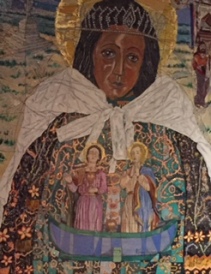
Sara and the Marys
Sainte Sara encompassing Sainte Marie-Salome and Sainte Marie-Jacobe

O Sainte Marie-Jacobe, priez pour nous.

O Sainte Marie-Salome, priez pour nous.

O gardeures de la Provence, priez pour nous.

The priest intoned the words in deep, liquid accents, his voice echoing from the ancient stone church in the remote village of Les Saintes-Maries-de-la-Mer, in the Camargue region of Southern France, where the waters of the Rhone River meet the Mediterranean Sea in a wild, wide, flat expanse populated by black bulls, pink flamingos, and white horses.

“O, Saint Mary-Jacobe, pray for us.”
“O, Saint Mary-Salome, pray for us.”
“O, guardians of the gates of Provence, pray for us.”

I could feel the words resonating through me, bringing sudden, hot tears. The people gathered in the small village square repeated the priest’s chant, their voices rising above the low, white-washed houses into the sunlit sky, out towards the shimmering sea where legend tells us the two Marys had drifted two thousand years ago in a boat without rudder or sail.

Continue reading “Our Ladies of Sea, Earth, and Sky by Joyce Zonana”

What Will the Faith Response to Zika Be? by Katey Zeh

tiger-mosquito-49141_640

In the face of the Zika epidemic the World Health Organization (WHO) has issued new recommendations for individuals at risk of contracting the virus either through mosquito bites or through sexual contact with an infected person. If someone has traveled to an area where Zika is present, the WHO recommends abstinence or consistent condom use for at least eight weeks or up to six months if a partner shows symptoms. (Only 20% of people infected with the virus are symptomatic.) But for women of childbearing age living in areas affected by the virus, the WHO urges them to speak with their health providers about possibly delaying pregnancy, presumably indefinitely. The Zika virus has been linked to devastating birth defects including microcephaly.

After issuing the revised guidelines Nyka Alexander, spokesperson for the WHO, clarified that the purpose of them was not to discourage all at-risk couples from conceiving, but rather to ensure that they consider the Zika virus and its potential impacts on the timing of pregnancy. “Whether and when to become pregnant should be a personal choice made on the basis of information and access to affordable, quality health services,” said Alexander.

For pregnancy to be a personal choice, women and men must have access to the tools, information, and resources they need to prevent, delay, or plan it. Worldwide more than 220 million women want to avoid pregnancy but have an unmet need for reliable, safe contraceptive methods. The Zika virus has brought significant attention to what has been a public health crisis and an ethical tragedy for decades: that despite modern medical advances 85 million women experience unintended pregnancies each year. Continue reading “What Will the Faith Response to Zika Be? by Katey Zeh”