The Tension of Opposites: Love, Chaos, & the Wild Vortex by Chris Ash

“Perhaps it shouldn’t be surprising that a high tolerance for ambiguity, ambivalence, and a tendency to think in opposites are characteristics researchers have found common among creative people in many different fields. But professional creators… come to understand that in order to be creative, they need to give themselves to sensations of ‘knowing but not knowing,’ inadequacy, uncertainty, awkwardness, awe, joy, horror, being out of control, and appreciating the nonlinear, metamorphosing features of reality and their own thought processes — the many faces of creative chaos.”

– John Briggs and F. David Peat, Seven Life Lessons of Chaos

Christy CroftAs someone whose interfaith, nature-based spirituality regularly draws inspiration from science, I experienced my recent read of the book Seven Life Lessons of Chaos as both an affirmation and a challenge. Throughout the book, one theme emerged over and over, each time in a different context: the creative impulse – that which generates nature and space, planets and stars, love and rage – emerges from within the tension of opposites.

Creation doesn’t burst forth from one opposite overtaking another, but rather as the direct outcome of the unending push-pull swirl of outward and inward, boldness and fear, light and dark. Living in creative authenticity regularly leaves me stewing in a mix of often-contradictory feelings, and while it’s easy for me to revel in my confidence when I’m feeling bold or in my wordy wit when I’m feeling brilliant, it’s far more difficult for me to sit with wonder in times when I feel rejected, unlovable, unaccomplished, insecure, or ugly. My inner dialogue frequently finds me alternating between the opposites that pull at my heart, mind, and way of being in the world.

Really, this is where many of us often find ourselves – be smart but not too intelligent, be beautiful but not vain, be sexy but not sexual. Madonna-whore, virgin-slut – choose a side, but know that once you do you will be judged. We are asked to choose between equally restrictive and caricatured forms that have been pre-fabricated for us by years of cultural control and legal oppression – forms that emphasize who we are in relationship to others, to men, and to our religious laws, rather than honoring who we are to ourselves, to our gods, and in our chaotic brilliance. Continue reading “The Tension of Opposites: Love, Chaos, & the Wild Vortex by Chris Ash”

What Traci West Taught Me about Dominant and Excluded Voices by Elise M. Edwards

Elise EdwardsIn my previous post, I mentioned a book I am writing about how theological and ethical considerations in architectural design can define good architecture.  In that post and in ones to follow, I am acknowledging the feminists and womanists and mujeristas who have influenced me while also opening up the dialogue to the feminists in this community who continue to inspire and guide me to do my best work.

But today, instead of talking about creativity or architecture, I want to discuss how I arrived at the conviction that community decisions about how we ought to live—whether those are decisions about laws, institutional policies, religious practices or architectural buildings—need to include the voices of the diverse people they directly and indirectly influence. Continue reading “What Traci West Taught Me about Dominant and Excluded Voices by Elise M. Edwards”

Pesach, Toilets, and Clean, Local Water: Seemingly Mundane Yet Necessary Components of an Embodied Liberation by Ivy Helman

20151004_161012Despite all of the ways Western society has separated the spiritual pursuit from the material and deemed spirituality superior to physicality, the religious holiday of Pesach doesn’t.  In fact, it is the physical liberation of the Israelites from slavery in Egypt that starts them on their path toward the covenant and an even deeper spiritual connection to the divine.  The Exodus story overflows with images, tales and situations in which: bodies are not ignored; nourishment, comfort and care is addressed spiritually as well as physically and the divine’s spiritual gift, so to speak, to the Israelites is not some other-worldly paradise but a this-worldly land flowing with milk and honey.

Of course, this doesn’t mean that the story is perfect: it is replete with war, murder, militarism, forms of colonialism and other manifestations of patriarchal violence.  Patriarchal influences encourage androcentric tellings of events and sexism as well.  Three examples are the all-male priesthood, the tenth plague “death of the first-born” (of course the only first born that counts are boy children), and the over-the-top covenantal concern about women as menstruators, adulterers, untrustworthy and so on. These aspects are important to acknowledge and critique, but we cannot stop there.  We must cherish the story for its insights as well. Continue reading “Pesach, Toilets, and Clean, Local Water: Seemingly Mundane Yet Necessary Components of an Embodied Liberation by Ivy Helman”

A Crone’s Life, an Embodied Experience by Deanne Quarrie 

Deanne Quarrie, D.Min.In January of 2013, I wrote an article here for FAR called Embody the Sacred. In it I wrote,

“If we are to fully embrace living a magical life it is important to remember how to live in our bodies comfortably and safely. If we re-awaken all of our senses, our awareness is expanded and our perceptions clarify and develop. Without this, our magical life will not develop as it could. Our enjoyment of all that is Sacred will be impeded, as if walled in and separated from all that is possible.”

I would like to rephrase this statement just a bit to reflect where I am in my thinking now.

If we are to fully embrace living, it is important to remember how to live in our bodies comfortably and safely. If we re-awaken all of our senses, our awareness is expanded and our perceptions clarify and develop. Without this, our lives will not develop as they could. Our enjoyment of all that is Sacred will be impeded, as if walled in and separated from all that is possible. Continue reading “A Crone’s Life, an Embodied Experience by Deanne Quarrie “

“Respect: Dualism Subversion and So Much More in Survival Reality Television,” by Ivy Helman.

20151004_161012In “Ecofeminism and Wilderness,” Linda Vance believes that Western society defines wilderness by “… the absence of humans, we are saying, in effect, that nature is at its best when utterly separated from the human world. The idea of wilderness is thus an extreme manifestation of the general Western conceptual rift between culture and nature,” (62).  Reality television shows, focusing on survival or living off the land, often reproduce this dualistic way of thinking.

At the same time they reproduce another of Vance’s concerns, “I would argue that wilderness recreation “re-creates” more than the self: it also recreates the history of the conquest of nature, the subjugation of indigenous peoples, the glorification of individualism, the triumph of human will over material reality, and the Protestant ideal of one-on-one contact with G-d. And as for the elements of physical challenge and risk, I think it goes without saying that they appeal most to those for whom day-to-day mobility is a given, and for whom danger isn’t always close at hand,” (71).  However, by presenting this dichotomy, many of the shows also subvert the ideal of untouched wilderness, challenge the notions of human abilities and highlight our lack of embeddedness and embodiment when it comes to survival situations. Continue reading ““Respect: Dualism Subversion and So Much More in Survival Reality Television,” by Ivy Helman.”

Fair and (Therefore) Lovely by Vibha Shetiya

VibahAccording to the Great Indian Cultural Lexicon, being light-skinned or “fair” translates to being “lovely.” A look at commercials that promise a make-over, courtesy of Fair and Lovely skin lightening cream will attest to this. [1] The definition, of course, applies to women, for that is where a woman’s identity begins and ends – within the realm of physical appearances. When the product first came out some three decades or so ago, it was mostly about being able to draw the attention of a (very often ordinary-looking) guy; the fairness/ beauty rule does not apply to men.[2] These days, things have “progressed”; the attention has shifted from the need to getting hitched to finding success in the workplace, as these messages scream out:

https://www.youtube.com/watch?v=kNU7QJXG2Tc

https://www.youtube.com/watch?v=L0_h31E9t30

https://www.youtube.com/watch?v=dGepwMtV7R8

The last one is especially cringe-worthy. The lengthy commercial, meant to be a public service message of sorts, targets women in villages and smaller towns, and goes into great detail about issues of women’s empowerment, about how they ought to think of a career now that they are done with college rather than go the usual marriage route. One of the young ladies, Manju, aspires to be a Collector, a high-ranking government official, a post usually limited to males. She works hard, and she also gets Fair and Lovely to work hard, as she happily lets us know. She eventually achieves her dream, all thanks to Fair and Lovely, of course. You decide what the audience is to get from this. Continue reading “Fair and (Therefore) Lovely by Vibha Shetiya”

Seeing Through My Nipples by Karen Moon

Karen 2006

This article is inspired from my Facebook group’s book study of Women Who Run with the Wolves by Clarissa Pinkola Estes, specifically Chapter 11: Retrieving a Sacred Sexuality.

I confess that I had never before heard of the term ‘seeing through your nipples.’ I continue to think on that. But I tell you what though; I do know the power of a nipple. And I can definitely say that it made me take one definitive path in life that has led me right here.

I’m going to take a moment and also ‘speak through my vulva’. I get that, too. It’s raw, and it’s honest. And I hope I don’t offend as it’s always so ‘touchy’ this talk of breastfeeding. But I am not meaning any of this in a judgmental way. I just wanted to speak of my experience personally. I wish I had had these stories before I became a mother so I could try them out, test them on my tongue and make a decision that worked for me without some of the trials I went through.

When I had my first child, way back in 2000, we were living in an apartment east of San Francisco in the rolling green hills. My mother-in-law came for the birth as my mom was on vacation somewhere in South America with my stepfather.

I had planned on breastfeeding, and my mother-in-law decided to ‘humor’ me. She is one of those tough New Jersey, Brooklyn born and raised women who have no idea how something like breastfeeding could actually work. She doubted the value of it. She wanted to see the can, the formula inside it, a nicely sanitized bottle and a chart with three hour intervals. And she was quite the persuasive lady. Continue reading “Seeing Through My Nipples by Karen Moon”

Breastfeeding and the Abject? by Sara Frykenberg

The trappings of motherhood are all too powerful reminders that, as Catherine Keller reminds us in her book From a Broken Web, mother goddesses have to be continually slain for patriarchal heroes to be born. Indeed, she suggests that conceptions of Western selfhood are based upon this symbolic matricide—so it is no wonder that breast milk might be considered abject…

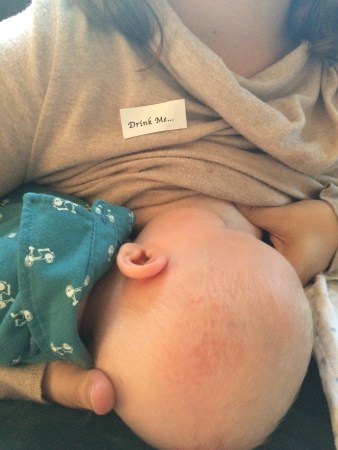
IMG_3269Once upon time formula companies and complicit medical experts launched a serious campaign to sell more formula, telling a generation of mothers that this product was both superior to breast milk and far better for baby and mother. Some were convinced, others found formula a good alternative to breast milk given their employment status, hormonal changes, their particular baby’s needs,personal choice, difficulty producing their own milk, or the like; and still others chose to breastfeed despite criticism, like my mother-in-law, who received scorn and derision from medical personnel as the only breastfeeding mother in the hospital in which she gave birth in 1970.

Despite this effort, science has finally “proven” that breast milk, when it is possible to give it, is better for your child than synthesized alternatives. Wow. Well, the politics of believability aside, women in the U.S. are now encouraged to trust their own bodies to feed their babies and give the breast a try. In fact, every new book, article, website and internet forum, birthing class teacher and hospital nurse will tell you that “breast is best,” repeatedly, for months, asking you about your breastfeeding plan, and urging you to keep trying until you and baby get it right. A counter-campaign, this vigorous encouragement is working to undo the attitudinal changes within popular culture that placed a stigma on the breastfeeding woman. Continue reading “Breastfeeding and the Abject? by Sara Frykenberg”

To Know Her Is to Love Her by Joyce Zonana

“As my mother passed from this life, she was surrounded by a great matrix of love. As she died I began to understand that I too am surrounded by love and always have been. This knowledge is a great mystery.”— Carol P. Christ, A Serpentine Path: Mysteries of the Goddess (forthcoming, FAR Press, 2016)
Joyce Zonana head shot

It has taken me 66 years—my entire life—to learn to love my mother, and, even more importantly, to accept her love for me.

When I was younger, I could not distinguish that love from control, and I felt smothered by her constant attention, care, and what I took to be criticism. I felt overwhelmed, stifled. I resisted, fighting to assert my autonomy and freedom, my difference. Our relationship become one of painful, sometimes ugly conflict, extending well beyond my adolescence and into my adulthood. For too many years, it was almost impossible for me to be in the same room with her.

Today, I happily sit on the floor at her feet, holding her hand, basking in the glow of her love, offering what I can of my own. Continue reading “To Know Her Is to Love Her by Joyce Zonana”

A-mazing Grace by Carol P. Christ

carol p. christ photo michael bakasA few days ago I received a message out of the blue on Facebook:

Thank you for your accepting my friend request. I am fighting to find my way out of depression during a life transition as I move into retirement from my years of work as an educator. I look forward to your book this spring. I have long called myself a Goddess feminist having struggled with patriarchal Christianity since my youth, but have felt abandoned by the Goddess for many years now. I’m not sure how I found you today. I stumbled onto a blog from you on your book while googling something else. Your words gave me a spark of hope. Laurel

In my blog I said that when I began to write A Serpentine Path, I felt abandoned by the Goddess. I wrote back, hoping that sharing what I had learned on my journey would be helpful.

The short answer is that the Goddess has never abandoned any of us. However, She does not have the power to make everything turn out as it could be or should be or we wish it would be. Hers is the power to inspire but not to control. If you have been unhappy, She is with you, She understands your pain, and She will be with you as you seek to find your way. I hope this doesn’t sound too preachy. It is from the heart of my experience. Take care of yourself.

I immediately received an answer back.

Thank you. Those were just the words I needed to hear with my heart. I am “too much in my head,” having spent a life in academia.

This interchange got me thinking about how we import toxic ideas from traditional theologies into what we believe are new religious worldviews. In this case the toxic idea is omnipotence—the idea that the Divine Power is in control of everything. It follows from this that the Divine Power can answer our prayers. If the Divine Power does not answer our prayers, there must be a reason. The reasons we give are many, including: because we are sinful and unworthy or because the ways of God are not our ways. We sometimes conclude, as Laurel and I did: the Divine Power simply does not care about me.

The prominence of magic in Wicca, the most widely known form of contemporary Goddess religion, can contribute to this feeling of abandonment. The Western occult or magical tradition teaches that there are practices, including rituals and spells, through which we can manifest our wills and achieve our deepest desires. In Goddess practice rituals and spells are directed to or through the Goddess. In this situation, it can feel logical to blame the Goddess when, after working very hard and doing every ritual and spell we can think of, our will or desire is not manifested. “Why me,” the child within us asks. “Why has the Goddess abandoned me?”

In the story I tell in A Serpentine Path, I felt precisely that. What I learned was that the Goddess had never abandoned me. She had been with me all along. Where I went astray was in believing that the world could become as I wanted it to be.

The world is made up of a multiplicity of wills, including my will and the will of the Goddess, but also the wills of every other individual, human and other than human, who has lived or is living now. If individuals, human and other than human, have the power to affect the world, then even the Divinity cannot have all the power. This means that Her power (and our power) is the power to influence the world, but not to determine or control it. This is one of the key metaphysical insights of process philosophy, but it is also an existential truth.

The Divine Power is not omnipotent. And neither am I. It may seem odd to put these two statements together. Yet they are mirror images: both ideas deny the reality that a multiplicity of wills have shaped and continue to shape the world we experience. The world really is not at my beck and call. Not even the Goddess gets that.

I would never have said that I believed that the world revolved around me. Stating it so baldly makes it clear how silly idea that idea is. For me “enlightenment” came when I realized—really understood—that the world is not “about me.” Once I gave up having to have what I thought I needed to have, I found, felt, and experienced love and beauty all around me. This truly is a-mazing grace. To feel love and beauty is not to deny suffering. Yet much of our suffering is caused by ideas about how life should be, as Laurel recognized, by living too much in the thoughts of our heads.

Email from Laurel Tangen-Foster, Ph.D.

Carol P. Christ is author or editor of eight books in Women and Religion and is one of the Foremothers of the Women’s Spirituality Movement. She leads the Goddess Pilgrimage to Crete in Spring and Fall. Photo of Carol by Michael Bakas.
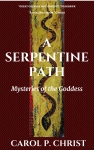
A Serpentine Path Cover with snakeskin backgroundA Serpentine Path: Mysteries of the Goddess will be published by Far Press in the spring of 2016. A journey from despair to the joy of life.
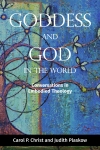
Goddess and God in the World: Conversations in Embodied Theology with Judith Plaskow will be published by Fortress Press in June 2016. Exploring the connections of theology and autobiography and alternatives to the transcendent, omnipotent male God.