Encountering and Countering Self-Disgust by Stephanie N. Arel

In my last post, Trump’s Misogyny – A Case for the Contempt-Oriented Personality, I wrote about disgust, claiming that media diagnosticians failed to identify disgust- contempt as part of Donald Trump’s psychological profile. At the end of the piece, I said that the statement “Make America Great Again” was misogynistic. I maintain this claim but now want to consider disgust a little more closely – particularly when it constitutes self-disgust underlying or complicit in misogyny. Confronting and ameliorating self-disgust provides an entrance into combating misogyny.

Self-disgust interferes with self-love. As a result, self-disgust impedes connection and empathy in human relationships. Self-disgust also attenuates intimacy –self and other directed. Self- disgust manifests in multiple ways – in withdrawal, refusal to engage, self and other directed violence, addictions (including those to negative affect), etc.: the list is a long one. Self-disgust which manifests as hubris motivates the projection of disgust onto others, so that the other becomes the source of disgust; the abject unwanted object present in the self – rejected and discarded –becomes transported, launched to rest on the back of another.

The simple way to describe this mechanism emerges in self-help literature that suggests that the thing that one dislikes most in others is that which one cannot tolerate in oneself. This negatively perceived part of self can also be conceptualized in terms of Carl Jung’s notion of the shadow – the unknown dark side of the personality which we all carry but whose integration into conscious life defines its denseness, or the weight of its impact. The more conscious we are of our shadow, the more we are able to identify that what we recognize as a deficiency in another is actually what we understand as a personal inferiority. Continue reading “Encountering and Countering Self-Disgust by Stephanie N. Arel”

The Death Penalty and Human Dignity: Where Do We Stand? by Stephanie N. Arel

stephanie-arel

On Wednesday, March 22, I had the pleasure to speak at a conference on law, economics, and religion hosted jointly by Georgetown University Law Center and the Pardes Institute of Jewish Studies. Entitled “The Moral Economy,” the conference provided rich learning from an accomplished cast of rabbis, attorneys, and judges, including Pardes faculty members and alumni.

I presented with Dr. Jenny Labendz of the Solomon Schechter Day School and Dr. Deborah Barer of Towson University in a panel entitled, “Death penalty, human dignity and ethics: Retribution and an eye for an eye?” We engaged in a fascinating discussion that covered Rabbinic and Talmudic Law alongside the Gospel of Matthew, the Beatitudes, and Catholic Social Thought. I felt privileged and honored to learn from them in an interreligious exchange.

The topic of our session though proved pressing. Amidst news reports that Arkansas is “turning its death penalty into an assembly line” – the state currently prepares to execute eight men in over 10 days in April – we queried together, “What is at stake for the prisoner and those implicated or involved in the death penalty process both on moral and economic grounds?” Continue reading “The Death Penalty and Human Dignity: Where Do We Stand? by Stephanie N. Arel”

Doctrine and Fidelity by Elise M. Edwards

elise-edwardsThis past week, I was listening to Krista Tippett’s podcast On Being as she spoke with Pádraig Ó Tuama.  He is a poet, theologian, and leader in the Corrymeela community of Northern Ireland. As he spoke about several things related to the challenges of belonging, reconciliation, and fractured communities, he said, ”The measure of Christian fidelity is more than the positions we take.”

I agree.  I interpreted his statement as a condemnation of the ways Christian doctrines and moral positions too often take priority over other matters of faith.

Continue reading “Doctrine and Fidelity by Elise M. Edwards”

A Time of Reckoning: The SCE and John Howard Yoder By Grace Yia-Hei Kao

How does a professional society—a Christian one, no less—come to terms with the sexual abuse perpetrated over decades by one of its most vaunted members?

At the recently concluded annual meeting of the Society of Christian Ethics, this question was at the forefront of many conference participants’ minds.

Continue reading “A Time of Reckoning: The SCE and John Howard Yoder By Grace Yia-Hei Kao”

A Gift Offered in Faith and Love by Elise M. Edwards

elise-edwards“The day begins with the sun and ends with the moon and stars; what you do in between is your gift to the world.” – Reyna Craig

The new year has begun, and many of us take this marking of time as an occasion to set intentions, goals, plans, or resolutions for the year ahead.  For us feminists, the year ahead holds clear challenges.  We know that the bodies, spirits, minds, hearts, and souls of women, racial and ethnic “minorities,” and all sorts of vulnerable people will be attacked.  We know that the protections secured under the law for these bodies, spirits, minds, hearts, and souls have been eroded and continue to be dismantled in the name of… well, what exactly? Justice? Life? Religion?

We’ve seen voting rights eroded in the name of democratic ideals.  We’ve seen challenges to bodily autonomy in the name of life.  We’ve seen state-sanctioned murder in the name of law and order.  We’ve seen a rise in religious intolerance in the name of religious liberty.  Our work in this age must be to continue to expand our collective understandings of these ideals.  This is the gift we offer to the world.

Continue reading “A Gift Offered in Faith and Love by Elise M. Edwards”

My Reaction to the Election Results by Elise M. Edwards

elise-edwardsI wanted to stay in bed yesterday morning.  I wanted to stay in bed for the whole day.  When I heard that Trump won the US Presidential election, I didn’t know how to deal with it.  How can I accept this reality?  I still don’t have an adequate answer.

Turn to prayer? Yes.  Do some writing? Ok. I’ll also take every hug and kind word that’s offered to me.  And still, my emotions will be raw for a long time.  I cry at random moments.  My voice catches unexpectedly.  I feel that so many Americans embraced a vision of the country that is intensely hostile to people like me (women, African-Americans, Black Lives Matter sympathizers, liberals, intellectuals). How can I not take that personally? Dismissing the harm of Trump’s open hostility or accepting it in deference to some supposedly higher goal feels like rejection too.  It justifies and legitimizes his contempt and denies the seriousness of it.  Do we really accept a man who speaks so openly of sexual assault because he promises to bring jobs back?  That denigrates women and all assault victims. The hatred directed at immigrants, Muslims, and LGBTQA persons is even more unrestrained and horrifying!

Continue reading “My Reaction to the Election Results by Elise M. Edwards”

The End is Nigh by John Erickson

How will the world end? No, it isn’t Lucifer himself coming from hell to bring in the end times, it is someone far worse, and his name is Donald Trump.
John Erickson, sports, coming out.When I was a little boy I was terrified that I would live to experience the end of the world.  Whether it was by an asteroid, Y2K, or a zombie plague, I would make myself sick by picturing these horrible things that could befall me and my family.  Although I was a precocious child, the crippling fear that would lurch its way up my stomach and into my head would sometimes make it impossible to sleep at night.  While I like to think I grew out of that phase, I now sit here feeling that way again.  I’m crippled with fear that the end of the world is at hand and there may be nothing we can do to stop it.   How will the world end? No, it isn’t Lucifer himself coming from hell to bring in the end times, it is someone far worse, and his name is Donald Trump.

By the time you’re reading this post, the first Presidential debate between Hillary Clinton and Donald Trump will have occurred and, no matter where you look, the aftermath will haunt us for weeks to come.  We will either be sitting here, coaxing in the sunlight that Clinton has, in proper fashion, just goaded Trump into revealing to the 100 or so million viewers that will have chimed in to viewing how completely dangerous he truly is, or will we be scurrying to uncover decade old bunkers that were used during the 1950s and the Cold War to take shelter from the fallout to come should, Donald Trump become the next President of the United States. Continue reading “The End is Nigh by John Erickson”

Voting for Hillary & the Real Meaning of Sanctity of Life by Marie Cartier

I just don’t trust Hillary,” a friend said. “Give me one good reason why I should vote for her—other than that, you know, she’s a woman—since I know you teach Women’s Studies.

OK. Here goes.

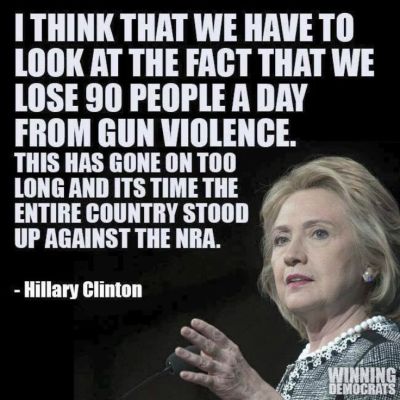
hillary-and-gunsI recently got a request for support from Gabby Giffords, who was shot on January 8, 2011. This U.S. Representative and eighteen others were shot during a constituent meeting held in a supermarket parking lot in Casas Adobes, Arizona, in the Tucson metropolitan area. Six people died, including federal District Court Chief Judge John Roll; Gabe Zimmerman, one of Rep. Giffords’ staffers; and a nine-year-old girl, Christina-Taylor Green. Giffords was holding the meeting, called “Congress on Your Corner” in the parking lot of a Safeway store when Jared Lee Loughner drew a pistol and shot her in the head before proceeding to fire on other people.

In her recent request for support, Rep. Giffords pondered why she didn’t die and six others had.  There is no answer—save for that, if there is God’s hand in this, she is the one who went on to fight against the all-powerful Gun Lobby who, for years on end continue to use big money to influence Congress.

On November 8th, we, the American people, will decide, for better or worse who is the next leader of the most powerful country in the free world. An important question to ask ourselves as we consider the candidates is: What does it mean to believe in the sanctity of life? Continue reading “Voting for Hillary & the Real Meaning of Sanctity of Life by Marie Cartier”

“And God Said It Was So”: Donald Trump Is the Spittin’ Image of Bad Theology by Carol P. Christ

Carol P. Christ by Michael Bakas high resoultionI try very hard this election season to avoid reading about, watching, or listening to Donald Trump: the man is a liar, a cheat, a bully, a narcissist, a racist, a sexist, the list goes on. Yet even progressive commentators are talking almost exclusively about him. And now I am joining them–despite my best intentions.

Reflecting on why facts seem to matter so little to Trump, Patricia J. Williams characterizes his campaign as an exercise in one-way communication:

Freedom of expression is reduced to an arbitrary insistence upon one-way communication, a barked order. Making America “great again,” by this measure, is a command, not a hope. . . This assumption—the belief that communication flows in one direction only, that it is the role of some to speak and others only to listen—is a paradox that stifles rather than encourages debate.

Continue reading ““And God Said It Was So”: Donald Trump Is the Spittin’ Image of Bad Theology by Carol P. Christ”

Racism: We Still Don’t Get It by Esther Nelson

esther-nelson

I was in Las Cruces, New Mexico, this summer for several weeks, spending much of my time unpacking boxes the moving van had delivered while simultaneously trying to create an aesthetically-pleasing and comfortable home.  I also went to the Unitarian Universalist church–twice!  (I haven’t attended church or any other place of worship regularly for decades.)  But, moving is a socially-disruptive experience and church is one place you can connect with individual people as well as with the larger community.  So, I decided to visit the local UU congregation.

Unitarian Universalism has a fairly long and circuitous history in the United States.  It’s roots are in liberal Protestant theology and practice, but the institution has branched out from its roots, seeking to be more “inclusive and diverse.”  Some of the historical background and development of the church can be found on Wikipedia.  As fascinating as this history and development is, I want to focus here on “Black Lives Matter”–a theme the congregation chose to use as it centered its worship on one of the Sundays I attended.
Continue reading “Racism: We Still Don’t Get It by Esther Nelson”