From the Archives: Rosh Hashanah and the Goddess by Joyce Zonana

Moderator’s Note: This was originally posted on Rosh Hashanah Sept 10, 2015. Rosh Hashanah this year begins on Sept. 15th but FAR will be taking a 16 day hiatus at that time so we are posting today.

When I was growing up in the 1950s in my Egyptian Jewish immigrant

My father, an Orthodox man who prayed each morning and went regularly to the local Sephardic synagogue in Brooklyn, privately followed the tenets of his faith.  But it was my mother, unconsciously devout, who brought the public rituals of our religion to life.  As a child, I longed to be at prayer with my father and was envious of the men and boys who studied and recited the sonorous ancient Hebrew; I did not want to be confined to polishing the silver and setting the table.  But today, as an adult, I am grateful for the silent teachings bequeathed to me by my mother.

Continue reading “From the Archives: Rosh Hashanah and the Goddess by Joyce Zonana”

A World in Which to Be by Xochitl Alvizo

My brother moved to Europe sometime between 2012 and 2013. He went for love, moving there with the woman from Germany who he planned to marry. He didn’t marry her, but he did marry someone else from Germany. He lived there a good while, but then also in Spain, then back to Germany, and eventually Basel, Switzerland. That is where he was living when he died on Monday, June 12, 2023, just three weeks ago, five days before (what would have been) my dad’s 70th birthday. I’ve now lost my dad and my brother, the two men in my family, within a two year period. It sucks – it really sucks to lose the people that help bring meaning to your life, those whom you most enjoy and from whom you learn life’s biggest lessons.

Continue reading “A World in Which to Be by Xochitl Alvizo”

Archives from the FAR Founders: Learning Compassion from Inmate Number 74799 by Cynthia Garrity-Bond

This was originally posted on July 21, 2017. This is the first post of our new series to highlight the work of the four founders of FAR, Garrity-Bond, Caroline Kline, Gina Messina and Xochitl Alvizo

Technically I was employed as a lab assistant at our community

Considered standard prison procedure, Michael was scheduled for an autopsy the following day. While my grief over Michael’s death was considerable, it was the pending autopsy that caused my immediate concern. As I pictured Michael on the cold table of steel, the crude instruments sawing and cutting into his already weathered body, I took it upon myself to somehow ease this last assault. I phoned the Tucson corner’s office, hoping to speak to the pathologist who would be performing Michael’s autopsy. With surprising bureaucratic ease, I was transferred to him. After introducing myself, I explained he would be receiving Prisoner 74799, my brother, from Tucson General, and that by all appearances this was just another disposable inmate whose criminal past simply caught up with him, sort of a karma-like ending. His thin, emaciated body, I warned, is covered in tattoos, which I feared might induce a harsher judgment upon this cast away soul. I asked the pathologist that when he begins the post, he please remember Prisoner 74799 was somebody’s son, somebody’s brother, father and friend and more importantly, that this man was loved. “Please” I pleaded, “try to see beyond the obvious signs of poor choices mapped onto his body, instead see he is more than his prison issued number and that Michael Paul, while far from saint, was a man who loved and was loved.”

Continue reading “Archives from the FAR Founders: Learning Compassion from Inmate Number 74799 by Cynthia Garrity-Bond”

That Old, Old, OLD Story – The Warts and Wisdom of the Ancient

My grandmother Clarine was an incredible human being. I absolutely could not be more proud to be her granddaughter. She started her first teaching position in 1927 at age 17. She met my grandfather in seminary; but despite her clear talent and call, the church apparently felt one minister was enough for the family and refused to ordain her. Undaunted, she famously wrote a one line reply to the bishop: Well, Moses got along fine without it, and Jesus got along fine without it, so I’ll be fine without it, too.

Continue reading “That Old, Old, OLD Story – The Warts and Wisdom of the Ancient”

From the Archives: Christmastime for the Self by John Erickson

This was originally posted on December 25, 2018

We’ve all been there.

Sitting around the tree watching the kids open presents.  Attempting to enjoy a holiday meal with extended and immediate family that you may or may not have traveled thousands of miles to see.  Trying with every fiber of your being to not talk about the elephant, or red hat, in the room.

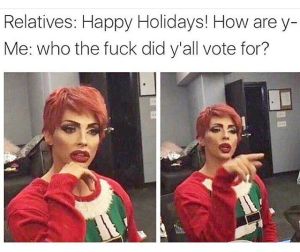
Alyssa Edwards

I get it.  It is hard to not go home for the holidays. It’s also hard to sit at home and watch every one of your friends post online about their dinners, get-togethers, and other joyous events while you sit at home.  I also understand that many of us, as a result of our sexual and/or gender identity, or maybe our political preference, don’t feel comfortable going home or, can’t go home.  This is not ok and that is why it is so important that we all have our chosen families to be with during these times of communal gathering or more importantly, ways to cope while we are at home in these uncomfortable situations to make sure we take care of ourselves and make it out the other end.

Continue reading “From the Archives: Christmastime for the Self by John Erickson”

Una Hora de Vida, Es Vida! by Xochitl Alvizo

I learned, recently, that this is a common phrase among my family members – “an hour of life, is life.” I remember the first time I heard my mom use the phrase, not more than a few years ago, I latched onto it immediately. Since then, I have realize that many of my relatives use the phrase – it’s kind of a family mantra, which makes sense, then, that when I heard it, it reverberated within me—“Yes! An hour of life is life.”

To me it was a clarion call to not waste a single hour – to never think, “Oh, but I only have an hour…” and instead embrace the hour for all its potentiality—I have an hour, what will I do with it?

Continue reading “Una Hora de Vida, Es Vida! by Xochitl Alvizo”

From the Archives: Thanksgiving and Service by Sara Frykenberg

This was originally posted on December 3, 2103

Growing up in an evangelical Christian church, I was taught that human beings should serve one another and put others before themselves.  These two different teachings, paired with patriarchal misogyny, have sometimes been very problematic for me.  I tend(ed) to give too much.  Too many demands with which I complied were self-negating (which after all, helped me to make other people more important than myself).  It took me a long time to learn how to appropriately prioritize my own needs, to stop mistaking self-esteem for the”‘sin of pride,” and how to say no when I needed to… Actually, I am still learning some of these lessons.

Conversely, my ritualized service to the church was sometimes confusing, awkward or embarrassing.  I clearly remember having the opportunity to serve as something like an usher during Thanksgiving at our family’s church as a child.  This involved wearing a pilgrim costume, which for me meant finding a Puritan style costume in the church’s closet that fit my overweight childhood frame.  This was not an easy task and left me feeling ashamed.  Later as an adolescent, my youth group asked us to wash one another’s feet as Jesus did for his disciples.  Now, don’t misunderstand me here— I do believe that this ritual has the potential to be very powerful and meaningful for those involved.  However, my teenage self could not identify with the symbolic gesture beyond realizing that:

1)    I thought touching other people’s feet was gross, as was having my dirty feet touched and,
2)    I knew I ‘should’ get something out of the ritual but did not, so I felt spiritually guilty or inadequate.

Overall, I often associated Christian service with guilt, inadequacy, my role as a daughter or woman or my sacrificial duty.

Despite these issues, I usually genuinely enjoy serving others and giving to other people.  I love to host people and care for them.  I like to help.  I even prefer to help.  Serving one another we can express and allow others to express love.  But this past week, one day before Thanksgiving, a dear friend of mine gently challenged me to allow myself to be served or, as she put it, “to give someone else the gift of giving to me.”  Specifically, she was referring to a pending holiday meal for which I expressed my anxiety and frustration with not being allowed to help—which somehow makes me feel like a child.  Even writing this phrase, “makes me feel like a child,” I know that I have touched deeper feelings of helplessness or vulnerability that at some point, I learned to battle with competence and over-achievement.  I do often feel like a child or guilty when other people do for me what I think I could or should do for myself; and my friend’s brief words encouraged me to explore this relationship to being served.

“Service” can sometimes feel uncomfortable for the reasons I mention above, but more so, for its connection to the coercive “servitude” required by existent hierarchies within andro-kyriarchal oppressive systems.  I have been subject to this coercive servitude, and also, its beneficiary.  As a white, middle class, Western woman I have far too much privilege that is contingent upon the forced labor and oppression of other people.  This kind of forced servitude is very wrong; and I am still learning how and where to choose other than to be complicit in this abuse.  But, there have also been many distinctive instances in my life where I have felt reciprocally and undeniably “served” by people around me, without abuse and without manipulation.

Driving to Colorado one summer to see the friend I mentioned above, my two companions and I served one another.  The individual in the back seat was responsible for cutting bagels and spreading cream cheese on them for the driver and navigator, while the navigator held the drink, food or whatever other item that the driver could not.  This may sound like a small thing, but it wasn’t.  I felt taken care of and loved in this small and traveling community.  We also had a safe word that meant, “leave me alone, I’m grumpy” on our long trip.  We made agreements to account for one another’s  discomfort and effort.  We respected one another and cared for each other.

Beginning my work as an adjunct professor, I encountered a great deal of stress and often long and awkward work hours.  Many times I felt like I needed help, but there was nothing I could ask for help with when it came to my job: I needed to grade my own papers, plan my own lectures, and yes, write my own blogs.  My husband has responded by taking care of me in other ways.  He makes me dinner, goes to the store and makes sure I take breaks.  We take turns taking care of one another, and I am grateful for him.

This past week after talking to my friend, I noticed how willing people were to touch me to soothe aching muscles.  I’m not sure how to describe what I felt, but it was like something invisible in certain spaces was suddenly visible.  I also realized that it had been a very long time since I had freely and openly received this touch.  Later during the weekend, a friend came to my house  and she made me dinner!  My husband rubbed my chest after a long night of coughing yesterday because I still haven’t completely rid myself of the smoldering in my lungs.  I was defensive for so long.  Shedding my defender allows me to rediscover all those things for which I am thankful.

Gratefulness is an action.  It can be found in those expressions that return, receive and allow for mutual loving.  I am learning new rituals that help me to remember that this kind of mutual serving and being served is sacred.  In a summer ritual, my friend and I washed one another’s hair instead of our feet.  I am still learning to ask for assistance from the goddess after freeing myself from an abusive omnipotent god, but I am starting to ask.

I am starting to pray again.

BIO: Sara Frykenberg, Ph.D.: Graduate of the women studies in religion program at Claremont Graduate University, Sara’s research considers the way in which process feminist theo/alogies reveal a kind transitory violence present in the liminal space between abusive paradigms and new non-abusive creations: a counter-necessary violence.  In addition to her feminist, theo/alogical and pedagogical pursuits, Sara is also an avid fan of science fiction and fantasy literature, and a level one Kundalini yoga teacher.

Rites of Fall, by Molly Remer

“Sometimes there is small magic
and scraps of enchantment.
Sometimes we push for more
and sometimes we yield,
joining hands
to welcome the sweet what is
as we witness the wheel’s turn…”

Each year fall waltzes in,
slow and supple,
her golden light illuminating 
the pines, 
her slowed rhythm 
tugging at our hearts and bodies, 
her red and brown cloak 
settling over the land. 
We are invited 
to yield to grace,
offering up our gratitude 
and celebration, 
releasing our stored up 
worries and concerns 
into her capable hands, 
remembering how to let things go,
how to scatter our offerings 
and our troubles into the winds. 
Now is the time to sit in the stillpoint,
to call ourselves back home,
to accept her invitation 
to sit in the center 
of our very own lives 
and choose, 
to recall our strength and to be held.
Extend your hands into autumn. 

Continue readingRites of Fall, by Molly Remer

My Daughter’s Religions by Sara Frykenberg

I find it interesting how certain or settled we often expect our little ones to be instead of getting curious about them or acknowledging that they are curious.

My daughter, Hazel, is six years old and will be starting first grade next week. She loves cats, swimming, her cousin, and food. Purportedly, Chinese style barbecue pork buns come first in her heart, even before mommy and daddy (though we are a close second). She also prefers to run instead of walk; and has recently declared that she is Taoist and Shinto. This determination came after some discussion which went something like this:

Sitting at the kitchen table one morning, Hazel declares “My best friend asked me if I was a Christian and I told her I was. I am a Christian.”

Mommy the agnostic is a little surprised. Daddy, the atheist, is biting back a retort—he is somewhat hostile towards Christianity. I am only hostile to abusive, hetero-Patriarchal Christianity. I say to Hazel, “Oh. That’s interesting. Do you know what that means?”

“No. What do Christians believe,” she asks.

Continue reading “My Daughter’s Religions by Sara Frykenberg”

Can I get an “Amen” up in here? by Laura Montoya 

I am a great evangelist. I used to evangelize in Pentecostal settings until I was 22. Then, I left my church to evangelize about feminist issues to every woman that crossed my path. Rhetoric is a gift I received when I was a kid and that I inherited from my grandpa and my dad. But during the COVID lockdowns, it was hard to socialize, and my evangelization skills turned toward making my friends and family join the privileged fan base of Ru Paul’s Drag Race. One by one, I convinced my sister, cousins, neighbors, and best friends to watch the reality show, and they did with astonishing devotion. Every week, two or three of us gather in someone’s living room wearing masks to watch episode after episode after episode. Our debates about the queens in the show could last all night long. Who had the best performance? Did you like their lip-synching? “That elimination was so fair/unfair!” 

Continue reading “Can I get an “Amen” up in here? by Laura Montoya “