From the Archives: I Sing Asherah Exalted! by Janet Maika’i Rudolph

This was originally posted Dec. 16th, 2021

With this season of the festivals of light upon us (Hanukkah, Christmas, Solstice, Kwanzaa), I wanted to focus on the more joyful aspects of our lives. For that, I have been diving into passages about joy and singing in the bible.

Sometimes when I write these posts, they take me in directions I never thought to go. This post is one of them. The surprise direction I found is in the Psalm below:

Sing unto him, sing psalms unto him: talk ye of all his wondrous works.
Glory ye in his holy name: let the heart of them rejoice that seek the LORD.
Psalm 105:2-3 KJV

Continue reading “From the Archives: I Sing Asherah Exalted! by Janet Maika’i Rudolph”

From the Archives: Tree of Life: The Festival of the Trees in an Age of Treefall by Jill Hammer

This was originally posted on January 22, 2019

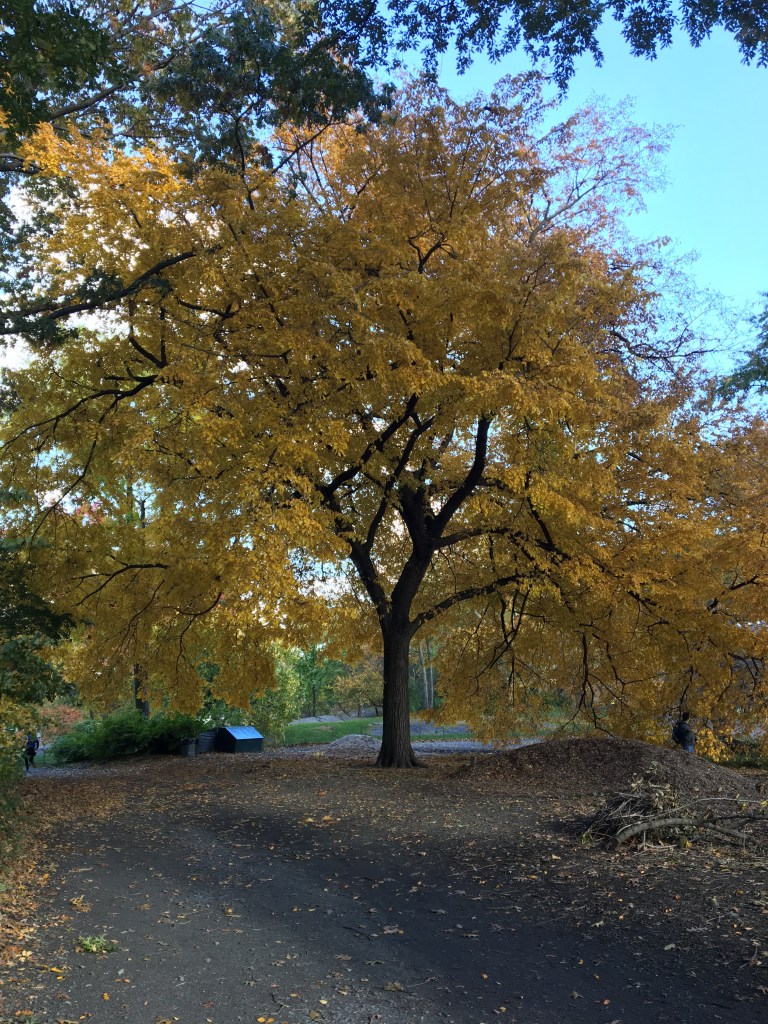
Almost every day, I walk in Central Park.  There are certain trees there I’ve come to know: the gnarled cherry trees by the reservoir, the bending willows and tall bald cypress by the pond, the sycamores that drop their bark each summer, the hawthorn not far from Central Park West.  Lately I’ve been taking photos of the trees to try to capture their essence, their posture in the world.  The trees around me feel like friends, which is what an ancient midrash (interpretation/legend) called Genesis Rabbah says about trees: that they are friends to humankind.  To me, they’ve always been a central manifestation of Mother Earth.

Currently, the national parks in the United States have no staff because of the government shutdown. Some people have taken the opportunity to cut down the rare and endangered Joshua trees in the Joshua Tree National Park—just for fun, I guess, or as a trophy of some kind.  Meanwhile, President Bolsonaro of Brazil recently has indicted that he wants to remove protection for the rainforest, in order to allow development.  It appears that my friends the trees have enemies.  Sometimes the enmity is for personal/corporate gain, and sometimes the enmity seems to have no reason at all.

Continue reading “From the Archives: Tree of Life: The Festival of the Trees in an Age of Treefall by Jill Hammer”

Legacy of Carol P. Christ: Kamala Harris! “I Feel Heard”

This was originally posted on August 17, 2020

Shortly after Kamala Harris was announced as Joe Biden’s choice for his Vice Presidential running mate, a panel of black women were asked, “How do you feel right now?” “I feel heard” was the simple yet profound response of one of them. As is well-known to those who follow the polls, black women voters are the backbone of the Democratic party. In the primary election, black women in South Carolina delivered the Presidential nomination to Joe Biden. Yet all too often black women have felt that their votes were taken for granted.

Instead of focusing on the needs and priorities of black women and their communities, all too often the Democratic Party’s strategy has been to reach out to other groups—for example working class white men or white suburban women. To feel heard at this moment means to be taken seriously as a political actor and as a person. Right now, the fact that a black woman was selected is what matters most. There were other qualified women and out of all of them. a black woman, Kamala Harris was chosen. And because of this, black women feel heard. It’s about time. Period.

Continue reading “Legacy of Carol P. Christ: Kamala Harris! “I Feel Heard””

From the Archives: Writing: Changing the World and Ourselves. By Ivy Helman

This was originally posted on October 12, 2014

20140903_180423

I still remember the first time I read Mary Daly’s Gyn/Ecology. It awoke something within me. Her use of language, the power of her writing and the ease with which she created new words taught me so much about the world around me and about the way the language, and subsequently its use in writing, shapes lives, choices, abilities and destinies. She also taught me about myself.

I was hooked, but not just on Mary Daly. Shortly after I finished her book, I moved onto other feminists writing about religion like Katie Cannon, Judith Plaskow, Alice Walker, Carol Christ, Rita Gross, Gloria Anzaldua, Audre Lorde, Adrienne Rich, Margaret Farley and Starhawk to name just a few. All of them, in fact every feminist I’ve ever read, has shown me the way in which words have power and how words speak truth to power. Ever since, I’ve wanted to be the kind of writer whose words carry a power that not only affects people but also inspires a more just, more equal, more compassionate and more humane world. In other words, I wanted to be a writer activist.

Continue reading “From the Archives: Writing: Changing the World and Ourselves. By Ivy Helman”

Archives from the FAR Founders: We are Worth the Time it Takes to Create a Practice by Xochitl Alvizo

Incarnation, Goddess spirituality, Xochitl Alvizo, god became fleshThis was originally posted on September 10, 2014. It seems relevant to me these days as I continue to develop practices for my groundedness, community, and well-being. 

Recently, in response to the excellent conversation following Nancy Vedder-Shults’ post on the goddess Kali, Carol Christ commented to Nancy, “I too love our conversations, wish there was more in depth talk on our blog [FAR], maybe there will be.” Carol’s comment* struck a deep chord within me. One of the main objectives that the FAR co-founders had in creating Feminism and Religion was that it be a place where we could and would engage with one another across a diversity of feminist issues and the broad range of feminist passions and work – where we could discuss, critique, and build upon on each other’s efforts.

So two things came to mind as I reflected on Carol’s comment. The first was my personal lament that I have not been as actively participating in the discussions that follow the FAR blog posts as I did when we first started Feminism and Religion. FAR has such rich and valuable material – it really does provide a great opportunity for conversation and dialogue – and sadly I have been a passive participant as of late. I read and learn from the discussions, but I have not been joining in. I lament that. FAR is definitely a place where I could engage with others in deep conversations, but how actively am I actually doing this? Continue reading “Archives from the FAR Founders: We are Worth the Time it Takes to Create a Practice by Xochitl Alvizo”

The Journal Gender a výzkum/ Gender and Research

I would like to introduce this community to Gender a výzkum (in Czech) or Gender and Research (in English), a transdisciplinary, peer-reviewed journal founded in the year 2000 and dedicated to research in Feminist and Gender Studies in the Czech Republic.  While the journal’s main focus is work pertaining to Central and Eastern Europe, it is open to a wide range of geographical locations and topics.  The journal, which publishes articles in Czech and English, often puts out calls for individuals or groups of people to edit monothematic issues.  Past monothematic issues include feminist reflections on Covid, an issue on the use of language concerning sex and gender, gender in popular culture, children, adolescence and sexuality, feminist interpretations of Islam, and postcolonial and decolonial thinking in feminist theory to name just some. If you would like to read them, the journal is available online as well as in print.

Continue reading “The Journal Gender a výzkum/ Gender and Research”

Three Women Sit on a Stone: Images of Fate in a Jewish Incantation by Jill Hammer

Tapestry, three fates, 16th century Netherlands

There is an old Yiddish incantation, documented from the 18th century forward, that features three mysterious women.  It is a folk spell warding off the evil eye–the negative influence that may come either from demons or from the jealousy and spite of others (or both). Fear of the evil eye is the reason it was traditional not to compliment cute babies or talented people—because the evil eye might be attracted to such beauty or talent and cause harm.  The evil eye, to give a personal example, is the reason my father, who was normally not a religious person, refused to allow my mother to shop for a crib until I was born, lest the evil eye notice they were going to have a baby and prepare some terrible fate for me.

Continue reading “Three Women Sit on a Stone: Images of Fate in a Jewish Incantation by Jill Hammer”

Legacy of Carol P. Christ: “It Came Upon a Solstice Morn”

***This was originally posted on December 25, 2017

It came upon a Solstice morn,

that glorious song of old

with angels bending near the earth,

to touch their harps of gold.

“Peace on the earth.

good will to all,”

from heaven’s all glorious realm.

The world in silent stillness waits,

to hear the angels sing.

Continue reading “Legacy of Carol P. Christ: “It Came Upon a Solstice Morn””

Can Feminist Christians Hasten the Advent of Reproductive Liberation? by Elizabeth M. Freese, PhD

Wikimedia Commons, Servite Church in Hungary

The collision of the 2023 Christian liturgical season of Advent with American reproductive politics has been jarring. Feminist religious critique and transformative activism are imperative.

With the Texas Supreme Court decision on a dire abortion case, alongside increasing criminalization of women having miscarriages, we are witnessing the principle of patriarchal dominance of female reproductive capacity and the denigration of women’s full, equal personhood pushed to the extreme. In part, this barbarity is perpetuated by Christianity. Even though this tradition often challenges social systems of injustice, and it does not actually support their hollow theology of “life at conception,” misogynist oppressors have plenty of Christian religiosity to stand on.

Continue reading “Can Feminist Christians Hasten the Advent of Reproductive Liberation? by Elizabeth M. Freese, PhD”

What “Can” Women Do? – An Excerpt from Nice Churchy Patriarchy by Liz Cooledge Jenkins

In an essay called Sister, You Can Be Anything God Desires You to Be,[1] Kara Triboulet recalls a discussion in her theology class at her Christian college. When the professor opened up the floor and invited students to express their views on women in leadership, these are some of the things her classmates said:

“I believe women can be in leadership, just not as pastors.”

“Allowing women to teach other women and children isn’t limiting. At least they have a place to serve.”

“Women can be directors, but not pastors.”

“The Bible is very clear . . . women can’t teach or lead men because men were created first. It’s just the way God ordained it, and we all just need to accept that.”

Continue reading “What “Can” Women Do? – An Excerpt from Nice Churchy Patriarchy by Liz Cooledge Jenkins”