I had a startling experience in church recently. It was Father’s Day, and the pastor was talking about how “God is our heavenly Father.” For the first time in 17 years, that idea held some appeal to me. But no sooner did the thought enter my mind, then it was ripped away by the realization that my church will never allow me to symbolize the divine as a “father.”
I grew up with “God the Father” language saturating my churches. I also grew up with a rageful, unsafe, sometimes abusive father, who was also wonderful, empowering, and feminist in many ways. Seventeen years ago, I attended my first seminary lecture on the topic of Feminist Theology. That day changed my life, as did my exposure to feminist theology throughout seminary and at a queer Methodist congregation. My journey took me through more scholarship and liturgy, jobs as chaplain or as assistant pastor struggling to convince my communities that sexism matters, parenting young daughters who lament their own subconscious male divine programming, and finding a prophetic call to speak, write, and sing the Female Divine. Continue reading “My Church Won’t Let Me Call the Divine “Father” by Trelawney Grenfell-Muir”
Speak the truth about conflict, pain, and suffering.
Take only what you need.
Think about the consequences of your actions for seven generations.
Approach the taking of life with great restraint.
Practice great generosity.
Repair the web.
In a recent interview on Voices of the Sacred Feminine on “Gratitude and Sharing: Principles of Goddess Spirituality,” Karen Tate asked me to review the “Nine Touchstones” of Goddess religion I offered in Rebirth of the Goddess as an alternative to the Ten Commandments. Tate expressed concern about the lack of social and political ethics in New Age spirituality and in some parts of the Neo-pagan movement at a time when ethical discernment and action is more necessary than ever.
Before discussing the ethical principles of Goddess feminism, it is necessary to dispel a common assumption that there can be no ethics in Goddess religion because ethics stem from a transcendent principle of justice that stands outside the world. Christian liberation theologians usually identify this transcendent principle with the commanding “Word of God” in the prophetic traditions of the Bible. They often assume that this word comes from outside ourselves and outside nature and as such is the only firm basis for ethics. Continue reading “Ethics of Goddess Religion: Healing the World by Carol P. Christ”
Aurora’s autobiographical narrative is a passionate paean to poets as the “only truth-tellers, now left to God”; she celebrates them as agents for personal and social transformation. As we come to the end of this National Poetry Month in the U.S., where truth is under siege, it’s worth recalling Aurora Leigh and its daring exploration of poetry, gender, divinity, and social justice.
I was in graduate school when I first read Aurora Leigh, Elizabeth Barrett Browning’s fiery 1856 epic about a young woman claiming her vocation as a poet despite Victorian society’s patriarchal strictures. The poem was not on any assigned reading-list; I’d simply stumbled across it while doing research for my dissertation. The opening lines brazenly assert the speaker’s authority and ambition:
OF writing many books there is no end;
And I who have written much in prose and verse
For others’ uses, will write now for mine,–
Will write my story for my better self . . .
Encountering those words, I was immediately possessed by Aurora’s voice and vision, a welcome change from all the male poets and critics I’d been reading. I devoured the verse novel’s nine books in one night. The poem became the centerpiece of my dissertation, and I studied and enthusiastically taught it for years.
When I learned about the Navajo Beauty Way, I understood it to be a path in which human beings respect all beings in the web of life and live in harmony with them. But I didn’t understand why this path was called the “Beauty Way.” As a young woman, I knew that my worth was defined by many in terms of my ability to conform to ideals of female beauty promulgated in movies, tv, and advertising. I didn’t believe the Navajos were talking about beauty in that sense, but because of my conditioning, I was not yet able to fully grasp what they might mean by beauty. I would have called the way they were describing a “Way of Harmony” or a “Way of Respect for Life.”
Still, I wondered: why the Beauty Way?
Marija Gimbutas described the societies of Old Europe as peaceful, settled, agricultural, highly artistic, matrifocal and probably matrilineal, and worshipping the Goddess as the power of birth, death, and regeneration in all of life. Though I am impressed with the beauty of the many small works of art Gimbutas reproduced and interpreted in The Language of the Goddess, I sometimes inadvertently omit the words “highly artistic” when repeating in her definition of the culture of Old Europe. I have tended to view the fact that Old Europe was peaceful and matrifocal as more important than the fact that it was highly artistic.Yet this judgment is wrong. In calling the cultures of Old Europe “highly artistic,” Gimbutas was trying to convey her understanding that appreciation of the beauty of life was fundamental within them.
We have been taught that “high” or “great” art is most often monumental in size. The Pyramid of Giza is over 230 meters (756 feet) tall. The Great Sphinx of Giza is 20 meters (66 feet) high. The Parthenon rose to 14 meters (45 feet) and the statue of Athena inside it was 9 to 11 meters (35-40 feet). It is telling that we use the words “high” and “great” (originally measures of size) to describe the value of artistic creations.
Statue of Athena in Parthenon reproduction in Nashville, Tennessee
The purpose of monumental works of art is to diminish the viewer, to make the her feel small, to induce her to bow down, to worship, and to obey a power or powers greater and higher than herself.
In contrast, the small scale of the art of Old Europe does not diminish anyone or anything. Its purpose is not to make anyone one want to bow down. Instead small works of art make the viewer feel comfortable, welcomed, and part of the beauty of life that is depicted.
Goddesses of Old Europe c. 5000 BCE
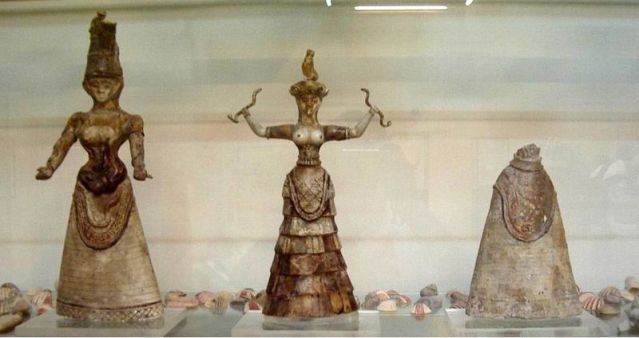
Marija Gimbutas viewed ancient Crete in the Bronze age as the final flowering of the culture of Old Europe. In Crete too, everything is on a small scale. Though the so-called Palaces or Sacred Centers are large, the rooms within them are small. There is not a single room where crowds could have bowed down to a King or Queen. Nor are there images of deities larger than life. The famous Minoan Snake Goddesses are less than 15 inches tall and the well-known pitcher Goddesses are even smaller. Such objects would have been held in hands during rituals or set on low benches in small rooms lit by oil lamps.
Snake Goddesses of Bronze Age Crete c. 1500 BCE
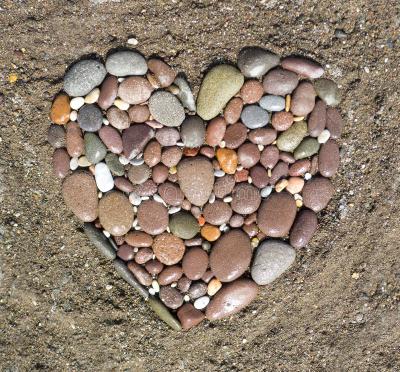
When my friend’s daughter Klia was seven years old, she spent her afternoons collecting stones by the sea. One day I asked her if the stones spoke to her. “Of course,” she replied. “What do they say?” “They say, ‘we are very beautiful.’”
Heart of stones in Lesbos
Klia intuited the meaning of the Beauty Way. It has nothing to do with artificial beauty standards. It has nothing to do with size. It is recognizing beauty everywhere and in everything. When we do so, we walk in beauty, in the grace and joy of life. And yes, the Beauty Way has ethical implications, for no one who truly recognizes beauty could want to harm it. This was understood by the Navajos, the Old Europeans, and the ancient Cretans, and many others. Only we seem to have forgotten. We can remember.
Ever since the election of You-Know-Who, I have been doing a lot of creative writing.
Ever since the election of You-Know-Who, I have been doing a lot of creative writing. Unlike academic publications, policy reports, or my dissertation, creative writing, much like my mentor Dr. Marie Cartier has written about, provided me with a needed escape from a world that seems to grow darker with each passing day. In college, I served as Poetry Editor for the Wisconsin Review, the oldest literary journal in Wisconsin. Continue reading “What I Believe (Post-2016) by John Erickson”
Doing a recent talk on pioneering woman writers, I like to do the Before Jane Austen test with my audience. Who can name a single woman writer in the English language before Jane Austen? Alas, because woman have been written out of history to such a large extent, most people come up blank. Then we talk about pioneering Renaissance authors, such as Aemilia Bassano Lanier, the subject of my recent novel, THE DARK LADY’S MASK, or her mentor, Anne Locke, the first person of either sex to write a sonnet sequence in the English language.
But my next question takes us even further back into history. Who was the first woman to write a book in English?
I recently arrived in Las Cruces, New Mexico, after driving across much of the country from Richmond, Virginia. It’s the second summer I’ve driven this distance (2,000 miles) so I varied my route a bit from last year, stopping at the Abbey of Gethsemani in Trappist, Kentucky, for a short visit. This is the place the popular and prolific monk, Thomas Merton, also known as Brother Louis, called home for twenty-seven years (1941-1968) . (Merton was accidentally electrocuted by an electric fan in Bangkok while attending a conference—December 1968.)
The grounds are verdant, well-kept, and peaceful. Visitors are free to wend their way along various paths on the property, attend any (and all) of the services held in the church, and watch a film on (male) monastic life (running continuously) in the visitors’ center. The gift shop sells books (many authored by Merton), fruit cake and fudge made by the monks at the Abbey, and an array of “stuff.” Accommodations for retreat are available by reservation.
Some time ago, I audited a class that included readings by Thomas Merton. During the semester, the professor mentioned a book titled, At Home in the World The Letters of Thomas Merton & Rosemary Radford Ruether, Edited by Mary Tardiff, OP (1995). Ruether (b. 1936) is a feminist scholar and Catholic theologian. She is also a prolific author and popular speaker. Continue reading “Contemplative Resistance by Esther Nelson”
I will never forget the day Nasr Abu Zaid (1943-2010), an Islamic Studies scholar and teacher extraordinaire, told me, “Shariah is not a law.” In spite of his assertion, many people—both Muslims and non-Muslims—are convinced that Shariah is synonymous with archaic legal rulings that are at odds with democracy and modernity.
What is Shariah, then, if not a law? When we see or hear the word Shariah, the word “Law” almost always follows. Shariah literally means a path—a well-trodden path such as animals use on their way to a watering hole. Shariah, then, can be understood as something that when embraced has potential to give life and sustenance.
Muslims believe that the Qur’an was revealed to Prophet Muhammad by the angel Gabriel circa 600 C.E. That revelation—Muslims believe it to be God’s actual speech—took place over a period of approximately twenty-one years. The Qur’an contains Shariah (path) in the form of information, narrative, and poetry. Since Shariah is essentially a path that leads to life, the critical question centers on how Shariah can be appropriated, leading us to the water that sustains.
In the fields of classics and archaeology, Gimbutas’s work is often dismissed as nothing more than a fantasy of a “golden age.” In contrast, scholars of Indo-European languages, Gimbutas’s original specialty, are much more likely to accept the general outlines of her hypothesis. The German linguist and cultural scientist Harald Haarmann is one of them. Continue reading “Was There a “Golden Age” before Patriarchy and War? by Carol P. Christ”


 I had a startling experience in church recently. It was Father’s Day, and the pastor was talking about how “God is our heavenly Father.” For the first time in 17 years, that idea held some appeal to me. But no sooner did the thought enter my mind, then it was ripped away by the realization that my church will never allow me to symbolize the divine as a “father.”
 In a recent interview on Voices of the Sacred Feminine on “
 I was in graduate school when I first read
  When I learned about the Navajo Beauty Way, I understood it to be a path in which human beings respect all beings in the web of life and live in harmony with them. But I didn’t understand why this path was called the “Beauty Way.” As a young woman, I knew that my worth was defined by many in terms of my ability to conform to ideals of female beauty promulgated in movies, tv, and advertising. I didn’t believe the Navajos were talking about beauty in that sense, but because of my conditioning, I was not yet able to fully grasp what they might mean by beauty. I would have called the way they were describing a “Way of Harmony” or a “Way of Respect for Life.”


 Doing a recent talk on pioneering woman writers, I like to do the Before Jane Austen test with my audience. Who can name a single woman writer in the English language before Jane Austen? Alas, because woman have been written out of history to such a large extent, most people come up blank. Then we talk about pioneering Renaissance authors, such as Aemilia Bassano Lanier, the subject of my recent novel,
  I recently arrived in Las Cruces, New Mexico, after driving across much of the country from Richmond, Virginia. It’s the second summer I’ve driven this distance (2,000 miles) so I varied my route a bit from last year, stopping at the Abbey of Gethsemani in Trappist, Kentucky, for a short visit. This is the place the popular and prolific monk, Thomas Merton, also known as Brother Louis, called home for twenty-seven years (1941-1968) . (Merton was accidentally electrocuted by an electric fan in Bangkok while attending a conference—December 1968.)
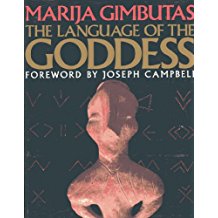 Marija Gimbutas coined the term “Old Europe” c.6500-3500 BCE to describe peaceful, sedentary, artistic, matrifocal, matrilineal and probably matrilocal agricultural societies that worshipped the Goddess as the power of birth, death, and regeneration in all of life.
 Feminism and Religion