It is in our hearts –one’s sense of superiority exists within. We are all and each capable of hate and bigotry.
It is considered the appropriate and necessary response to say that there is no room for it “here” – that we will not tolerate, in this case, white supremacy – here. Except here is exactly where it exists; here in our country, in our cities, in our communities, laws, structures, churches, homes, hearts and mind. The thread of a people’s sense of supremacy (power to dominate or defeat) has been woven into the fabric of this colonialist nation from the very beginning of what has come to be known as the United States of America. Continue reading “On the Events of Charlottesville, VA by Xochitl Alvizo”
It is quite common, I think, for Jewish feminists to gravitate to the first creation story of Genesis/Bereshit as an example of human equality but struggle to claim this same passage as an example of the goodness of embodiment. Genesis/Bereshit 1:27 reads, “So G-d created humankind in the divine image, in the image of G-d, the Holy One created them; male and female G-d created them.” In this passage, we have not only equality between men and women, in direct contrast to the second creation story, but also a description of human nature.
Our Creator made us in the divine image: b’tzelem Elohim. The most traditional explanations of b’tzelem Elohim describe our divine-likeness to mean: our intelligence, our capacity for goodness, our creativity as well as our inner divine spark. Most traditional teachings also understand this description as a prescription for action: since every single human being is made in the divine image, we must treat every single human being with respect, dignity, concern and so on. Continue reading “B’tzelem Elohim and Embodiment by Ivy Helman”
Several years ago, I was pastor of a welcoming and affirming church. As a queer clergywoman, I thought that such a place would be the perfect place to flourish and thrive as a pastor. And yet, because of heterosexist and sexist microaggressions, I found myself anxious, depressed, and in need of physical, emotional, psychological, and spiritual care.
After a three-day retreat filled with self-care and soul-nourishment at a non-profit retreat center that catered to activists and artists , I felt as though a tremendous weight was lifted off my shoulders, that I could focus and find clarity in my vocation. Pausing to care for myself gave me the courage to leave my toxic job and live more fully into my calling. This experience taught me the vital importance of self-care.
Womanist Audre Lorde once proclaimed, “Caring for myself is not self-indulgence, it is self-preservation, and that is an act of political warfare.” Because caring for the self violates the patriarchal norms that traditionally dictate that you should be the one caring for everyone else. Yes, everyone needs to pause to care for the self. But oppressed minorities have a particular need for self-care, not simply as a way of refreshing oneself in order to do the work of justice, but as a vital part of the work of social justice. Because caring for yourself in a society—and a church—that wishes for you to do otherwise is an act of political warfare. When feminists care for themselves, it is a radical act of soul redemption, spirit rejuvenation, and a political and spiritual act of acknowledging your holy and innate self-worth. In case anyone has told you that you are not worthy, let me reassure you. You are worthy. And you deserve to care for yourself.
While the Republicans in Congress and in state legislatures across the country are working to repeal and restrict a woman’s right to control her own body, the Democratic Party has decided not to “insist” that the right to abortion is a basic human right.
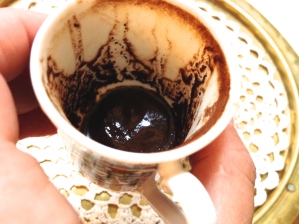
In my lifetime of researching women’s ritual dances in Greece and the Balkans, I have often come across related practices of divination or healing. One of these is the custom of coffee divination, the art of interpreting patterns in the fine grounds left in the cup after drinking Greek or Turkish coffee. The practice is found in Greece, the Balkans, Asia Minor, the Caucasus and the Middle East, and all over the world where people from these regions have emigrated. It is practiced mainly by women, particularly older women.[1]
Kafemanteía is related to much older techniques of divination and ritual, including the libations or liquid offerings which were an integral part of prayer in ancient Greece.[2] Sometimes, after the libation was poured, ‘the empty cup was examined for signs of oracle.’[3] The Old Testament mentions Joseph’s skill in divination by use of a cup,[4] while Istustaya and Papaya, the spinning and weaving pre-Hittite goddesses of destiny, divined using bowls of liquid akin to vessels used for scrying in many cultures.[5] The humble coffee cup can thus be seen as belonging to a long tradition of ceremonial vessels used in divination.[6]
Female figure in stance of invocation, with miniature votive shrines, pillars and cups or bowls for offerings. 5000 BCE, Netafim spring, Eilat, Israel.
In antiquity, Joan Breton Connelly makes clear, ‘religious office presented the one arena in which Greek women assumed roles equal and comparable to those of men,’ a fact which despite abundant evidence ‘has, until recently, been ignored by modern commentators or, worse yet, denied’.[7] In ancient Germanic, Celtic, Canaanite, Mesopotamian, and Anatolian cultures, ‘it was primarily women who were regarded as able to interpret signs and omens and to foretell the future’.[8]
Women who read cups today tend to view their ability either as a divine gift or as a talent learned or inherited from their mother, grandmother or aunt. The concept of inherited oracular or shamanic talent is an ancient one, according to Barbara Tedlock, who suggests that intuition as an ‘unconscious cognitive process’ may be ‘genetically determined in its structure and function.’[9]
In her 2005 book The Woman in the Shaman’s Body, Tedlock describes what she calls ‘the primacy of women in shamanism’, stating that ‘women’s bodies and minds are particularly suited to tap into the power of the transcendental.’[10] Her assertions have important implications for the discussion of kafemanteía as a women’s art, but also reignite feminist controversy about biological ‘essentialism’ and ways that theories about differences between the sexes have been used to justify oppression based on gender.
As an in-depth discussion of essentialism is not possible here, I highly recommend Carol P. Christ’s excellent posts on the topic for those who wish to think more deeply about these questions. As Christ shows, the assumption that ‘if there are sex differences they must inevitably determine behaviour’ is a flawed syllogism. Christ invites us to discuss these issues in a more open-minded way: ‘I think our feminist conversations would be richer if we could find ways to talk about sex differences without immediately jumping to the conclusion that it is regressive or anti-feminist to do so.’[11] In our discussion of kafemanteía, I suggest we remain open to the possibility that neurological and biological differences may have significance, though not in a deterministic way. Men can also be readers of coffee grounds and tea leaves, but the fact remains that most readers of cups are women. Why might this be?
The social component of kafemanteía is very important, offering comfort and company to both reader and querent. According to neurologist Louann Brizendine, women have both a greater need and greater capacity for the positive emotional interaction of this social relationship. Neurologically, the female brain contains more mirror neurons than the male brain, giving women an advantage in establishing emotional connection and triggering production of the anti-stress hormone oxytocin.[12] Rather than ‘fight or flight,’ female stress responses follow a behavioural pattern known as ‘tend and befriend,’ based on the maintenance of social networks that increase bonding and decrease stress.
Reading the patterns
The intuitive response when reading the patterns in a cup often comes from what we call ‘gut feelings,’ which, as neuroscientific research reveals, ‘are not just free-floating emotional states but actual physical sensations that convey meaning to certain areas in the brain.’‘ [13] As Brizendine shows, areas of the brain that track gut feelings are larger, more sensitive, and more active in women’s brains; thus ‘the relationship between a woman’s gut feelings and her intuitive hunches is grounded in biology.’ [14] A further element to consider is the fact that neurological activity in most men is left-brain dominant, while women’s brain function tends towards a more even balance between left- and right-hemisphere activity.
Finally, Barbara Tedlock presents fascinating information on protein and collagen matrices embedded in connective tissues in the human body, ‘composed of liquid crystals and biopolymers that behave as electronic conductors, storing large amounts of cognitive information.’ [15] Given that these matrices can be seen as the biological structure in which ‘somatic consciousness’ resides, I would venture to ask whether the greater proportion of fat cells in women’s bodies may enable greater cellular conductivity for storing and transmitting intuitive and cognitive information. I would love to see further research in connection with the biological tendency of women to accumulate more fat cells post-menopause, and the image of the older wise woman or crone considered in many cultures to have oracular or divinatory powers.
I have had my cup read many times on my travels, and have often been astonished by the accuracy of information offered by the reader, including precise personal details which she could not have possibly known. This remains a mystery. Although I support further study into kafemanteía, I acknowledge that in essence it appears to defy conclusive rational explanation and therefore may remain permanently impenetrable to the scholarly mind. Perhaps all we can do is to simply increase our awareness of, and respect for, this living divinatory art, and the older women who keep it alive worldwide. I would be interested to hear from others about their experiences!
This post is drawn from a much longer article I have recently written, ‘Kafemanteía: coffee divination as women’s prophetic art in ancient and modern times.’ It appears in the current issue of Walking the Worlds 3:2 (2017): 52-68, available from www.walkingtheworlds.com
Laura Shannon has been researching and teaching traditional women’s ritual dances since 1987. She is considered one of the ‘grandmothers’ of the worldwide Sacred / Circle Dance movement and gives workshops regularly in over twenty countries worldwide. Laura holds an honours degree in Intercultural Studies (1986) and a diploma in Dance Movement Therapy (1990). She has also dedicated much time to primary research in Balkan and Greek villages, learning songs, dances, rituals and textile patterns which have been passed down for many generations, and which embody an age-old worldview of sustainability, community, and reverence for the earth. Laura’s essay ‘Women’s Ritual Dances: An Ancient Source of Healing in Our Times’, was published in Dancing on the Earth. Laura lives partly in Greece and partly in the Findhorn ecological community in Scotland
References:
Barber, Elizabeth Wayland. The Dancing Goddesses. New York: Norton, 2013.
Brizendine, Louann. The Female Brain. New York: Morgan Road Books, 2006.
Christ, Carol P. ‘What If There Are Sex Differences But Biology Is Not Destiny?’ FAR February 16, 2015.
Christ, Carol P. ‘Has the Vatican Discovered that Women Should Be Running the World?’ FAR February 9, 2015.
Connelly, Joan Breton. Portrait of a Priestess. Princeton: Princeton University Press, 2007.
Green, Marian. “Wise Women Counsellors: Popular Methods of Divination.” In World Atlas of Divination, edited by John Matthews, 81-87. Boston: Little, Brown, 1992.
Karcher, Stephen. The Illustrated Encyclopedia of Divination. Shaftesbury, Dorset: Element, 1997.
Miller, Guldjin. The Secret Art of Coffee Reading. Australia: Guldjin Miller, 2015.
Seremetakis, C. Nadia. The Last Word. Chicago: The University of Chicago Press, 1991.
Shannon, L. ‘Kafemanteía: coffee divination as women’s prophetic art in ancient and modern times.’ Walking the Worlds 3:2 (2017): 52-68
Stone, Merlin. “Inner Voice: Intuition.” In Merlin Stone Remembered, edited by David B. Axelrod, Carol F. Thomas, and Lenny Schneir. Woodbury, MN: Llewellyn Books, 2014.
Tedlock, Barbara. The Woman in the Shaman’s Body. New York: Bantam Dell, 2005.
Tedlock, Barbara. “Toward a Theory of Divinatory Practice.” Anthropology of Consciousness 17:2 (2006): 62-77.
Walker, Charles. The Encyclopedia of the Occult. New York: Crescent Books, 1995.
Winkelman, Michael. Shamanism: A Neural Ecology of Consciousness and Healing. Westport, Conn.: Bergin and Garvey, 2000: 243-44. Quoted in Tedlock (2006):70.
I sometimes have to work hard at spirituality.
… And I haven’t been.
I have realized that lately, when I sit down to write blogs for this community, I have a difficult time incorporating one of the most basic FAR themes into my pieces: religion. I identify as agnostic—but that’s not really the problem. I am a spiritual person, or, have been. I was a deeply religious person as adolescent and young adult. After leaving my childhood faith, though it did take time, I was able to find a safe outlet to first, participate, and then, flourish in my spiritual life. I have found joy in deep meditations and rigorous, physical spiritual discipline. I believe in larger powers that are relational, shared, intentional, and sustaining. I appreciate the rich flavor to life that I have only had access to through the spiritual. But, at least right now, I am not participating in it. And to be honest, I sometimes think I am not fully participating in me. Continue reading “Working Hard at Spirituality by Sara Frykenberg”
In the early 1990’s I discovered the compelling story of Inanna, the ancient Sumerian Goddess, translated and retold in the book, Inanna, Queen of Heaven and Earth by Diane Wolkstein and Samuel Kramer. I was inspired to create a series of paintings from Inanna’s story.
My father died on July 6, 2017, 98 years, 4 months, 12 days. The last time I saw him was in the spring of 2004. During that visit, he gave me “the silent treatment” (refused to look at me or speak to me) when I stepped over an invisible line. That was not the first time, but it would be the last. When I gave lectures in California in 2008 and 2010, I agonized and yet made the decision not to visit him. I did not want to give him the chance to hurt me again.
My father and I kept in touch at Christmas and birthdays. In recent years we found our mutual interest in the family genealogy to be safe ground on which we could make contact. I was pleased to be able to tell him that I found the place of origin of our branch of the Christ family in Unterpreppach, Lower Bavaria when I visited Germany in the spring of 2016 with my cousin Bill. My father was with me in spirit when I visited the Christ family graves at Most Holy Trinity Roman Catholic Cemetery in Williamsburg, Brooklyn in the winter of 2016.
When my father had his first heart attack a few years ago, I agonized again and made the decision not to visit. I did not want to give him the chance to hurt me again. This time the decision was final. Continue reading “Grief and Healing by Carol P. Christ”
Over the past few months, a precious person has come closer into my family’s life in such a way that their presence in my home, among my loved ones, has come to feel natural and easy. This is someone I love, someone who adores my children and appreciates my partner of 18 years and whose sweet spirit and vibrant laughter have added joy and mirth to our family home.
Yesterday, they rode with me to drop my freshly-mohawked teenager off at a farm to help with preparations for an upcoming arts camp. I introduced them by name to the camp assistant and walked over to chat with the camp director for a bit. Later, as we got back into the car to head to lunch, I asked what they thought of the farm.
“It was nice,” they said. “I’m glad your children have a place like that. Also, while I was chatting with the camp assistant, she asked if I was family.”
“What did you say?”
“I said yes.”
They weren’t wrong.
The meaning the word “family” holds for me is something I’ve given much consideration over the years. For generations, many of us have been expected to turn a blind eye to the ways patriarchal domination of women’s and children’s bodies perpetuates abuse in our own family systems. My inability to sweep these abuses under the carpet, to keep silence and pretend all is well, has led to my estrangement from one entire side of my family. It’s an estrangement I feel will be permanent, and while I grieve the loss of an ideal I never had, I welcome the opportunity to live authentically and boldly, confident in my dedication to my ideals, which include honesty, justice, and the unconditional protection of children and vulnerable populations.
For a while, I sat with the gap this estrangement created in my life, unwilling to fill it with harmful relationships with those to whom I am blood-related, yet hesitant to broadly redefine it in a way that negates the importance of those who have chosen to love and raise up a child, however imperfectly. Continue reading “Family, Interdependence, and Mutual Support by Chris Ash”
While trying to find a topic for today’s blog, I came across a facebook post from July 10 by former Orthodox priest Christoforos Schuff in which he announced:
After reaffirming my beliefs on gender, sexuality, faith and the Church…and sharing my declaration of faith with His Eminence Jean, Archbishop of the Rue Daru Exarchate of the Ecumenical Patriarchate of Constantinople, I was asked kindly and respectfully to remove my cassock and cross. It is finished…with love, peace and mutual respect. May the Divine enlighten our minds and hearts!


 It is in our hearts –one’s sense of superiority exists within. We are all and each capable of hate and bigotry.
 It is quite common, I think, for Jewish feminists to gravitate to the first creation story of Genesis/Bereshit as an example of human equality but struggle to claim this same passage as an example of the goodness of embodiment. Genesis/Bereshit 1:27 reads, “So G-d created humankind in the divine image, in the image of G-d, the Holy One created them; male and female G-d created them.” In this passage, we have not only equality between men and women, in direct contrast to the second creation story, but also a description of human nature.
 While the Republicans in Congress and in state legislatures across the country are working to repeal and restrict a woman’s right to control her own body, the Democratic Party has decided not to “insist” that the right to abortion is a basic human right.


 I sometimes have to work hard at spirituality.
 In the early 1990’s I discovered the compelling story of Inanna, the ancient Sumerian Goddess, translated and retold in the book, Inanna, Queen of Heaven and Earth by Diane Wolkstein and Samuel Kramer. I was inspired to create a series of paintings from Inanna’s story.
  My father died on July 6, 2017, 98 years, 4 months, 12 days. The last time I saw him was in the spring of 2004. During that visit, he gave me “the silent treatment” (refused to look at me or speak to me) when I stepped over an invisible line. That was not the first time, but it would be the last. When I gave lectures in California in 2008 and 2010, I agonized and yet made the decision not to visit him. I did not want to give him the chance to hurt me again.
 Over the past few months, a precious person has come closer into my family’s life in such a way that their presence in my home, among my loved ones, has come to feel natural and easy. This is someone I love, someone who adores my children and appreciates my partner of 18 years and whose sweet spirit and vibrant laughter have added joy and mirth to our family home.
 While trying to find a topic for today’s blog, I came across a facebook post from July 10 by former Orthodox priest Christoforos Schuff in which he announced:
