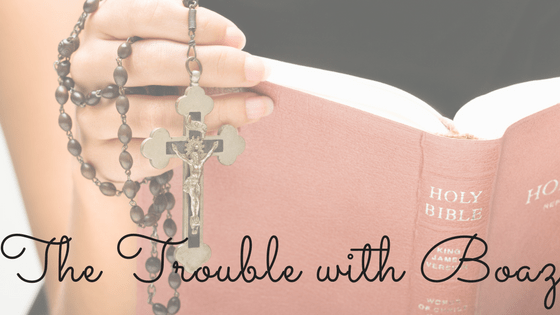
I’ve always been troubled by the story of Boaz found in the Book of Ruth. While there are plenty of biblical narratives that horrify me–Hagar, Tamar, and other “texts of terror” as Phyllis Trible called them–the story of Boaz is uniquely problematic in how it has been interpreted and applied by some Christian traditions, particularly among evangelicals. What is so insidious about this biblical re-telling is how the relationship between Boaz, a wealthy landowner, and Ruth, a foreign widow, is idealized as some kind of romantic love story.
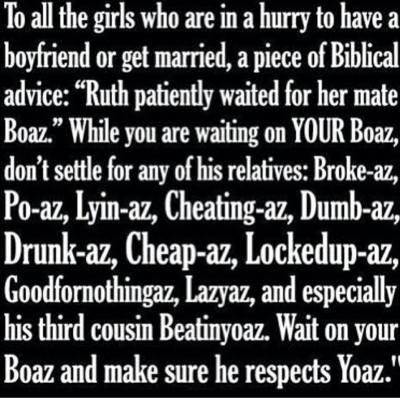
Waiting for your Boaz is a popular blogging platform among single white evangelical women who desire a husband. Their Facebook page alone has nearly 300,000 likes. For purchase on the main site is a book entitled 31 Days of Prayer for your Future Husband: Becoming a Wife Before the Wedding Day. The premise of Waiting for your Boaz is that if single women quit searching for a husband (i.e. dating) and pray for one instead, God will “write your love story” and like a matchmaker, will bring them one eventually.
While there are many troubling theological issues at play in this framework, for this particular piece I will focus on the cooption of the biblical narrative to uphold a worldview in which the fate of women is left to the whims of men and a male God.
In the biblical narrative Boaz is the distant relative of Naomi, Ruth’s mother-in-law. When the women are widowed suddenly and thus left destitute, they return to Naomi’s homeland in Bethlehem. (Orpah, Naomi’s other daughter-in-law who is also a widow, remains in Moab.) With no other known male relatives available to help them, Boaz is the women’s only hope for sustenance. He permits Ruth to glean the leftover crops after his fields have been harvested and instructs the workers not to bother her while she gathers food. While I acknowledge that Boaz acts kindly–or at least neutrally–toward Ruth, we ought not forget the immense power dynamics at play: Boaz is a native, wealthy, land-owning man while Ruth is a foreign, widowed woman with no rights.
At no other point in the narrative is this difference in power more evident than when Naomi insists that Ruth put herself at even greater risk–again for their collective well-being–by offering herself sexually to a drunk Boaz in the hopes that doing so might result in their continued protection.
This is not a fairytale. This is a story of survival.
In the end Boaz does offer Ruth and thus Naomi his protection through marriage. For two widows with no rights whatsoever, this is the best possible outcome, but it comes at great cost: namely Ruth’s bodily safety and autonomy which are threatened not only by her being a foreign woman working in the field, but also by her own mother-in-law’s admonition that Ruth offer herself as sexual collateral.
Single women ought to be praying for this? I think not.
Ruth does not wait. She cannot wait. Like many women, both ancient and contemporary, she uses what little power she has to do what is necessary in order to stay alive at great risk to her personal safety. Instead of admiring Boaz and his benevolent paternalism, our focus ought to be on removing the restrictions and confronting the injustices that leave women like Ruth and Naomi in such desperate circumstances in the first place.
 Katey Zeh, M.Div is a strategist, writer, and speaker who inspires communities to create a more just, compassionate world. She has written for outlets including Huffington Post, Sojourners, Religion Dispatches, Response magazine, the Good Mother Project, the Journal for Feminist Studies in Religion, and the United Methodist News Service. She is the co-host of Kindreds, a podcast for soul sisters. Her book Women Rise Up will be published by the FAR Press in March of 2018. Find her on Twitter at @kateyzeh or on her website kateyzeh.com.



 On a trip to Ireland several years ago, I was fortunate to have been able to see the Sheela-na-gigs in the National Museum of Dublin. Two of these Sheelas including the one removed from the Seir Kieran Church of County Offaly, pictured below, are currently on display. They stand at the doorway of a room dedicated to items from the medieval period and easily missed. As there was little interest in them and they are not in cases, I was able to silently commune without interruption.
 Today I am finishing the last bit of the honey I hand-carried home from my most recent trip to Trentino. Sun yellow in color, it is made from the nectar of mountain flowers. Its label tells its origin—di montagna, of the mountains, and its type — mille fiore, often translated as “wildflowers.” Literally, however, it means “a thousand flowers.”

 Even though snakes never inhabited Ireland, as in the rest of the ancient world both the serpent and the dragon were ancient symbols of life, fertility, wisdom and immortality for the Celts.
 These days I find it hard to write – I feel plagued with negativity, and the news and violence and overall hateful actions of others have weighed deeply on my soul. While I personally am ready to celebrate a milestone birthday, am another year closer to completing my Ph.D., witnessed the graduation of one daughter, experienced the independence of another, a milestone for my twins, as well as my father’s successful completing of another orbit around the sun after a year plagued with health issues – rather than joy, my heart is filled with pain – pain of the election, pain of the failure of our political system’s supposed checks and balances, pain of violence and bigotry like that enacted in Charlottesville, pain of terror attacks in England, Spain, Finland, France, etc. Where we ought to be united, we are divided. Thus, I write from a place of remembering – a place of strength – a place to say I count (as you count) – and I begin this blog in the voice of Enheduanna, where she becomes the first voice in history to reveal herself – her name, by simply stating – – “I AM.”