The following is a guest post by Mary Sharratt’s Welsh mare, Miss Boo aka Queen Boudicca
The ancient Romans and Gauls knew something that many modern day humans have forgotten. Mares are divine.
The worship of Epona was popular throughout the Roman Empire. Epona was a Gaulish deity whose name means “divine mare” or “she who is like a mare.” Epona was the the only Celtic divinity to receive her own official feast day in the Roman Calendar: Eponalia, December 18, was celebrated on the second day of Saturnalia, the Roman midwinter celebration (December 17 to December 23). But as far as we horses are concerned, every day is Epona’s Day! Go out and hug a horse right now!
The patron deity of horses, ponies, donkeys, and mules, Epona also protected those who looked after equines or worked with them. Thus she was beloved of the Roman cavalry. Epona’s worship stretched from Roman Britain, across Gaul and Germania to Spain, Rome, and Eastern Europe. Not only did she have a temple in Rome and her own holiday, but there were shrines to her in almost every stable. Her altars were adorned with fresh roses. Horses and donkeys were adorned with roses for her processions.
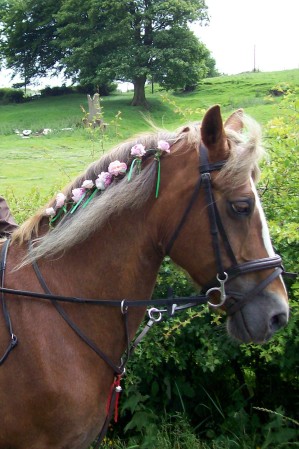
Some modern humans are inspired by these ancient traditions. At midsummer, my human ties roses in my beautiful mane when we ride out together.
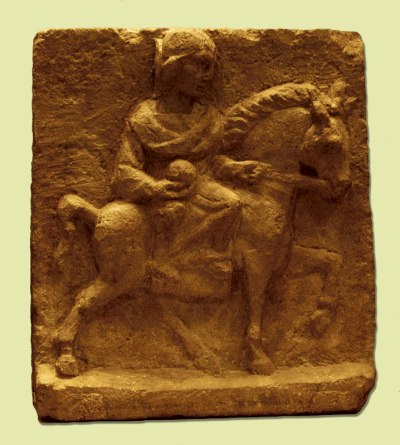
In her iconography, Epona is often depicted as a majestic woman riding side saddle, always travelling from left to right. In the image at the top of the page, “Epona from Kastel,” she is riding and carrying a round fruit or loaf. Epona is associated with abundance, fertility, and sovereignty.
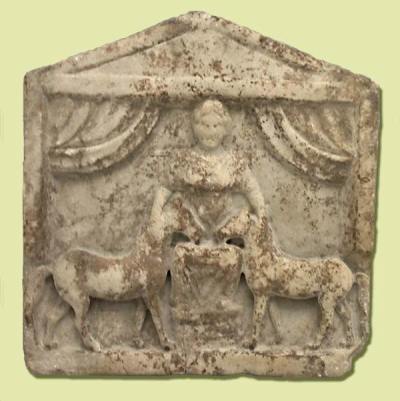
A votive image from Budapest shows Epona as a great sovereign lady seated between two horses who feed from her lap.
In the Middle Ages, Epona’s archetype lived on in literary figures such as Rhiannon in the Mabinogian.
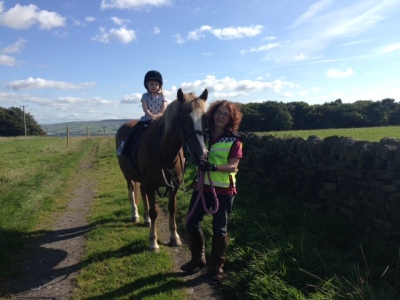
Epona was a nurturing mother figure, a giver of abundance and plenty. But what does this mean for us today? Anyone who has spent any time around us horses knows that we are capable of great empathy. Any person who is sad or depressed should spend some time just quietly grooming horses and being with them, and the healing will unfold. When my human is upset, I know right away and I’m especially gentle with her and give her lots of tender snuffles. I also love children and am extra careful around them. Here’s a picture of me with one of my little human friends.
People have reported great success using horses to treat autistic children and adults. Even people suffering from eating disorders can heal if they spend time with equines. Horses have huge hearts. Especially mares! We’re hard-wired to nurture.
Heartland Girls’ Ranch in Minnesota offers equine therapy to help heal sex-trafficked girls. Each girl is matched with a horse that she cares for and this partnership helps build back her sense of trust and self-worth.
The Romans celebrated Eponalia by giving every horse, donkey, and mule a day of rest. Modern humans who keep horses can observe this by giving their horses a day off and by offering them apples, which are sacred to Epona. Humans can also honour Epona by donating to equine charities, to Heartland Ranch, or your local horse rescue centre.
What would human civilization look like had there not been a millennia-long partnership between humans and equines? Have a heart for the horses who have carried their humans so far and so faithfully.
Links: Epona.net
Epona’s Day: The Gifts of Midwinter by Caitlin Matthews
Heartland Girls’ Ranch
Miss Boo aka Queen Boudicca is a Welsh mare who lives in the Pendle region of Lancashire. A hereditary Welsh trad witch in the most archetypal sense of the word, Miss Boo lives in deep communion with the Earth and is a keeper of ancestral wisdom. Miss Boo is a committed feminist, and she and her herd preserve an ancient matriarchal social structure unchanged since the dawn of their species. Don’t mess with chestnut mares! She is the proud owner of the author, Mary Sharratt. All royalties from Mary’s book sales will go to keeping Miss Boo in the style to which she has become accustomed. Visit her human’s website.


 Reflecting on our different choices to “stay or leave” the religions of our upbringings while writing Goddess and God in the World with Judith Plaskow, I was prompted to think again about the social and ethnic structures of denominationalism. One of the things Judith has been saying to me since we began discussing this question years ago, is that for her being Jewish is an identity that deeply affects her choice to stay within her religion.
 There is no correlation between difference and danger. Yet, differences are regularly considered threatening. In fact, much of Western society’s patriarchal energy is spent categorizing, controlling, managing and fighting difference. Difference is so ingrained within the psyche that most differences are understood to be antithetical, perhaps even unbridgeable, opposites. Good/bad, black/white, rich/poor, women/men and human/animal are just a few examples. To further amplify this distinction, patriarchy considers one aspect of the difference more valuable than the other.
  Yesterday morning when I learned about the
  A friend recently asked me whether I believed in sin. It was a strange question for me to consider because the concept of “belief” as applied to “sin” already suggests that sin itself is not a self-evident or manifest reality. Considering the question, I had to answer that I didn’t actually believe in sin as an objective ontic something. Hurt, wounds, violence, injustice, suffering – these are objective realities that I have no trouble identifying. It was in naming the contrast or painful human experiences as sin with which I had the difficulty, since sin connotes moral, spiritual, intellectual, or volitional defect or evil. My intuition pushes back against this reading of the suffering the world reflects, at least in the microcosm, the imperfection of creatures, or perhaps better put, animals, and in a best case scenario, animals in process.
 During the January 21st Women’s March in New York City, I was inspired and delighted by so many of the signs women and men had crafted to express their opposition to the current disastrous regime in the United States: “Grab America Back,” “Support Your Mom,” “Sad!,” “Miss Uterus Strikes Back.” But one image stood out, mesmerizing me: that of a woman proudly wearing an American flag as hijab, with a message below—“We The People Are Greater Than Fear.” For several blocks as we made our way up Fifth Avenue, I walked beside a woman carrying that sign, and it became, for me, the most powerful symbol of the resistance we must all wage during the dark time ahead.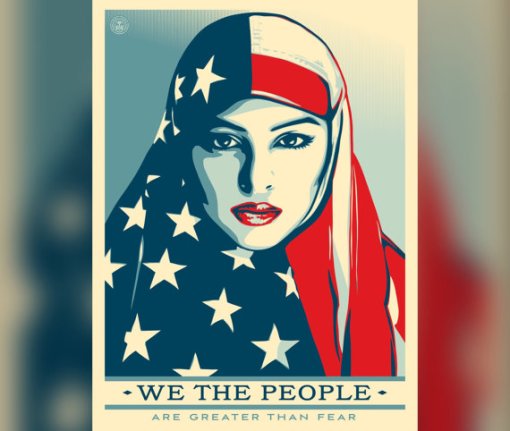

 In our book
  Activism and Politics have had a complex relationship with Hollywood. Now more than ever actors, directors, and many more associated with the media industry are using their voices, their positions, and their money to causes, political parties, and movements. More and more groups and reports are being generated stating the power of positive representation and even of the necessity of forward progress. Yet, despite the pressure and call for action, there still is heavy resistance, which can be most clearly seen during award season.
  Ever since reading Elie Wiesel’s book, NIGHT, I’ve identified with Madame Schächter, one of eighty Jewish people corralled and hermetically sealed inside one of the cattle wagons on the rail journey to Auschwitz from a ghetto in Sighet. The text tells us, “Madame Schächter had gone out of her mind.” Initially she moaned, confused as to why she had been separated from her family. She soon grew hysterical. “Fire! I can see a fire! I can see a fire!” When her fellow prisoners looked out the window and saw no fire, they attempted to silence her. Nevertheless, she persisted with her cries. They soon tied her up, gagged, and hit her. As the train approached its destination (Birkenau, the reception center for Auschwitz), Madame Schächter screamed, “Jews, look! Look through the window! Flames! Look!” When the Jews looked through the window this time, they saw flames “gushing out of a tall chimney into the black sky.”
 Did the ancient Celts believe in heaven and hell?
