Tikvah v’hashamayim (Hope and the Heavens): A Jewish Perspective on Redemption by Ivy Helman.

headshotThe Torah is bursting with hopes over-fulfilled.  Abraham and Sarah hoped for a child and gave birth to a nation.  The Israelites hoped for freedom from slavery and eventually received an entire Promised Land.  We understand hope and, in so many ways, we live on it, as hope has sustained us for thousands of years.  Today, our hopes inspire our actions and motivate us to work for peace, justice and equality.   In Jewish terms, we call this goal or vision of a better world in the here-and-now: redemption.

Yet, redemption does not just appear out of thin air or because we wish it.  Redemption and the hope of it requires work and cooperation with the Source of All Life.  As Deuteronomy 30:19 says, “I have put before you life and death… [therefore] choose life…”  This cooperation could be a simple commitment to tikkun olam, repairing the world (some times translated as social justice).  For others, choosing life could mean more observant religious practice.  It could also be a combination of the two.  In the end, though, I think both hope and redemption require choosing life in some form or another.

Just as how we choose life depends on who we are, how we achieve this redeemed world depends on how we understand G-d’s redemptive power.  Some of us think redemption will come through the moshiach (a savior), Continue reading “Tikvah v’hashamayim (Hope and the Heavens): A Jewish Perspective on Redemption by Ivy Helman.”

Third Time’s the Charm by Kecia Ali

dissertation, Advising, feminism and religionIn the space of a week, three obtuse remarks by non-Muslim men about Muslim women ticked me off.

First was a letter to the editor by Rabbi Howard Berman, published in the Boston Globe on April 21. The title (“Women’s Strides set Judaism apart”) was telling. According to Berman, strict religious hierarchy means that only in (his branch of) Judaism have women’s rights and roles advanced. Mormons and Catholics have no shot – never mind that Mormon women had recently raised the issue of women’s priesthood, or that lay and religious women among Catholics have long been fighting the good fight, sometimes with male allies. He then contradicts himself on the role of official hierarchy: Islam, where there is less centralization than in American or world Judaism, also gives women no chance of gaining authority.

I fumed and mentally composed a pithy refutation, which I never actually wrote. Continue reading “Third Time’s the Charm by Kecia Ali”

Deciding to Leave or Remain in the Religion of Your Birth – Part II by Judith Plaskow

Photo by Manhattan College

This is a response to Carol P. Christ’s blog of April 29, 2013 on why she decided to leave the Christian tradition. Carol and I discuss these questions further in our forthcoming book Goddess and God in the World: Conversations in Embodied Theology.

You raise the important question of what factors lead feminists to leave or remain within the religion of their birth. Your central challenge to me is how I can commit myself to a tradition in which God is imagined as a violent warrior when these images have harmed and continue to harm women and the world. How can I not recoil from using such images in worship? Why is the power of symbols less important to me than to you?

The first thing I would say is that, like you, I find these images profoundly problematic. One of the projects I have taken on in my retirement is reading the Bible from cover to cover, and I was appalled in going through all the prophets together at the amount of violence in their teachings. When I have spoken on the topic of dealing with difficult texts in the Jewish and Christian traditions—a subject that is dear to my heart—I always talk about God’s violence in addition to texts that demean women. And, yes, I have sometimes asked myself how I can remain part of a tradition in which God is depicted in this way. So I do not disagree with your critique of this imagery, but obviously for me, it is not decisive. Why not? Continue reading “Deciding to Leave or Remain in the Religion of Your Birth – Part II by Judith Plaskow”

Gender in Kabbalah by Judith Laura

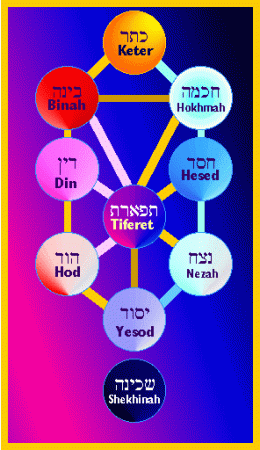
Judith LauraI first started delving into both Jewish Kabbalah and Hermetic Qabalah in the 1990s, after friends told me these forms of mysticism included both female and male representations of divinity and therefore were gender equitable. They were right about the first part: Kabbalah/Qabalah contain both divine masculine and feminine imaging and male and female images.  But as far as gender equity goes, to use today’s slang, not so much!

tree of life kabbalah

Though they are both transliterations of the same Hebrew word, as is common I use “Kabbalah” for the Jewish versions, and “Qabalah” for the Hermetic version, best known through its association with the British Hermetic Order of the Golden Dawn, which began in the 19th Century. The word means “that which is received,” with the understanding that it was “received” from ancient times. Though there is one tradition that says Adam was given Kabbalah in the Garden of Eden, the first written material for Kabbalah, Sefir Yetsirah (Book of Creation), is dated to between 200 and 500 C.E. Kabbalistic concepts changed over the centuries, with writings becoming more significant in the 13th century and even more popular in the 16th and 17th centuries.

Beginning with the Sefir Bahir (Bright Book) in late 12th century France, Kabbalah is represented by the Tree of Life, which has round areas transliterated sefirot (Heb. pl.; sing. sefirah) that I think of as fruit and others call “spheres,” but which in the Bahir, are more accurately translated “sapphires.”*  These “divine emanations,” as they are often called in English, are gendered. How equal is the gender representation? Continue reading “Gender in Kabbalah by Judith Laura”

“From Teshuvah to Justice: Jonah’s Call to Change” by Ivy Helman

(I offer here an abridged version of the sermon I gave on Yom Kippur (5773) at Temple Emanuel in Lowell, MA.  The full version will be available on their website soon.  The book of Jonah is always read on Yom Kippur in the afternoon service as the Haftorah.  It is rather traditional that someone (usually the Rabbi) offer an interpretation of it.  Temple Emanuel asked me this year.  I thank the congregation for the honor and I hope my words offered them, and now you, food for thought.)

Scholars believe the Greek philosopher Plato lived between 428 BCE and 348 BCE.  The Allegory of the Cave is one of Plato’s most famous stories.  It illustrates the effects of a change in knowledge, education and experiences on the human being.  Some of you may know it or have read it at some point but for those of you who don’t, let me offer a very brief summary.

There are human beings shackled to a cave in a way that they can only see the wall directly in front of them.  Continue reading ““From Teshuvah to Justice: Jonah’s Call to Change” by Ivy Helman”

Yom Kippur as Seen (With Respect) by a Pagan By Barbara Ardinger

No matter which or how many gods we believe in, thinking about what we’ve done wrong and how we can set it straight is useful. The Day of Atonement, the Talmud says, “absolves from sins against God, but not from sins against a fellow man unless the pardon of the offended person is secured.”

 Back in the Stone Age, otherwise known as the early 1980s, I had jobs as a technical writer and editor in five different industries, including aerospace and computer development. Hey, I was trained as a Shakespearean scholar, but in those days—pretty much like today—there were almost no jobs in the academy for newly-hatched Ph.D’s. So I tried technical writing. At one of the aerospace jobs, I sat in the “bullpen”—me and nineteen middle-aged white guys—whereas all the other women slaved—on typewriters in that pre-computer age—in the typing pool. There was a major class distinction in that aerospace firm, and I was glad to be with the guys. (Yes, shame on me.) Those were the days of 9 to 5. As far as I’m concerned, that movie is nonfiction. Continue reading “Yom Kippur as Seen (With Respect) by a Pagan By Barbara Ardinger”

How literal is too literal? My Experience with Tallit Katan. By Ivy Helman

I tried a new spiritual practice yesterday.  I wore a tallit katan.  It is commonly worn by Orthodox, Hasidic and other Ultra Orthodox men and boys from the age of 3 onward and usually not worn by women within these communities.  Occasionally, one can see Jews (mostly men) from Conservative shuls wearing these garments and rarely from Reform congregations.  They seem to be a marker of a more observant Jewish practice that reads much of the Torah literally.  One is commanded to wear fringes (tzitziyot) when wearing four-cornered garments as reminders of the covenant between G-d and the Jews and more specifically of the 613 commandments.

There are a number of reasons women and men from Orthodox and ultra Orthodox communities give for discouraging women from the wearing of tallit katan and tallit gadol.  First, women are said to be exempt from time-bound mitzvot, or commandments .  Wearing tzitziyot are considered time-bound because the Torah says one should be able to see them which has been interpreted to mean that they be worn during the day.  The reason given that women are not held to time-sensitive mitzvot has to do primarily with their childcare responsibilities.  Children and fulfilling their needs often requires much time and may not allow one to complete a task within a given time frame.  A related ideology says that women are often generally thought to be more spiritually attuned, and therefore do not need such physical reminders to follow the mitzvot. Continue reading “How literal is too literal? My Experience with Tallit Katan. By Ivy Helman”

Silencing Miriam: Prophetess, Liberator, and Leader By Michele Stopera Freyhauf

The prophetess Miriam, Aaron’s sister, took a tambourine in her hand, while all the women went out after her with tambourines, dancing; and she led them in the refrain: Sing to the LORD, for he is gloriously triumphant; horse and chariot he has cast into the sea.”(NAB, Exodus 15:20-21)

The Song of Miriam is not a story of death and destruction, but rather liberation.  It is a poetic celebration of God’s liberation of the Israelites from the oppressive Egyptians, which, according to Bernhard W. Anderson in “The Song of Miriam Poetically and Theologically Considered,” marks the beginning of the Israelite tradition (292).  Phyllis Trible in “Bringing Miriam out of the Shadows” states that this act marks the end of the Exodus, which was started by Miriam, not Moses (169, 172).  The act of liberation reveals God’s action in humanity.  Gerald Janzen in Exodus believes this act also moved the Israelites “to fear the LORD and believe in the LORD and in his servant Moses” (109).  The uniqueness of this passage is that the most unlikely person leads – this person is not a man but rather a woman.

This brief passage in the Hebrew Scriptures is revelatory – Miriam is revealed for the first time.  She is a prophetess, Aaron’s sister, and the role of leader of the victory dance to honor the Divine Warrior.

Continue reading “Silencing Miriam: Prophetess, Liberator, and Leader By Michele Stopera Freyhauf”

Why a Kippah Reminds Me that Rationality Should Not Be Our Only Imago Dei By Ivy Helman

Neil Gilman in his book Sacred Fragments writes, “Since our faculty of reason is G-d-given, since it is the quality that distinguishes us from the rest of creation, and since all human beings share that same innate faculty, what better way to establish the veracity of a religious tradition than by demonstrating its inherent rationality?”  To be fair, Gilman is not the only and definitely not the first to support this position.  Many theologians, especially those influenced by various Greek philosophers like Socrates, Plato and Aristotle, have said the same thing.  In the Roman Catholic tradition, Thomas Aquinas is adamant that rationality is humanity’s imago dei, how we are made in the image of God – what the beginning of Bereshit (Genesis) suggests.  Descartes argues, “I think therefore I am.

Patriarchy emphasizes rationality as divinely given over and above other attributes that humans share with non-human life – like instinct, growth and maturity, life and death, memory, caring, empathy, dependence, interconnectedness, relationality, and communication (in all its forms, not just speech).  Continue reading “Why a Kippah Reminds Me that Rationality Should Not Be Our Only Imago Dei By Ivy Helman”

The Transformative Power of Daily Practices by Ivy Helman

My simple daily rituals and spiritual practices are what keep me mindful of G-d and G-d’s presence in my life.  They also remind me of G-d’s call to justice, care, compassion and love. 

“I find by experience, not by reasoning,

but by my own discovery that G-d is near me,

and I can be near G-d at all times.

I cannot explain it but I am as sure of my experience

as I am of the fact that I live and love,

but I know I do.

In the same way, I know I am in contact with G-d.”

This poem by Lily Montagu speaks to me.  I read it most mornings as I say my morning prayers, and it is one of those mantras I try to live by.  I have found that contrary to popular belief, sustained religious practices can be just as transformative as instantaneous conversion experiences.  This is why I have developed certain spiritual and specifically Jewish practices (For more about my joinery to Judaism, see one of my previous blogs “Reflections on my Spiritual Journey: Claiming Judaism”).  I find that they help me develop and cultivate a strong relationship with G-d.  For example, I keep a kosher home; wear a kippah daily; try to pray at least twice a day and before snacks and meals; practice the principles of Mussar; attend regularly Shabbat services Friday evenings at my Reform Congregation in Lowell and Saturday morning services at a Conservative congregation in Nashua, NH; light Shabbat candles; try not cook or create on Shabbat; make Havadalah to mark the end of Shabbat; give tzedakah as much as I can and study Torah with my friends.  This list is not all encompassing and there are quite a few areas of my practice I wish were more disciplined as well.

Continue reading “The Transformative Power of Daily Practices by Ivy Helman”