Ignorance and Invisibility by Ivy Helman

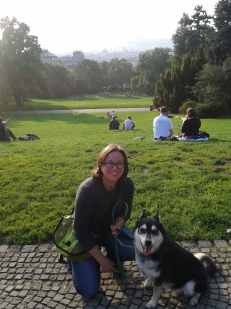
20140903_180423According to the United States Holocaust Memorial Museum, the Jewish population of Czechoslovakia numbered some 357,000 in 1933. By 1950, it was recorded to be 17,000. To be sure, some escaped to Israel or the United States. Yet, within the modern boundaries of the Czech Republic, some 77,000+ perished. You can find the names of the dead inscribed on the walls of Prague’s Pinkas Synagogue. The Jewish community here remains extremely affected by the effects of WWII and the lingering legacy of communism.

How much of that did you know? Did you know that Prague is home to what the Nazis once wanted to call the “Museum of an Extinct Race”? Did you know that most of the synagogues in this entire country are boarded up, torn down or used for something else? Did you know that the entire Jewish Quarter of Prague was almost destroyed until someone stepped in and persuaded others to preserve it? Did you know that Western media is saying that Jewish life in Prague is undergoing a grand rebirth, while at the same time, most tourists leave Prague thinking there are no Jews here anymore? Continue reading “Ignorance and Invisibility by Ivy Helman”

A New Perspective on the Story of Ruth by Ivy Helman

20140903_180423When I think about having returned to the Judaism of my family, I often think about a short phrase that is on almost all of the conversion documents I’ve seen. “Your people shall be my people and your G-d shall be my G-d.”  It comes from the Book of Ruth and is a powerful phrase in and of itself.  Imagine choosing a journey to a foreign land and being so committed to the person you are traveling with that you are willing to forsake the religion and practices of your people to join hers, even when she extorts you to return to your home.   Think about the kind of trust one needs in another to be able to leave everything behind and follow another path.  That is ideally what the convert to Judaism has chosen: to leave behind their past, setting out on a new religious path.  In fact, it is often frowned upon to ask a convert about their religious past because it is as if it never existed.

Besides these documents, I’ve also encountered the Book of Ruth early in my training as a feminist scholar of religion.  I read many commentaries on the story of Ruth, but what I read never spoke to me.  Yes,  two women were bonded in a deep friendship (perhaps as lovers) struggling to survive and avoid bouts of harassment from men. They also defied patriarchal standards of the day.  Sweet and touching, yes.  A good example of the importance of friendship between women, definitely!   What I 20140904_125500didn’t get then that I do now are the values elevated in these two women.

First, what struck me is just how much our pasts are an important part of who we are.  In many ways, they help to shape our futures.  Ruth’s past built within her the values necessary to make the decision to journey to a foreign land with another woman and without what, could be thought of, as adequate protections.

Continue reading “A New Perspective on the Story of Ruth by Ivy Helman”

Painting Tiamat/Tehom by Angela Yarber

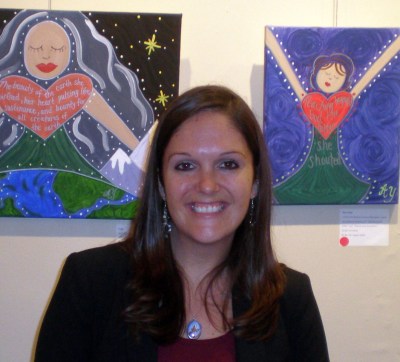
angelaToday I am honored to give a lecture on “Queering Iconography: Holy Women Icons from Sappho to Pauli Murray” at the North Star LGBT Center in Winston-Salem, NC. So, I want to continue the theme of featuring some of my queer Holy Women Icons. Joining Virginia Woolf , the Shulamite, Mary Daly, Baby Suggs, Pachamama and Gaia, Frida Kahlo, Salome, Guadalupe and Mary, Fatima, Sojourner Truth, Saraswati, Jarena Lee, Isadora Duncan, Miriam, Lilith, Georgia O’Keeffe, Guanyin, Dorothy Day, Sappho, Jephthah’s daughter, Anna Julia Cooper, the Holy Woman Icon archetype, Maya Angelou, Martha Graham, Pauli Murray, La Negrita, and all my other Holy Women Icons with a folk feminist twist is the often overlooked and misunderstood primordial goddess of creation: tehom.

In Genesis 1 we read, “In beginning, God created the heavens and the earth, the earth was a formless void and darkness covered the face of the deep, while a wind from God swept over the face of the waters.” It is the creation narrative held dear, formative, and meaningful for countless Jews and Christians. Interestingly, this word, deep, in Hebrew is tehom. Tehom translates as “deep or depths,” but it’s also a cognate for Tiamat, a Babylonian Goddess of creation. Out of the face of the deep, the world begins. Out of tehom, God creates. Out of Tiamat, the earth comes into being. This dancing Babylonian goddess syncretistically intermingles with the creation myth so pivotal to the faith of Christians and Jews in a way that could be terrifying, or beautiful, or—like the chaotic body of Tiamat that brings the world into being—both. Continue reading “Painting Tiamat/Tehom by Angela Yarber”

JUSTICE AND PREJUDICE IN THE “PROPHETIC TRADITION” by Carol P. Christ

carol christBesides being advocates of social justice, the prophets of Israel were advocates of “exclusive monotheism,” exclusively “male monotheism,” “religious othering,” and “religious prejudice.” 

Many progressive Jews and Christians find inspiration in prophets because of their insistence that their God cares about the poor and “the widow at the gate.” For progressive Christians, Jesus stands in the prophetic tradition, and the core of his message is “concern for the poor.” For progressive Jews the prophetic tradition is the root of their concern for human rights.

Those who locate their spirituality and concern for social justice in the prophets can point proudly to Martin Luther King and the many priests, ministers, and rabbis, as well as ordinary Christians and Jews who marched with him as exemplars of the prophetic tradition.

But the prophetic tradition also has a nasty underside. Continue reading “JUSTICE AND PREJUDICE IN THE “PROPHETIC TRADITION” by Carol P. Christ”

Wrestling with Jewish Learning By Casey Tova Markenson

TOVA_01You will be handed a sheet of paper. The paper will have a quote from the Torah or the Gemara or Abraham Joshua Heschel. The ‘what’ and ‘who’ and ‘why’ behind those sources will not be explained. You will read the passage and reflect on it with a partner. In ten minutes, you will share a piece of your conversation with the rest of the group. Then, the Jewish part of the Jewish social justice program you’re about to experience will be complete.

I have read and reflected on countless texts as part of that ritual. I don’t remember any of them. I do remember being embarrassed that I didn’t know who Rebbe Nachman was. I remember sensing that my training in literary criticism didn’t “count” as Jewish knowledge. I do remember every time I revealed that I misunderstood a detail or a Hebrew word, and all of the times that a (usually male identified) peer excessively explained it.  I remember feeling left out of an exclusive club, one that I was embarrassed to want to join to begin with. Continue reading “Wrestling with Jewish Learning By Casey Tova Markenson”

Pesach, Patriachy and the Unfinished Work of Liberation.

headshot2Pesach, or Passover, begins tomorrow at sunset. It has always seemed strange to me that a festival centered on liberation begins with a focus on housework and cleanliness to the point where one is almost a slave to the process of chametz (leavened food) removal.  Not only that, but the spiritual interpretation of what the chametz represents adds to this conundrum.

The Rabbis of the Talmud teach us that chametz represents egotism and arrogance. The divine instruction to eat only unleavened bread for the festival of Pesach is a call to cultivate humility because they believe that our inflated sense of self-worth causes harm to other human beings as we value ourselves and our lives more than them. As we remove the chametz from our homes, we are also supposed to be removing the self-centeredness, arrogance and egotism within ourselves. Cultivating humility redirects our attention to all those parts of our lives that have suffered by being too self-centered, including our relationship with the Holy One. Continue reading “Pesach, Patriachy and the Unfinished Work of Liberation.”

The Politics of Miztvot by Ivy Helman

headshotRecently, Ben of Ben’s Tallit Shop commented on an older post of mine on this website entitled: “How Literal is Too Literal? My Experience with Tallit Katan.   He wrote, “In my opinion, it makes sense to first try the mitzvah of tzitzit in private for a month or two to ensure you are undertaking it for the right reasons.  Making a political statement is not a valid reason (though some people, I imagine, would argue otherwise).  Mitzvahs and politics don’t mix.”

First of all, this comment is both sexist and patronizing!  A man would never suggest to another man to do what he suggested I do and “try the mitzvah… in private… to ensure you are undertaking it for the right reasons.”  I’d dismiss it entirely if I was that kind of person, but I’m not.  Sexism and patronizing aside (as if one could do that really), I would like to engage with his thoughts on the mixing of politics and mitzvot because I think that can lead to great reflection and insight for Jewish feminists.

Not all mitzvot have an inherently political nature, but many do.  In fact, one could even argue something as seemingly apolitical as lighting Shabbat candles could be political.  Lighting candles ushers in Shabbat peace for one’s household and ideally for one’s community even if that peace is only for one day a week.  Since this is at odds with the world’s political environment of fighting, war and violence, it could be interpreted as a political act.  After all, won’t every day in the redeemed world be Shabbat? Continue reading “The Politics of Miztvot by Ivy Helman”

Sex, Religion, and Discourse: An Interview with Judith Butler

One of my academic joys is interviewing people I find particularly interesting (see most of my posts here). This time I am honored to present a recent interview I did with Judith Butler.

Image from The European Graduate School

Many wonder how gender performance relates to chromosomes, phenotypes, genitalia, and other scientific “evidence” for innate sexual differences. Continue reading “Sex, Religion, and Discourse: An Interview with Judith Butler”

Why I Don’t Believe in Female Pastors by Andreea Nica

Andreea Nica, pentecostalismIt may come as a surprise to those who identify as both feminists and religious practitioners that I don’t believe women should be pastors of any dominant religious congregation. This includes most religions which, I assert, are rooted in and structured by the tenets of patriarchy. Does that mean I think women should be congregants of a patriarchal-originated religious system? You guessed it – no. While this may seem like a radical notion to some, it took me quite some time to come to terms with my own conflict in being both feminist and a believer.

My transition from the Pentecostal sect was a long, intricate process that involved life-altering decisions. The notion of leaving the church was driven by my immersion in women’s studies during my undergraduate degree. There were many difficult questions I simply didn’t have an answer for, as the church didn’t provide me with them.

One of them being: Can women instruct an entire congregation of believers?

For those who are female pastors, I’m sure you’ve heard this one a million times, but somehow it never fades from religious and secular discourse. Whether it’s the Islamic, Jewish, Christian, or Mormon faith, women have had to constantly fight for their right to preach religious doctrine. In the beginning of my transition, I was on the side of: Preach it ladies! Continue reading “Why I Don’t Believe in Female Pastors by Andreea Nica”

On the Path of Holiness by Ivy Helman

headshotGrowing up, there was a way in which I always felt excluded from holy things.  There was the holy: blessed water, sacred oil, priestly blessings, consecrated priests, pilgrimage sites, religious buildings and communion to name a few and then there was everything else including me.  Yet, I was a good kid who always (or almost always) did as I was told.  Doing good works is not contrary to a Catholic childhood or education.  In fact, it is an integral part of Catholicism, but there is also a competing notion that good works are in a different ontological category from holiness.  While goodness merits salvation, salvation is not connected to being holy.  Holiness was granted; salvation was earned.  In addition, holiness also seemed more distant because men had more access to holiness than women did.  Only men could be ordained and priests consecrate the Eucharist, celebrate the sacraments and bless people and things.  These are all holy things and the closer one interacts with holiness, the more holiness is bound to transfer onto the person coming into contact with them. Continue reading “On the Path of Holiness by Ivy Helman”