


The legend of La Llorona has been a part of Hispanic culture in the Southwest since the days of the conquistadores. Though the tales vary from source to source, the one common thread is that La Llorona is a woman named Maria who is always dressed in a white gown, the spirit of a young Mexican mother who drowned her children in the river in a moment of rage or abandonment by her lover and then took her own life in her deep shame and sorrow. La Llorona’s disembodied spirit is said to haunt the rivers at night – especially the Rio Grande – where she can be heard weeping in remorse for her dead children. Children are cautioned not to go out after dark because La Llorona might murder or drown them too. Because the tale of the Weeping Woman originated with the Patriarchal Spanish conquest I have always been suspicious of the various versions of this story believing that its meaning has been distorted.
Immediately what comes to mind is the Mater Dolorosa, Our Lady of Sorrows, or Mother of Sorrows. All refer to the Virgin Mary, the only goddess left in Christianity. Our Lady of the Seven Sorrows is another name used to refer to this goddess. The Mater Dolorosa is also a key subject for Marian art in the Catholic Church.
 Human beings tell stories. This may sound like a simple truth. To folklorists, literature professors, and people who work in media and in government, I would sound like a rather simple-minded child to be arriving so late in life at this obvious fact. We tell stories. And, just as the phrase “telling a story” might connote, our stories are not always true to life. Our stories are descriptors and meaning-making efforts, largely rooted in our grappling with self and group identity.
 Click
Click 


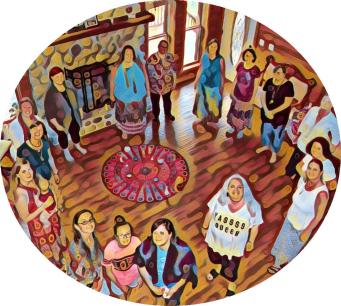 tapestries, their faces are turned towards me, waiting expectantly. We are here for our first overnight Red Tent Retreat, our women’s circle’s second only overnight ceremony in ten years. We are preparing to go on a pilgrimage. I tell them a synopsis version of Inanna’s descent into the underworld, her passage through seven gates and the requirement that at each gate she lie down something of herself, to give up or sacrifice something she holds dear, until she arrives naked and shaking in the depths of the underworld, with nothing left to offer, but her life.
 This year the summer solstice occurs on Tuesday, June 20 in the Northern Hemisphere. (In the Southern Hemisphere, it’s the winter solstice and it occurs on June 21.) For us in the Northern Hemisphere, the summer solstice is the longest day of the year. The word “solstice” means “sun stands still.” It’s when the sun reaches its highest point in the sky and seems to stand in the same place before it begins moving toward the winter solstice. We like to think that the primary solar deity is Apollo, but there’s a whole crew of solar gods who are born near the winter solstice and live for a season in great honor, after which they’re sacrificed, spend a season underground, and are reborn.
