

 A magical moment occurs when in the dappled light of forest trees you spot a gentle doe staring at you with her deep, dark, liquid eyes. We all feel the grace and peace she bestows – awestruck by an instant of unity.
Category: Goddess Spirituality
Yes, there are Goddesses in the Bible, Part 4 by Janet MaiKa’i Rudolph
 This is the 4th in a series of blog posts about finding goddesses in the bible who had been hidden away through translation or denigration or other means. In my last blog post I discussed Lilith as a Great Goddess symbolized by both tree and bird. You can see it here.
Today I continue with the topic of trees along with an examination of reversals and how many of beautiful, female pagan symbols were changed or removed from the texts. Perhaps the most obvious and pernicious has been that Eve “caused the fall” of humankind through a sinful act. Thus, the logic goes, it was Her action that has created the “grand curse” that we have labored under ever since. As I wrote in my last blog post, Lilith is another example, being portrayed as a demon in order to denigrate her Great Goddess roots. Lilith originally embodied both bird and tree energies. In my last blog post I showed one image of the Goddess in the tree which was a common theme in ancient Levantine cultures. The image today shows the goddess breast in the tree, which is identified as Isis suckling the future pharaoh Tutmose III. These images show the “Goddess in the Tree” as freely bestowing Her gifts and nurturing (not cursing) humankind. Continue reading “Yes, there are Goddesses in the Bible, Part 4 by Janet MaiKa’i Rudolph”
Yes There are Goddesses in the Bible, Part 3
 This blog post is the 3rd in a series of looking for female deities in the bible who have been translated out of easy reach or otherwise hidden within its words. In my last blog post I discussed bird imagery and the bible. It is available here.
You can’t complete a discussion about birds without also bringing up Lilith. She appears by name only in one place in the bible; Isaiah 34:14. Isaiah uses the word liyliyth as a feature in a hellish landscape. Although it is also a name, liyliyth is treated as a common noun. The most prevalent translation is “screech owl” although others have included such names as night creature, night monster, night hag, and she-vampire. Continue reading “Yes There are Goddesses in the Bible, Part 3”
Yes, There are Goddesses in the Bible – Part 2 by Janet Maika’i Rudolph
As I wrote in my last blog post, there are female deities and goddesses sprinkled all throughout the bible. They just aren’t obviously in plain sight.
One example is the Goddess and Her association with birds. Many ancient creation myths have stories about life emerging from a cosmic egg and the Goddess who carries and/or lays that primordial egg-of-life. Like the bird, women carry the eggs of life’s creation within our bodies. This has given rise to numerous cultural symbolisms that have come down to us associating the Goddess with birds. The dove is Venus’ hallmark. Mother Goose is the keeper of our cultural stories. It is the stork who brings us babies. As I will show below, divinity, or the biblical LORD is sometimes depicted as a bird, making this biblical description of god a female. Continue reading “Yes, There are Goddesses in the Bible – Part 2 by Janet Maika’i Rudolph”
Yes, There are Goddesses in the Bible by Janet Maika’i Rudolph

“Freud once asserted that mortals are not made to keep secrets;
what they would like to conceal oozes from all their pores.”
Psychoanalyst Theodore Reik[1]
It’s remarkable how much female imagery there is in the Bible hidden within its wording. The more I delve into its passages, the more that I have found these hidden/not so hidden sacred feminine images, even deities. I have begun a project of digging in and rooting out these little gems. When people think about the sacred feminine or female deities in the Bible the most well known is the Shekinah. The Shekinah is a lovely presence. The word means “dwelling” and usually represents “god’s divine presence” or a place where the divine resides.
The problem is that the Shekinah as a feminine essence of the divine is never stated explicitly, it is an interpretation of how the word is used. I love the concept of the Shekinah but as an essence that upholds the entire weight of the feminine divine in the bible, I find it unsatisfying by itself. Luckily for me, Goddess Shekinah has lots of company. Sometimes they are indeed hiding in plain sight. Sometimes they hide in the translations. The passage I am presenting today has some of both going on. The following is the King James Version of Genesis 49:25. Jacob has been giving blessings to each of his sons and this is part of the blessing he gives to Joseph: Continue reading “Yes, There are Goddesses in the Bible by Janet Maika’i Rudolph”
Butterfly – Soul Transformation by Judith Shaw
I offer this look at the life and stories of Butterfly as a healing salve for our very troubled world. In this time of great, world-wide transformation, as we grapple with the many, many racial, social, economic and environmental injustices currently tearing the fabric of society apart, may the lessons that Butterfly brings help us on our path to love.
Continue reading “Butterfly – Soul Transformation by Judith Shaw”
Cow, Nursemaid to Humanity by Judith Shaw
Our human connection to Cow goes back to the days of prehistory. Aurochs (wild oxen), cattle’s wild ancestors, are found in prehistoric cave art throughout Europe, India and Africa. About 10,500 years ago modern cattle were domesticated from only 80 wild oxen in southeastern Turkey. This was not an easy task as wild aurochs are much bigger than cattle and not at all docile. But succeed they did and cattle became a foundation of human civilization. They provided not only food and clothing but also became beasts of burden for agriculture. An estimated 1.4 billion cattle exist today.
Continue reading “Cow, Nursemaid to Humanity by Judith Shaw”
The Serpent and the Goddess by Judith Shaw
The otherworldly energy of Snake – it’s vitality, its uncanny ability to sense danger, and its ability to shed its skin and reappear as if reborn must have invoked feelings of awe in our ancestors. All across the pre-historic world one finds depictions of Snake and the spiral or meander as Snake’s symbols.
Continue reading “The Serpent and the Goddess by Judith Shaw”
Tlachtga, Forgotten Celtic Goddess – by Judith Shaw
I am the Sun – bringer of the warming light of day. I am Lightning – bringer of fire to Earth. I am Tlachtga who flew through the sky together with my father Mog Ruith in our glowing wheel. I am destruction and creation. I illuminate the darkness and point to the pathway of light that resides in each of you. Over time I made my final resting place at the Hill of Tlachtga, where the great fire ritual of Samhain is practiced, reminding the folk of the promise of Sun’s return at the end of the time of darkness and dreaming.
Continue reading “Tlachtga, Forgotten Celtic Goddess – by Judith Shaw”
To Light a Flaming Pumpkin: The Inexact Art of Family Ritual, by Molly Remer
Our bounty is in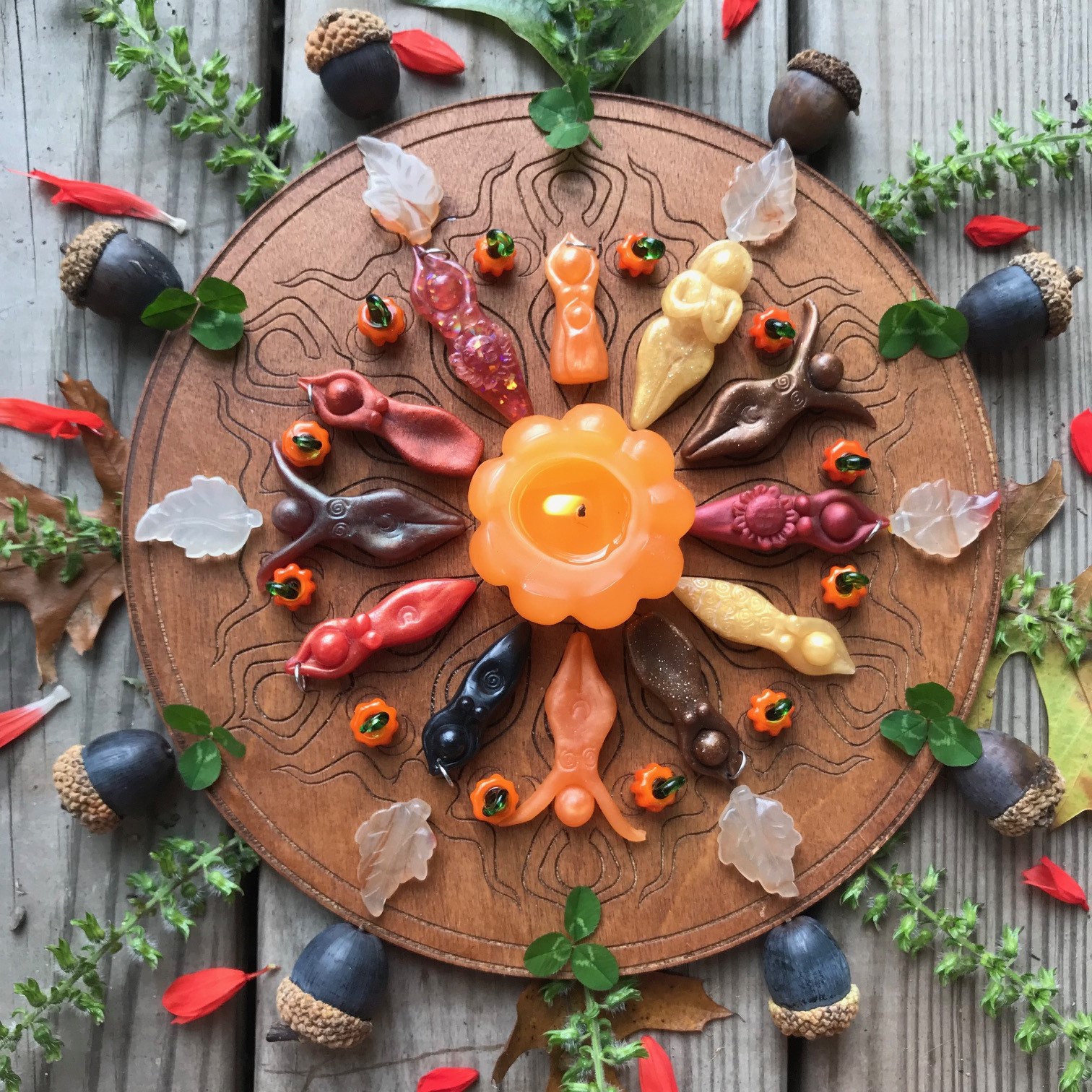
creativity
friendship
community
the myriad small adventures
of everyday.
We tell of magic
and moonrise
and listening to the pulse
of the earth beneath our feet.
Ah, October. Fall has settled into the trees and air. Last year on Samhain (Halloween), as the sun was setting and the full moon was rising, my family stood together in the dim light on our back deck, lit a fire in a hollowed out pumpkin and offered handfuls of herbs into the flames as we celebrated our blessings, our harvests, and our bounty, as a family and as individuals. As we spoke aloud our blessings and our bounty, our words got deeper, broader, and more authentic. My twelve year old son stepped forward to say how thankful he is that he gets to live with his best friend, his fifteen year old brother, and they embraced over the flaming pumpkin. My fifteen year old son offered his thanks for a family that has “cool 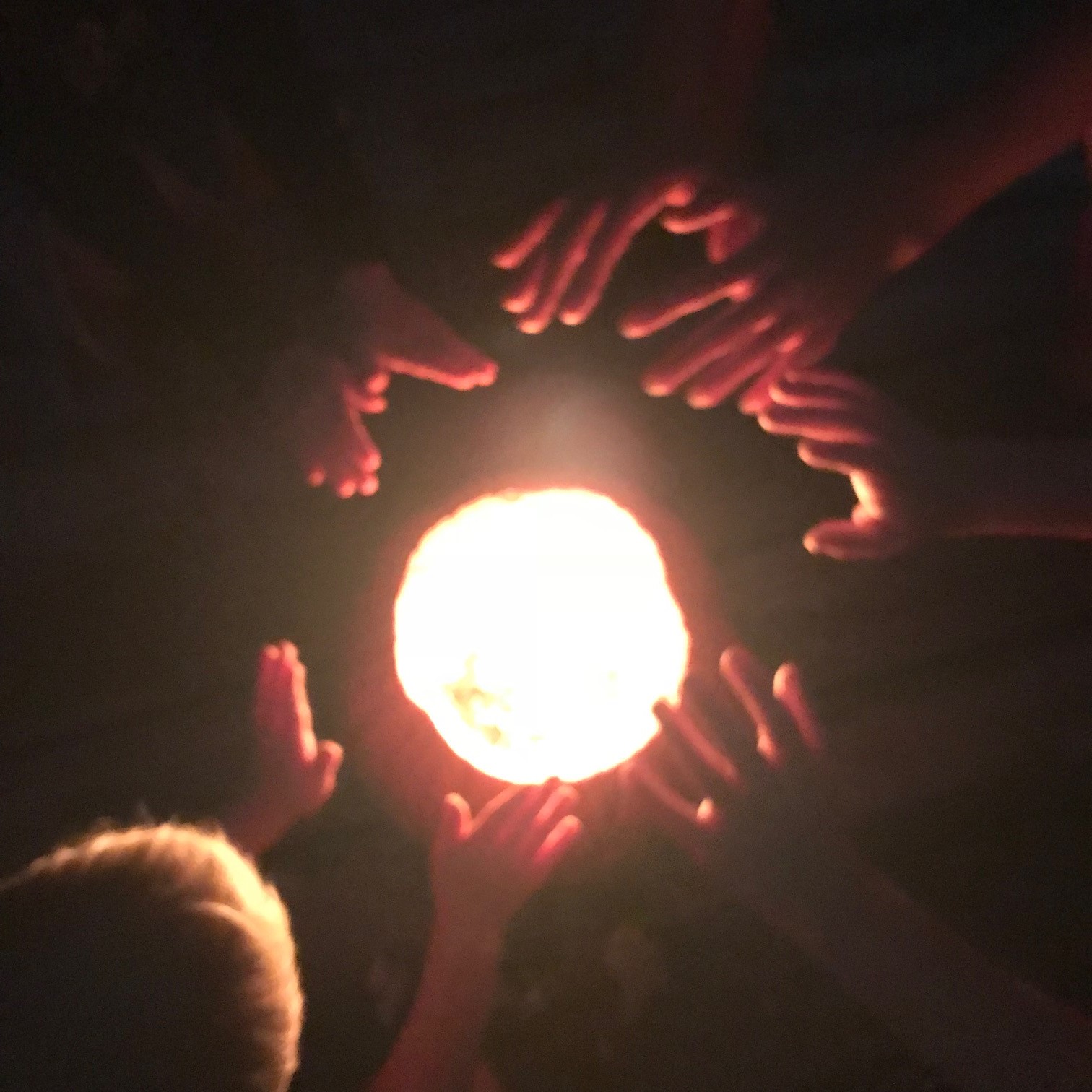 rituals like this” and my four year son offered his blessings for the “energy we feel together.” My seven year old daughter offered her gratitude for pandas and for toys.
The next week, we returned the seeds to the pumpkin and released it to the outdoors to grow next year.
Seventeen years ago, I held my first Winter Solstice ritual. I wrote my wish for a baby onto a small piece of paper and rolled it up into a “seed” of my dreams that I planted within a special wooden box. On the autumn equinox the following year, I gave birth to my first child, a son who now stands inches above me, but who joins hands with his family each month to sing “Dance in the Circle of Moonlight” together on the back deck under the full moon.
After having this first baby, it became increasingly important to me that we celebrate holidays and traditions that reflect our spiritual values and worldview rather than the packaged version of the holidays offered by society, or the religious observances of dominant faiths that do not match our own. While we have celebrated the wheel of the year together in a variety of ways in what has now been sixteen years of parenting and twenty-one years of marriage, it wasn’t really until last year that I felt I finally, truly hit my stride in planning fulfilling, nourishing family rituals. Perhaps it is because I am no longer trying to juggle nursing a baby or changing a diaper while simultaneously also guiding a ceremony. Perhaps it is because I’ve loosened up and accepted the myriad imperfections possible within a multi-age celebration. Perhaps it is because when one of the children wanders off during circle or interrupts me while I’m talking, I accept it as part of the flow, and continue our work without breaking my stride. Perhaps it is because I now laugh too when someone makes a joke during my careful ritual, and continue to roll with it, instead of feeling like it is disrespectful. Perhaps it is because I consider a 15-20 minutes family ritual perfectly sufficient instead of trying to plan for a full-fledged, retreat-style “program” of activities. Perhaps it is because we’ve joined hands in family circle in so many ways and for so many years that we all now trust that I’m not giving up on doing this together.
In the course of the year we’ve anointed one another’s foreheads with fragrant oils while standing in the freezing water of a freshwater stream. We’ve felt the raindrops kiss our faces and the rays of the sun peek in and out of the clouds as we celebrated the summer solstice by releasing wildflowers into the river. We’ve howled at the moon together, built a green man face from leaves, stones, and sticks in the field, created flower mandalas, thrown pinches of cornmeal into the woods as a symbolic sacrifice, soaked our feet in warm water laced with rose petals and then massaged one another’s feet with lotion, walked through a spiral of candlelight, and offered handfuls of herbs into a flaming pumpkin.
As we notice the changing seasons and honor the call of nature within our lives through ceremony, celebration, and song, we make visible the interconnected dance of life. We reaffirm our commitment, our relatedness, to each other and to the natural environment around us. We communicate with and are in relationship to that larger force of life and spirit that we call Goddess. And, we bring our spiritual beliefs into our bodies, hands, minds, and hearts in an ever-spinning Wheel of celebration, attention, observation, enjoyment, communion, and love.
“We can think of ritual as the container we weave in which we can be carried away by magic and ecstasy.”
—Starhawk and Valentine, The Twelve Wild Swans
For your own flaming pumpkin ritual, choose a large, round pumpkin, cut off the top 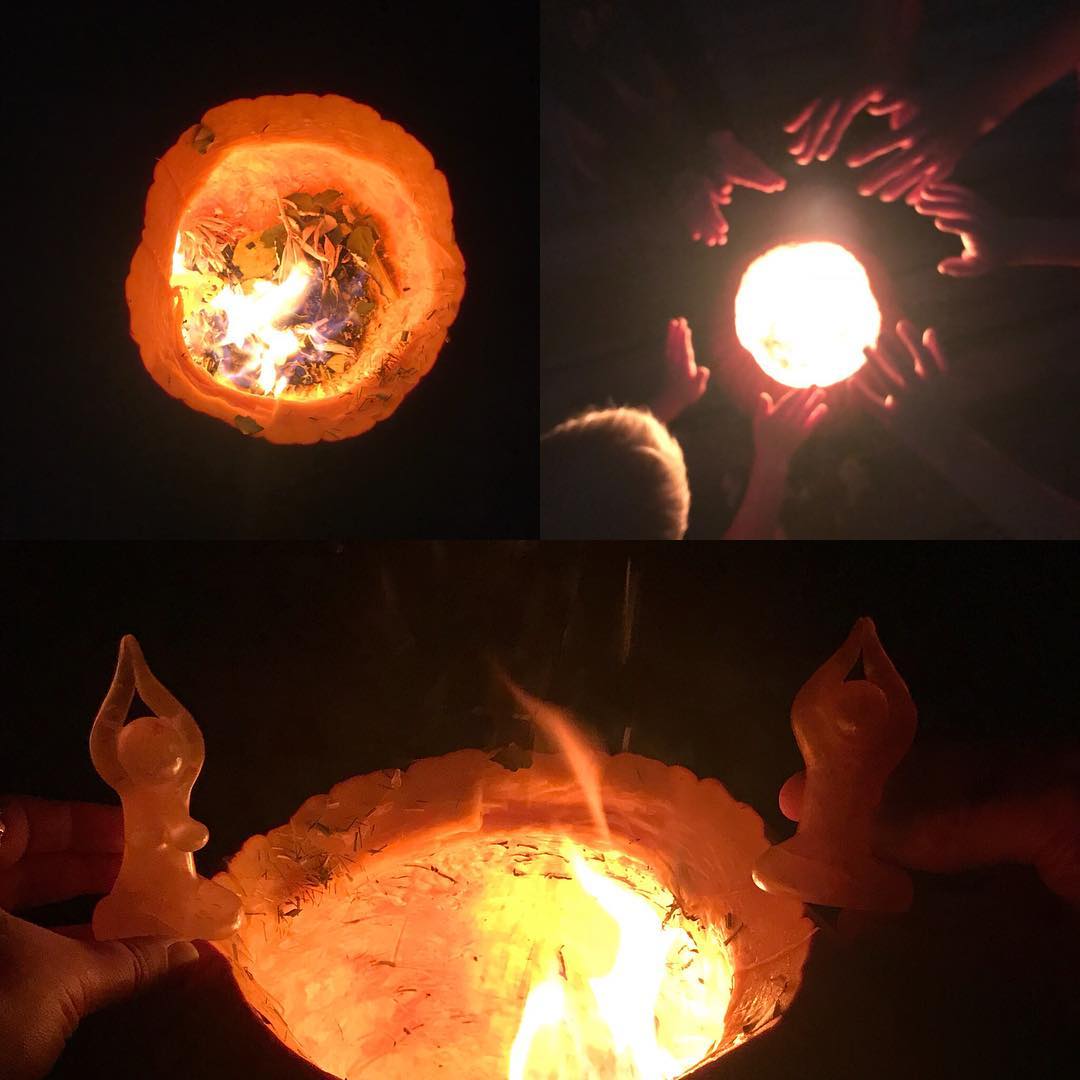 and hollow it out. Keep the seeds to plant with the remnants of your fire later. You may start the fire with paper and a lighter and then keep adding herbs to keep it burning, or you may stoke it by putting some alcohol in the bottom of the pumpkin to begin with. Alcohol burns cool and can create a longer lasting, less smoky flaming pumpkin. Offer your autumn bounty into the pumpkin with herbs sprinkles/handfuls—these can be spontaneous spoken aloud declarations of your harvest, your celebrations, your gratitude, etc. What are you thankful for?
- Optional: offer any sacrifices/releasing on slips of paper into the flames
- Optional: Sing “Hallowed Evening” chant (by my kids and me)
Hallowed evening
Hallowed night
We dance in the shadows
We offer our light.
Additional Articles:
- All We Need to Make Magic by Molly (Feminism and Religion)
- Tips for Rituals with Kids by Molly (Brigid’s Grove)
- To Light a Flaming Pumpkin cross post with full family Samhain ritual.
- Flaming pumpkin inspiration from Coloring Book of Shadows: Planner for a Magickal 2018 by Amy Cesari

