Overnight at a Neolithic Dolmen: A Womb Healing Ceremony by Eline Kieft

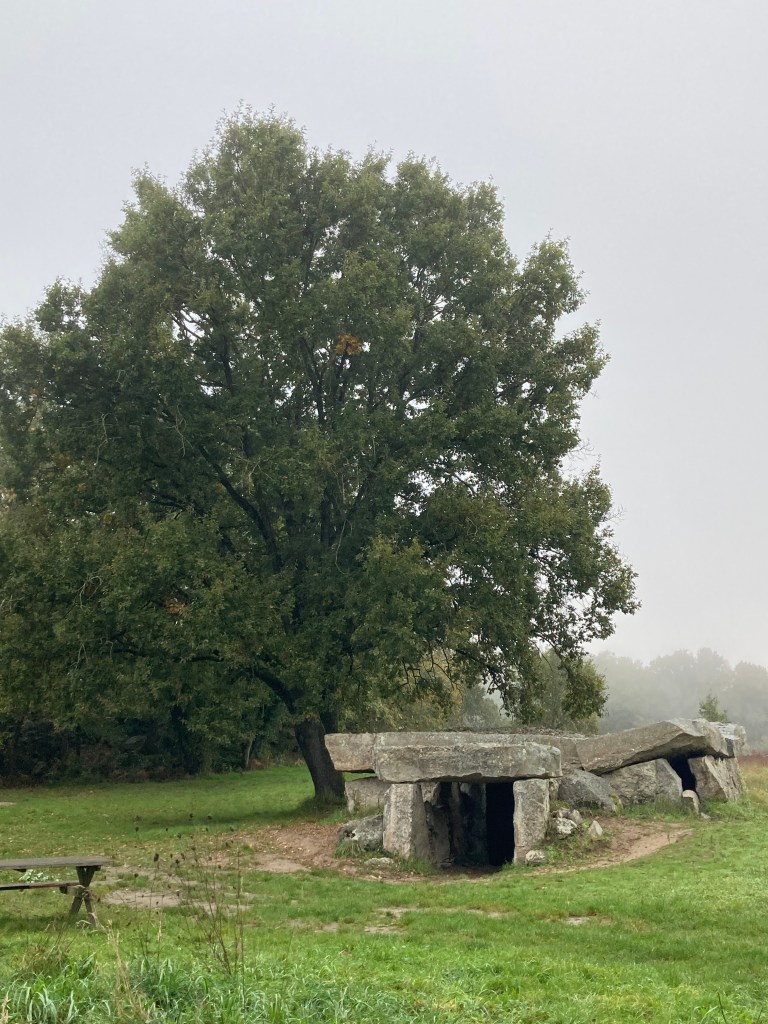
In preparation for my hysterectomy, I decided to spend a night in a dolmen at Samhain last year, to seek guidance and healing. I chose Dolmen de Bajouilière in Saint-Rémy-la-Varenne, in Northern France, a site I had discovered by chance the previous year on my local explorations.

This well-preserved structure, with its spacious square divided into two rooms, felt inviting and safe for an overnight ritual. Though I am accustomed to spending nights in neolithic monuments, mostly in the UK, I felt some hesitation, partly due to my intermediate French and unfamiliarity with the local spirits.

Nevertheless, I recognized this resistance as part of the ego’s fear of the unknown, and I gave myself permission to retreat if needed. If I would feel too vulnerable, it wouldn’t serve my body and spirit ahead of the surgery. Please join me on my overnight Samhain Ceremony full of deep imagery and transformation as I shed my womb three times… 

Continue reading “Overnight at a Neolithic Dolmen: A Womb Healing Ceremony by Eline Kieft”

Patriarchy as Primer of Cruelty by Janet Maika’i Rudolph

Matilda Joslyn Gage

This was a hard post to write. When I write about my personal trauma, it is not only healing for me but adds to the canon of stories of other women that help all of us navigate trauma. That makes it easier. When writing about the trauma of women in a whole culture, I feel a sense of helplessness, especially here in the United States. We are all experiencing a group trauma and it is digging in deep.

January 5, 2024, will live in the Patriarchal Hall of Infamy. On this date the Supremes agreed to allow the rapist, misogynist, trying-to-be-dictator former President an opportunity to have his rights heard. But this same date, the Supremes also told we women that our lives are insignificant. No that’s not right, less than insignificant, a mere distraction to what they consider to be more important issues. They allowed an Idaho abortion law to go into effect that doesn’t allow an abortion even in the case of a medical emergency when a pregnant woman in life-threatening distress has been rushed to the emergency room. The split screen exhibits patriarchy for what it is. I want to use the word, “culmination” but that means the height. I don’t think we’ve reached a culmination because there seems no end to the cruelty that patriarchy seeks to inflict.

Continue reading “Patriarchy as Primer of Cruelty by Janet Maika’i Rudolph”

The Holy of Holies and the Umbilical Cord: The Evolution of a Ritual Object by Jill Hammer

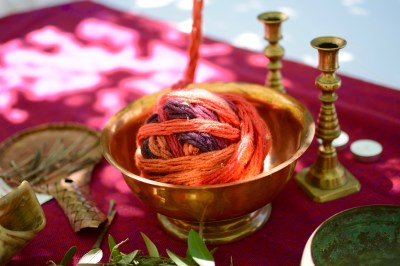
In the Jewish calendar, we’re just past the holiday season—the High Holidays, the harvest festival of Sukkot, and the concluding festival of Simchat Torah when the last verses of the Torah are read and the first verses are started again. The Torah readings for these holidays speak often of the offerings once made on the altar in the Tabernacle in celebration of these festivals.  Particularly on Yom Kippur, the readings mention the kodesh kodashim: the holy of holies. This enclosed sacred space contained, according to legend: the tablets of the Commandments inside an ark, topped by two cherubim that held up an empty space between them—an empty space understood to be the amplified presence of an invisible God.  As I think back over my powerful summer, which was largely spent with Jewish priestesses on various retreats and adventures (in Connecticut, Mississippi, California, Costa Rica, England and Scotland), I am thinking about a unique ritual object we use, and realizing that in its own way, it is a kind of Holy of Holies.

Continue reading “The Holy of Holies and the Umbilical Cord: The Evolution of a Ritual Object by Jill Hammer”

We Won’t Go Back by John Erickson

Bottom line: abortion is healthcare. Nearly a fourth of women in America will have an abortion by age 45. Every day, people across the United States make deeply personal decisions about their pregnancies. Those decisions deserve respect.

Someone once asked me: John, why are you a feminist?  It is always a jarring question because I believe all people should be feminists and we should all fight for gender equality no matter what.  I’ve been drawn to Martin Niemöller’s prolific quote:

First they came for the socialists, and I did not speak out—because I was not a socialist.
Then they came for the trade unionists, and I did not speak out— because I was not a trade unionist.
Then they came for the Jews, and I did not speak out—because I was not a Jew.
Then they came for me—and there was no one left to speak for me.

Right now, it seems like a full on frontal assault against all of us.  No matter what community you’re in, you can draw back to an instance of discrimination you’ve faced both pre-2016 as well as after the election of President Trump. Continue reading “We Won’t Go Back by John Erickson”

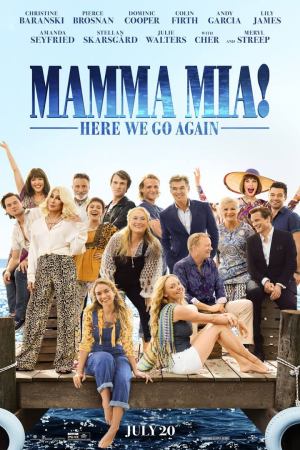
Mamma Mia and the Mother-Daughter Connection by Katie M. Deaver

A couple of weeks ago I went to see the new Mamma Mia: Here We Go Again! movie.  In addition to being a fan of movies inspired by musicals I also loved the emphasis that was placed on the mother/daughter relationship in the first Mamma Mia and had heard that this new installment would continue to focus on that relationship.  It definitely didn’t disappoint!

This second movie takes place five years after the original Mamma Mia, and roughly a year after the death of Donna Sheridan, with Donna’s daughter Sophie preparing for the grand reopening of the Hotel Bella Donna.  This second movie also features lots of flashbacks where we are able to see a young Donna arrive at the island of Kalokairi as well as see how she first meets Sam, Bill, and Harry, her daughter Sophie’s three possible fathers.

As one might imagine, even if you aren’t familiar with the movie there is a lot going on, but the part that I found most intriguing was the very end of the movie.  At this point Sophie has given birth to her own baby and is bringing the child to the church to be baptized.  During the ceremony Donna’s spirit is there at the font with her daughter and new grandchild and you could feel this amazing sense of connection and love between not only three generations but across the lines of physical and spiritual presence and space.

Continue reading “Mamma Mia and the Mother-Daughter Connection by Katie M. Deaver”

On Snakes by Ivy Helman

imageIn the ancient world, snakes represented fertility, creativity, rebirth, wisdom and, even, death.  They were often closely connected to female goddesses, priestesses and powerful human females who were the embodiment of such powers.    For example, there is the Minoan goddess/priestess holding the two snakes in her outstretched arms.  She is closely linked with fertility and domesticity.  Similar figurines, with similar associations and dating to approximately 1200 BCE, have also been founded in the land of what once was Canaan, where Israelites also lived.  Medusa, in whose hair lived venomous snakes, turned men who looked at her to stone.  Ovid’s account of the creation of Medusa credits the Greek goddess Athena with Medusa’s lively hair.  Another Greek legend says Perseus, after killing Medusa, gave her head to Athena who incorporated it into her shield.  Athena, the goddess of wisdom, is portrayed often with snakes wrapped around her as a belt and/or on the floor next to her. Continue reading “On Snakes by Ivy Helman”

The Intersections of Faith and Reproductive Justice by Katey Zeh

The Intersections of Faith & Reproductive Justice

Last week I participated in a panel discussion hosted by the Center for American Progress (CAP) on the intersections of faith and reproductive justice. These conversations are critically important, particularly in these political times when threats to our bodily autonomy and right of conscience are sanctioned by our current administration, Congress, and many state legislatures.

The framing of these public discussions is always interesting and somewhat troubling to me. Often progressive spaces like these do recognize that many people of faith support reproductive health care, but with that understanding is the assumption that supporting the full spectrum of reproductive healthcare, including access to safe abortion care, necessitates some kind of moral reckoning for religious people.

Continue reading “The Intersections of Faith and Reproductive Justice by Katey Zeh”

What If…She’s Stronger than She Knows…by Molly Remer

“When I dare to be powerful–to use my strength in the service of my vision–then it becomes less and less important whether I am afraid.”

Audre Lorde

“The purpose of life is not to maintain personal comfort; it’s to grow the soul.”

–Christina Baldwin

When teaching childbirth classes, I would speak to my clients about shifting the common fear-based “what if” cultural dialog of birth to “positive” anticipation rather than fears, encouraging them to ask themselves questions like: “what if I give birth and it is one of the most powerful, thrilling moments of my life?” While I stand by this practice, I also think about the what ifs that crawl out of our dark places and lodge in our hearts. The what ifs that snake around the edges of our consciousness in the early hours of the morning. The what ifs we try to push down, down, down and away. The what ifs that stalk us. The what ifs so very awful that we fear in giving voice to them, we might give life to them as well.

We may feel guilty, ashamed, negative, and apologetic about our deepest “what ifs.” We worry that if we speak of them, they might come true. We worry that in voicing them, we might make ourselves, our families, our communities, our work, or philosophies, our faiths, or whatever look bad. We want to be positive. We want to be blissfully empowered, confident, and courageous. And, guess what? We are. Sometimes that courage comes from looking the “what ifs” right in the eye. Sometimes it comes from living through them. My most powerful gift from my pregnancy with my daughter, my pregnancy-after-loss baby, was to watch myself feel the fear and do it anyway. I was brave. And, it changed me to learn that.

What if we can learn more from our shadows than we ever thought possible? There is power in thinking what if I can’t do this and then discovering that you CAN.

Continue reading “What If…She’s Stronger than She Knows…by Molly Remer”

Call Me the Devil, If You’d Like by Natalie Weaver

Call me the devil, if you’d like.

I have just completed the three-hour retreat at the church to prepare my son for his first communion.  It was a long morning, to be sure, but during that time I decide I want to try to bring the family all together.  I host such occasions often, at significant cost and personal effort, but I think it builds up love and community so I do it anyhow.  I go home and begin sending out invitations for the gathering.

At precisely the moment of my welcoming, I learn that I have, once again, been directly charged by so-and-so, because I have worked in a professional capacity and (I am not kidding, dear readers) because I have not had my children in T-ball and Rec Center sports. I am accused of self-aggrandizement because I go to professional conferences (to which I also take my children almost without exception).  I am charged with doing things for my own glory because I teach overloads and offer paid lecture series.

There is no acknowledgement that I work to eat and to earn income to support my children or that I have never had the option not to work outside the home.  I am furious, of course, because I have heard this in varying degrees over the length of my professional life and time as a parent, including once on Mother’s Day. I’m tired of the insult, but when I respond after years of such claims in outrage, I am accused of being too angry.

But, life goes on, and so does the gathering.  It’s a nice time, but after the gathering, I wake up to the boldly voiced disgruntlement of a friend who has been inadvertently insulted by a conversation that occurred at the table.  The insult is derived from the charge that I did not say the right words when I should have. There is a very strong critique and withering suggestion about my core values at stake, since the issue is racial.  I listen and apologize but am left wondering, “don’t you know me by now?”  Have you not dined with me, celebrated with me, felt my love and friendship, outreach and appreciation? I am stymied.  Am I here to be judged?

Continue reading “Call Me the Devil, If You’d Like by Natalie Weaver”

Priestess as Shamanic Path – Part 2 by Molly Remer

This is a continuation of Molly’s piece from Wednesday, 10 August 2016. You can read Part 1 here.

After explaining that the homebirth of her second son was her, “first initiation into the Goddess…even though at that time I didn’t consciously know of Her,” Monica Sjoo writing in an anthology of priestess essays called Voices of the 567bGoddess, explains:

The Birthing Woman is the original shaman. She brings the ancestral spirit being into this realm while risking her life doing so. No wonder that the most ancient temples were the sacred birth places and that the priestesses of the Mother were also midwives, healers, astrologers and guides to the souls of the dying. Women bridge the borderline realms between life and death and in the past have therefore always been the oracles, sibyls, mediums and wise women…

…the power of original creation thinking is connected to the power of mothering. Motherhood is ritually powerful and of great spiritual and occult competence because bearing, like bleeding, is a transformative magical act. It is the power of ritual magic, the power of thought or mind, that gives rise to biological organisms as well as to social organizations, cultures and transformations of all kinds… (page unknown).

I have been a childbirth educator since 2006 and I have given birth five times. Each birth brought me the gift of a profound sense of my own inherent worth and value. It was the shamanic journey through the death-birth of my tiny third child, however, that ushered in a new sense of my own spirituality and that involved a profound almost near-death experience for me. After passing through this intense, initiatory crisis, the direction and focus of my life and work changed and deepened. Shortly after the death-birth of my third son, I wrote: Continue reading “Priestess as Shamanic Path – Part 2 by Molly Remer”