The Feminization of Poverty: The Impact on Migrant Mothers in the U.S. by Michele Stopera Freyhauf

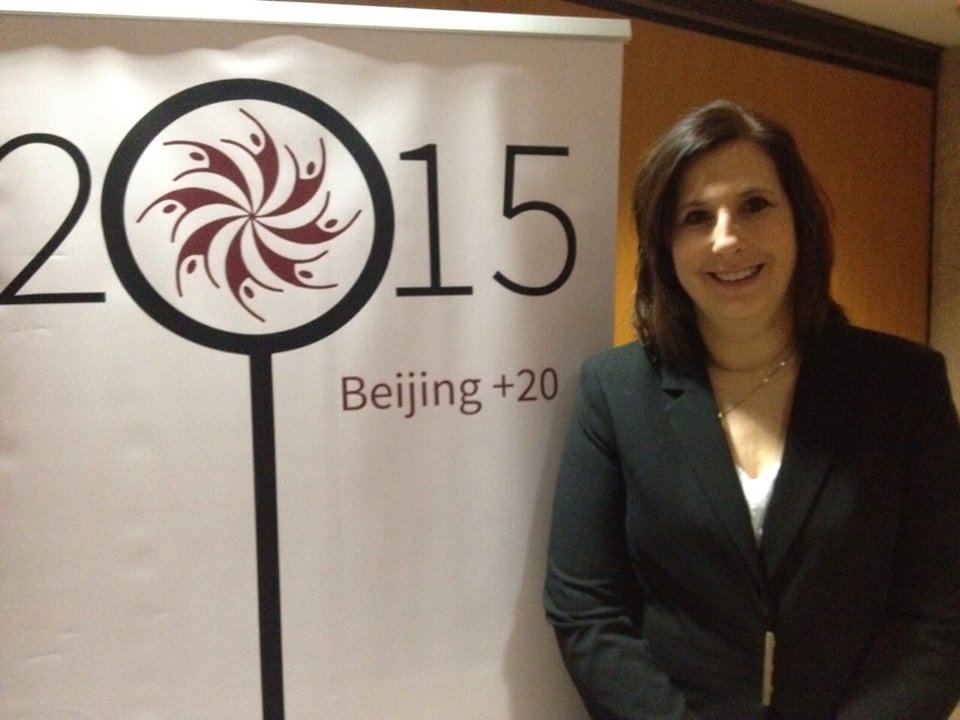
Freyhauf, Durham, United Nations, Feminism and Religion, John Carroll, UrsulineI had the honor of speaking at the United Nations during the Commission for the Status of Women this past March about the Feminization of Poverty and the Impact on Migrant Mothers.  Below is the text of my speech delivered.  By posting my speech, it is my hope to use social media to help draw attention to this problem and use our resources to find solutions.

Over the last thirty years, rich countries have grown much richer, and poor countries have become, in absolute and relative terms, poorer. Global inequality in wages are striking and poor countries are turning to the IMF or World Bank for loans, which require “so-called” structural adjustments of devaluing currency, cuts in support for “noncompetitive industries,” and the reduction of public services such as healthcare and food subsidies, which has provided disastrous results for the poor, especially women and children.

The feminization of poverty not only means that more of the world’s poverty is born by women, thanks in large part to globalization of the world economy, but includes a denial of access to fundamental human rights, including health, education, nutritious food, property, representation, etc. Feminized poverty encompasses more than matters of individual suffering – it ensnares a vicious cycle of poverty that impacts their entire family.

Feminization of poverty has no singular cause. The United Nations Development Fund for Women identified 4 key dimensions that indicated a heightened rate of poverty for women:

First is called “the temporal dimension,” which means that women are often the primary caretakers of children and household duties. Women who live in developing nations may also have agricultural or physical responsibilities. With these demands, less time is available to devote to paid employment causing them to earn a smaller income even though they effectively do more work than their male counterparts.

Second is “the valuation dimension” which is defined as unpaid labor that women perform to take care of family members and other household chores. Work that is considered “less than” because formal education or training is not required.

Third, is “The employment segmentation dimension.” Women are natural caretakers and thus corralled into “women’s work”, such as teaching, working with textiles, or domestic servitude that includes caring for children or the elderly.

Finally, “the spatial dimension.” When employment is non-existent or difficult to find, women may have to migrate to other areas to find work temporarily. If a woman has children, she may refuse to take the job and stay to care her family. However, Some opt to leave their families behind, to secure what they consider a better life – a means of support – but this choice often comes a great cost. Continue reading “The Feminization of Poverty: The Impact on Migrant Mothers in the U.S. by Michele Stopera Freyhauf”

Transforming the Church from Within or Without? by Xochitl Alvizo

“Power belongs to those who stay to write the report!” stated Jeanne Audrey Powers during her presentation at the Religion and the Feminist Movement conference at Harvard Divinity School back in 2002. Though the statement sounds a little funny, it does raise a good question about how one participates in creating change. Where does the power for change and transformation lie? Is it in the writing of reports; is it from within institutions; from without? This question seems to be of particular relevance to those of us who have feminist visions and commitments and also remain involved in Christian churches – churches of a tradition with deeply embedded patriarchal habits and practices.

Recently, this concern was raised in a class for which I am a TA. We were talking about the fact that some feminist theologians develop feminist systematic theologies; by definition a cohesive theological system done from a feminist perspective. In part, the motivation is to reclaim the systematic way of doing theology and have it stand alongside other widely recognized theologies – but do so in a feminist way. Additionally, the traditional systematic format gives it validity and may serve to temper the prevailing habit of teaching feminist theologies as so-called ‘contextual’ theologies (as if other theologies are not also contextual, but that’s a topic for another post). A critique of this development, of course, is that by writing systematic theologies feminists are simply reinforcing patriarchal forms and patterns of academentia instead of expanding and creating new ones. Continue reading “Transforming the Church from Within or Without? by Xochitl Alvizo”

Watching “Noah” Brought Me Closer to Humanity by Andreea Nica

Andreea Nica, pentecostalismAs a child, I enjoyed the story of Noah’s Ark. I would often imagine pairs of animals running for safety in Noah’s architecturally majestic haven. Practical questions didn’t enter my mind during this blissful period of naivety. I ignored the part where God expressed regret in creating humanity, or when Noah gets drunk and lies bare naked for his children to cover his shame. My bible study teacher would explain to us that the point of the story was that Noah, a holy man, trusted God and carried out his will.

Disclaimer: I understand that the film is not meant to be an exact representation of the story in the bible, but loosely based around it. Also, if you plan on watching the film, read at your discretion.

In the film, Noah’s character is played by leading actor Russell Crowe, who appears strong, confident, and zealous in his trust in God – all necessary qualities to fulfill God’s demand of killing off the rest of humanity because of their wickedness. Later in the film, Noah realizes that he and his family are also wicked leading to his revelation, ahem, God’s revelation, that humanity must cease with Noah’s family. This doesn’t pan out too well with his children and wife. It was also bad news for Emma Watson, the orphan girl Noah’s family saves and raises as their own, who after accepting that she is barren is miraculously healed and gives birth to two girls. Noah decides that the female infants must die according to God’s will to end humanity. Continue reading “Watching “Noah” Brought Me Closer to Humanity by Andreea Nica”

The Politics of Miztvot by Ivy Helman

headshotRecently, Ben of Ben’s Tallit Shop commented on an older post of mine on this website entitled: “How Literal is Too Literal? My Experience with Tallit Katan.   He wrote, “In my opinion, it makes sense to first try the mitzvah of tzitzit in private for a month or two to ensure you are undertaking it for the right reasons.  Making a political statement is not a valid reason (though some people, I imagine, would argue otherwise).  Mitzvahs and politics don’t mix.”

First of all, this comment is both sexist and patronizing!  A man would never suggest to another man to do what he suggested I do and “try the mitzvah… in private… to ensure you are undertaking it for the right reasons.”  I’d dismiss it entirely if I was that kind of person, but I’m not.  Sexism and patronizing aside (as if one could do that really), I would like to engage with his thoughts on the mixing of politics and mitzvot because I think that can lead to great reflection and insight for Jewish feminists.

Not all mitzvot have an inherently political nature, but many do.  In fact, one could even argue something as seemingly apolitical as lighting Shabbat candles could be political.  Lighting candles ushers in Shabbat peace for one’s household and ideally for one’s community even if that peace is only for one day a week.  Since this is at odds with the world’s political environment of fighting, war and violence, it could be interpreted as a political act.  After all, won’t every day in the redeemed world be Shabbat? Continue reading “The Politics of Miztvot by Ivy Helman”

Sex, Religion, and Discourse: An Interview with Judith Butler

One of my academic joys is interviewing people I find particularly interesting (see most of my posts here). This time I am honored to present a recent interview I did with Judith Butler.

Image from The European Graduate School

Many wonder how gender performance relates to chromosomes, phenotypes, genitalia, and other scientific “evidence” for innate sexual differences. Continue reading “Sex, Religion, and Discourse: An Interview with Judith Butler”

Why I Don’t Believe in Female Pastors by Andreea Nica

Andreea Nica, pentecostalismIt may come as a surprise to those who identify as both feminists and religious practitioners that I don’t believe women should be pastors of any dominant religious congregation. This includes most religions which, I assert, are rooted in and structured by the tenets of patriarchy. Does that mean I think women should be congregants of a patriarchal-originated religious system? You guessed it – no. While this may seem like a radical notion to some, it took me quite some time to come to terms with my own conflict in being both feminist and a believer.

My transition from the Pentecostal sect was a long, intricate process that involved life-altering decisions. The notion of leaving the church was driven by my immersion in women’s studies during my undergraduate degree. There were many difficult questions I simply didn’t have an answer for, as the church didn’t provide me with them.

One of them being: Can women instruct an entire congregation of believers?

For those who are female pastors, I’m sure you’ve heard this one a million times, but somehow it never fades from religious and secular discourse. Whether it’s the Islamic, Jewish, Christian, or Mormon faith, women have had to constantly fight for their right to preach religious doctrine. In the beginning of my transition, I was on the side of: Preach it ladies! Continue reading “Why I Don’t Believe in Female Pastors by Andreea Nica”

Evangelical Missionaries Preach Death in Uganda by Andreea Nica

Andreea Nica, pentecostalismA former evangelical Christian friend of mine sent me information on the intriguing documentary God Loves Uganda. The newly released documentary addresses how the American evangelical movement has prompted a political and social shockwave in the country of Uganda. While missionaries are typically associated with delivering aid and improving the conditions of third world countries, the spreading of Christian values and ideals has inflicted suffering upon ethnic communities through evangelical indoctrination.

The intent of the film is to raise awareness of the political and social brutality that the evangelical missionaries are instigating; specifically through their teaching that homosexuality is a sin and should be dealt with accordingly. In Uganda this means death. Given the rise of globalization, transnational religious actors have been more enabled to engender other nations with their respective religious beliefs, often with minimal regard for the cultural and political landscape of the nation they wish to transform. Continue reading “Evangelical Missionaries Preach Death in Uganda by Andreea Nica”

Yes, You’re a Homophobe by John Erickson

Jesus loved sinners and Jesus would rather be dancing with me in West Hollywood on a Friday night than lugging through a swamp luring ducks into a trap with a duck caller made by a clan who think that my sexual actions are similar to that of an individual having sex with an animal.

John Erickson, sports, coming out.

To be able to walk down the street holding the hand of the one you love is a great feeling and an action that some of us aren’t able to perform without fear.

A line has been drawn in the sand between those who support gay rights and those who do not.  While some call it being on the “right side of history,” I simply now refer to it as not sounding and looking like a bigot in the halls of history and in the various books, Facebook posts, and Tweets that our children will one day read. Continue reading “Yes, You’re a Homophobe by John Erickson”

Who Am I Under Oppression? By Deanne Quarrie

Deanne QuarrieIn a class I am taking we were asked to journal with these questions: Ask yourself who are you in the inner voice that does not speak in the world around you or which you have worked tirelessly to bring into fruition in your life. Who are you that has felt suppressed and suffocated?

I sometimes think that I do not know who I am anymore.  Life teaches us that it is those outside of ourselves who determine our value to society.  We are given love and support (if we are lucky) by our parents as children.  Our value is determined by how much time and attention they give us.  If we get a lot, we grow up confident in ourselves trusting our way through life. When we attend school our value is determined by the effort we put into our studies, the grades we receive and the extracurricular activities we take part in and finally by the friends we choose. Continue reading “Who Am I Under Oppression? By Deanne Quarrie”

What Would Malala Do? by Gina Messina-Dysert

Gina Messina-Dysert profileOctober 11th was International Day of the Girl – a movement that empowers girls around the world to see themselves as powerful change agents. This year’s theme is “Innovation for girls’ education.”  Certainly, this makes sense given that education is one of our most powerful resources – just ask Malala.  During her recent interview on The Daily Show, Malala reminded the world that it is education that can solve global problems – not war.

The youngest person in history to be nominated for a Nobel Peace Prize, Malala is clear in her message; the only way to make change is through peace, dialogue, and education.  When asked about her reaction to the threat to her life by the Taliban, Malala responded saying that she thought quite a bit about what she would say if she came face to face with a Talib.  “I would tell him how important education is and that I would even want education for your children as well. That’s what I want to tell you, now do what you want.”

Although the Taliban has continued to threatened her life, Malala says striking back is not the right approach.  “If you hit a Talib, then there would be no difference between you and the Talib. You must not treat others with cruelty. … You must fight others through peace and through dialogue and through education.”  Such words of wisdom from a child. Continue reading “What Would Malala Do? by Gina Messina-Dysert”