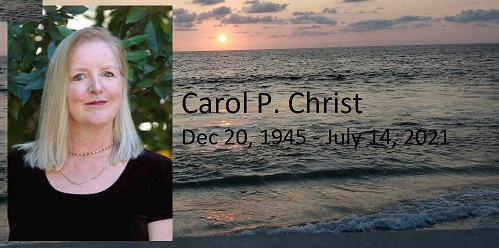
Legacy of Carol P. Christ: Practice Great Generosity

This was originally posted on August 20, 2018

Nurture life.

Walk in love and beauty.

Trust the knowledge that comes through the body.

Speak the truth about conflict, pain, and suffering.

Take only what you need.

Think about the consequences of your actions for seven generations.

Approach the taking of life with great restraint.

Practice great generosity.

Repair the web

In Rebirth of the Goddess, I offered Nine Touchstones of Goddess Spirituality as an alternative to the Ten Commandments. The Nine Touchstones are intended to inform all our relationships, whether personal, communal, social, or political.

The eighth touchstone asks us to practice great generosity.

Continue reading “Legacy of Carol P. Christ: Practice Great Generosity”

For Mahsa by Lori Stewart

On Friday, September 16, 2022 Mahsa Amini died in a Tehran hospital having been arrested by Iranian morality police on September 13 for wearing “inappropriate attire”. She was 22. Mahsa’s family claims she had bruises to her head and limbs from being beaten. The Iranian police dispute that claim saying Mahsa died from a pre-existing health condition.

Mahsa’s death sparked major protests against the Islamic Republic in Iran and protests of support are occurring around the world. Women are burning their hijabs, which they are mandated by Iranian law to wear, chanting, “Women, life, freedom”. They are cutting their hair which is a longstanding symbol of protest and loss in Iran’s history. This action harkens back to the epic Persian poem “Shahnameh” by Ferdowsi in which hair is a theme and the cutting of hair a symbol of mourning. Around the world, people have followed suit by cutting their hair in solidarity with the protesters in Iran. A recent chant by the protesters is “it’s the beginning of the end” as they challenge their theocratic government.

Continue reading “For Mahsa by Lori Stewart”

Remembering “The Burning Times,” Part 2: Healing by Beth Bartlett

You can read part 1 here.

The effects of “the burning times” are still with us. I can feel this in my own body. As Starhawk put it so vividly, “the smoke of the burned witches still hangs in our nostrils, . . . remind[ing] us to see ourselves as separated. . . in competition with each other, alienated, powerless and alone.”[i] However, she continues, “the struggle also continues.” That struggle is the impulse toward wholeness, healing. That journey toward healing begins with remembering and acknowledging past harms, so that we may better understand who we are and the ways these continue to live in our bodies, psyches, and culture in order to address them.

In South American indigenous cultures, trauma is recognized as susto, or “soul wound,” and it is on that level that healing needs to happen.[ii]  To quote Shirley Turcotte, “Healing from trauma is a spiritual matter, a relationship matter, and there are places in recovery that require a precious spiritual response.”[iii] The women’s spirituality movement continues to be one such precious response. The work of Starhawk and others to reclaim the word “witch” and to revive and reimagine a tradition of valuing immanence, the sacredness of the earth, and the ability to change the world for the good has been invaluable in this.[iv] In her examination of the reasons for the persecution of witches, Starhawk names the “war on immanence” as one of three factors.[v] If the spirit was not present in the earth itself, then people had to rely on priests and the Church for access to a transcendent god. 

Continue reading “Remembering “The Burning Times,” Part 2: Healing by Beth Bartlett”

Calling on the Ancient Ways to Make a New Future by Caryn MacGrandle

Dawn follows the dark. Call on Elen of the Ways for the ancient pathways revealing the mysteries of the deep wild wood where your heart resides.

Well, duh. Of course.

I camped out alone on my newly bought land in North Carolina for the first time this weekend.

From Judith Shaw’s incredible Oracle of Celtic Goddess deck, the Elen of the Ways card jumped out at me as I was packing, so I took her along with me.

This was a first for me camping alone in the woods, and I’m awfully proud of myself.

I met a new neighbor who told me to carry a gun at all times.

‘Well, I don’t have one,’ I told him, ‘but I do have a stun gun, extreme pepper spray and tons of knives. So that should do,’ I said with a smile.

Continue reading “Calling on the Ancient Ways to Make a New Future by Caryn MacGrandle”

Remembering “The Burning Times,” Part 1 by Beth Bartlett

I first saw it when looking at their faces while showing The Burning Times in class — the blank stares, the pained expressions, the tears, the looking away. The scenes and sounds of women tortured and burned alive touched something deep and ancient in them.  Here it was — the historical trauma of women.[i]  The lasting impact of historical trauma is experienced by subsequent generations for hundreds of years, manifesting in such things as depression, PTSD, self-destructive behaviors, anger, violence, suicide, and more. As Native LGBTQ activist and writer Chris Stark so eloquently put it: “The experiences of our grandparents and great-grandparents are written into the library of our bodies . . . . My ancestors’ loss and screams are written in me – their pain and murder and rape merged with my own as a child. . . We carry them through time. We remember.”

Continue reading “Remembering “The Burning Times,” Part 1 by Beth Bartlett”

Revisiting Our Sisters’ Feminisms by Xochitl Alvizo

This post draws much from a previous post I wrote back in 2013, which generated great discussion in the comments. I came back to it as I was reflecting on our sisters’ revolution in Iran, Women, Life, Freedom, following the death of Mahsa “Zina” Amini while she was in the custody of the “morality police” in Iran. This woman-led movement has been nonstop for seven weeks. I’m in full support of the women and have continued to learn more about their context and history. The movement is powerful and inspiring, heavy and difficult, but its energy is alive and blazing. There is an impromptu song that has come to represent the movement; the song was created by linking real-time tweets and Instagram posts together – you can hear the song, read the lyrics, and see the screenshots in the video below:

Now the post I’m drawing back to from 2013 – a little different from the original – but one intended to invite us to reflect on our engagement with and support of one another across place and difference. And about the relationship between the local and global, and the need to hold a balance of both.

Continue reading “Revisiting Our Sisters’ Feminisms by Xochitl Alvizo”

Little Deer Comes to Life  – A ‘Good Mother’ Story by Sara Wright

Late last March an emaciated doe appeared around the house even before the snow was gone. Although I am used to having wild animals visit I was bewildered; this deer seemed too tame. I could get within a couple of feet of her while talking to her softly.

Every morning there she was standing at the front door nipping twigs from the crabapple tree when I let the dogs out before dawn. I could see where she was spending the night curled into last year’s fallen leaves, just outside my bedroom window. I named her Red Deer because of her pitiful rusty red coat. It wasn’t long before the first emerald shoots appeared in my flower garden. Red Deer feasted indiscriminately denuding all the plants. Initially annoyed, my increasing concern for the emaciated deer’s welfare eventually allowed me to let go of my flowers – after all, the garden was perennial and all these plants would return next year. The doe was so listless that I thought she might be dying…. I didn’t realize it at the time but I was taking the long view and incorporating it into the present.

Continue reading “Little Deer Comes to Life  – A ‘Good Mother’ Story by Sara Wright”

Legacy of Carol P. Christ: Restored in Beauty

This was originally posted on May 11, 2015

The path leading to the Klapados Waterfall begins at the edge of an open meadow in the pine and oak woodlands of a mountain in the island of Lesbos. After driving several miles on a very rutted dirt track, we parked under an oak tree, crossed the meadow and scrambled down a winding path. After about 20 minutes, it ended at a stream surrounded by plane trees. From there, we climbed over rocks to reach a pool created by the seasonal waterfall.

waterfall at klapados 1

On the day we visited it, the waterfall was only a trickle of cascading drops that moistened its moss-covered path to the pool. The roots of a plane tree growing at the top of cliff followed the path of the water, weaving a web over the rockface all the way down to the pool.

Continue reading “Legacy of Carol P. Christ: Restored in Beauty”

Coming Home for Samhain by Carolyn Lee Boyd

Tigh nan Cailleach, House of the Cailleach, Glen Lyon, Scotland

Samhain is the beginning of winter according to the Celtic calendar. On this day, people brought their livestock in from the pastures and settled by their hearths to survive the coming cold until the magical renewal of spring. Here in New England, leaves are beginning to blaze red-gold, plants to brown as nutrients fill their roots, and animals to nestle underground to hibernate. Across the northern hemisphere, we should once again begin our own retreat below the the busyness of our lives to re-energize and plan for the fruition of spring works.

I’ve usually thought of winter as a time of withdrawal from other beings and the world, but maybe Celtic tradition offers us a more nuanced way of perceiving this season. A wonderful Scottish Samhain story has made me rethink of winter as a time to also reconnect and re-vitalize each other and chart our course to spring’s promise together. I cannot say what the story means to those from whose land it emerged, but I can share the thoughts it evokes in me. Settle in, get comfy, and listen…

Continue reading “Coming Home for Samhain by Carolyn Lee Boyd”

The Appalachian Cailleach Speaks by Annelinde Metzner   

The Cailleach is a Celtic Ancestor-Goddess, a Divine Hag, a Crone who controls the winter winds in the far reaches of remote places. Living in the still-wild mountains of Western North Carolina, I’ve found it is easy to conjure up the Cailleach rising up through a rhododendron “hell.” She certainly took my breath away, and captured my consciousness, when I wrote this poem in 1995. Some years later, Lisa Sturz of the Red Herring Puppets created for me the eight-foot tall, wearable Grandmother puppet you see here. She has appeared in a number of my theater productions to the Goddess, while the poem was being dramatically read, with improvised music on the psaltery. Grandmother is happy to be coming out of my basement once more, for the Samhain service at our Unitarian church here in Black Mountain.

Continue reading “The Appalachian Cailleach Speaks by Annelinde Metzner   “