

 In national quarantine and sheltering-in-place or is it “safer-at-home,” all I could think about was that we were living in a scene from the late Afrofuturist writer Octavia Butler’s book Parable of the Sower. So I texted my friend, Afrofuturist writer Tananarive Due and said: hey let’s do a webinar on this. And this turned into weekly – then monthly – free webinars on the wisdom we can glean from Octavia Butler as we live through these political days.
Here, I share a recent workshop and dialogue that lifts up Octavia’s Parable of the Sower and highlights themes of prophecy, dystopia, theology and a way forward in times like these.
If you are interested in engaging more intimate work centered on Octavia’s work, visit OctaviaWebinar.com for more information.
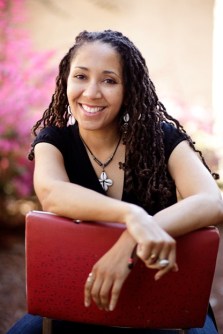
Dr. Monica A. Coleman is Professor of Africana Studies at the University of Delaware. She spent over ten years in graduate theological education at Claremont School of Theology, the Center for Process Studies and Lutheran School of Theology at Chicago. Coleman has earned degrees from Harvard University, Vanderbilt University and Claremont Graduate University. She has received funding from leading foundations in the United States, including the Ford Foundation, the Andrew W. Mellon Foundation, and the Woodrow Wilson Fellowship Foundation, among others.
Dr. Coleman offers workshops, lectures and books for your organization, university or church. She warmly connects with people as she shares principles for growth and liberation. Read her story here.
 A conversation I often have with students is focused on the ways mission and purpose are inextricably linked with our roles as human beings. Understanding what it means to say that human beings have a specific purpose can feel overwhelming and spiral us into an existential crisis; a hallmark of a “Messina class,” according to one of my students.
 Exactly a year ago on May 22th, I didn’t join the ancestors. I had a very close shave after an undiagnosed ectopic pregnancy, and I was rushed into hospital for a life-saving operation. Ectopic pregnancy means that the foetus nested in my fallopian tube instead of my womb. This is a dangerous condition, and one of the leading causes for maternal death in the first three months. According to the doctors it had been a window of two hours. Any longer, and I would no longer be here.
 This month more than most, I feel like I have so much to say that I don’t really know where to begin. It doesn’t help that next door they are remodelling
 The Predator
 Every year I bring back wood frogs, peepers or toads to this property to increase my amphibian population… this year with a drought underway the peepers captured my heart because a bizarre heat wave hit Maine just after the coldest freeze I ever remember. The poor peepers froze and then steamed and fried under a relentless solstice sun, their vernal pools rapidly disappearing from under them.
 A few years ago, I visited the family farm founded by ancestors from Germany in the Pokonos with a newly discovered cousin. The woman I met was delightful: warm and friendly and very much connected to family still living in the area. Her mother had vivid memories of the farm. In contrast, my great-grandmother left home to marry in Brooklyn. My father had fond memories of visiting the farm as a child, but lost touch with the relatives there when his family moved to California in the 1930s.
 (With apologies to Jean de La Fontaine for significant changes to his fable)
 I woke up this morning with a terrible itch in my mind. I want to sue the government. I’m not a lawyer, at least not yet, and I know that governments have sovereign immunity that typically prevents them from being sued. But, it didn’t and doesn’t seem right that I feel so lied to and unprotected during this pandemic. What is more, I know I am not deluded. Either it is bad or it isn’t. Either it is spreading and lethal, or it isn’t. Either precautions help, or they don’t. It can’t be that ambiguous from a viral-behavioral perspective. Government leadership refuses to speak or model a consistent, truthful, and accountable model for the social welfare, leading to such absurd reductions (in Ohio, for example) as that each individual school child can decide whether s/he wants to wear a face-covering this fall. So, what gives? Why all the half-, mixed, mis-, and disinformation?
 For the past four Sunday afternoons, I’ve walked along Monument Avenue in Richmond, Virginia, to observe firsthand the changes happening to the statues of Confederate generals placed there a century or so ago. I focus here on the Robert E. Lee statue. Robert E. Lee (1807-1870) “…was an American Confederate general best known as a commander of the Confederate States Army during the American Civil War” (Wikipedia). These days, Lee’s statue seems to be home base for activists who are working diligently to keep protests and demonstrations ongoing, yet peaceful.
 Feminism and Religion