Mary of Magdala and Intersectionality by Gina Messina

We recently celebrated the feast day of St. Mary of Magdala, a woman who is responsible for the founding of the Christian tradition and a model of what it means to live up to the role and expectation of being a human being. 

Committed to Jesus’ message of love, inclusion, liberation, and social justice, she funded his ministry and in his darkest hour, when the male apostles had abandoned him, Mary of Magdala stood at the foot of the cross. 

The Gospels honor her as the person Jesus chose to reveal his resurrected self to – and the first person to preach the message of the Risen Christ — a message initially met with utter disbelief by the male apostles. This male dominated book was careful to ensure that the world knew that Mary of Magdala — a woman — had a primary role in Jesus’ ministry and the establishing of Christianity. Without her – we would not know the message of Jesus as we do today. 

We see how she has been punished for this.  The shifting of her identity dictated by the patriarchal structures of the Church is well demonstrated through art history. Early on her image was shared as a woman who was respected – her head covered and wearing colors that signified her position of importance. Following the not so accidental interpretation of Mary of Magdala as a prostitute in 591 CE by Pope Gregory I, suddenly the imagery changes to a woman with red hair, long and flowing, often nude, begging to be forgiven. What better way to silence a woman than call her a whore? Continue reading “Mary of Magdala and Intersectionality by Gina Messina”

Movement of Moving and Spiritual Journey by Elisabeth Schilling

It looks like it is time again for me to pack up and drive a few hundred or more miles to a new destination, a place I will finally try to plant roots, this time offering commitment + endurance, hoping to build a life of more balance and authenticity. I assume I will need a constant reminder of gratitude, quelling the entitlement that can bubble up when I think “this should be easier.” I’m not sure when, why, or where I’ve picked up that refrain, but I see it in others and myself and wish for an alternative.

With the help of several people, I’ve secured a full-time college teaching position on a beautiful college campus of a kind of institution I am certain is doing its part to heal the world. At least that is what I feel when I serve at a community college, a place where I feel inspired and challenged by students who have a diversity of needs. I’ve been teaching in such institutions for so long, I’ve fallen in love and know, by experience, that I can help in such spaces.

Continue reading “Movement of Moving and Spiritual Journey by Elisabeth Schilling”

On Believing Things That Are Not True by Carol P. Christ

Anyone who is following American politics these days knows that the American President and his acolytes have little respect for what the rest of us consider to be the truth—or at least the best approximation of the truth that we can discern. Last week, while discussing the “lie” of white supremacy that approximately 40% of the American public has bought hook, line, and sinker, I had occasion to reflect again on the relation between traditional religious beliefs and rejection of reason and common sense. As is also well-known the President and his supporters have no respect for factual truth.
In response to a question about how to reach the women who believe whatever the President says, I responded:

I would also say that fundamentalist religion is a big problem because it teaches people to accept things that science and common sense show are not true on the authority of God (who is portrayed as a white male). This teaches people to distrust their own common sense and reasonably reliable facts. I remember growing up with liberal Protestantism and Vatican II Catholicism. In both contexts I was encouraged to think for myself and not to accept everything on the authority of scripture or tradition. Of course when the churches and synagogues encouraged us to think for ourselves, they also opened the door that enabled us to leave. Because we did, liberal and progressive denominations are in decline relative to their more fundamental and authoritarian counterparts.

With these thoughts swirling around in my head, I keep returning to a Ted Talk I came upon a few weeks ago titled “Letting Go of God” by comedian and philosopher Julia Sweeney. Continue reading “On Believing Things That Are Not True by Carol P. Christ”

“If All Knowledge Must be Reinterpreted, Why Not Religion?” Says Islamic Feminist

xcelina-feminismo.jpg.pagespeed.ic._RyiiQg3TR.jpg

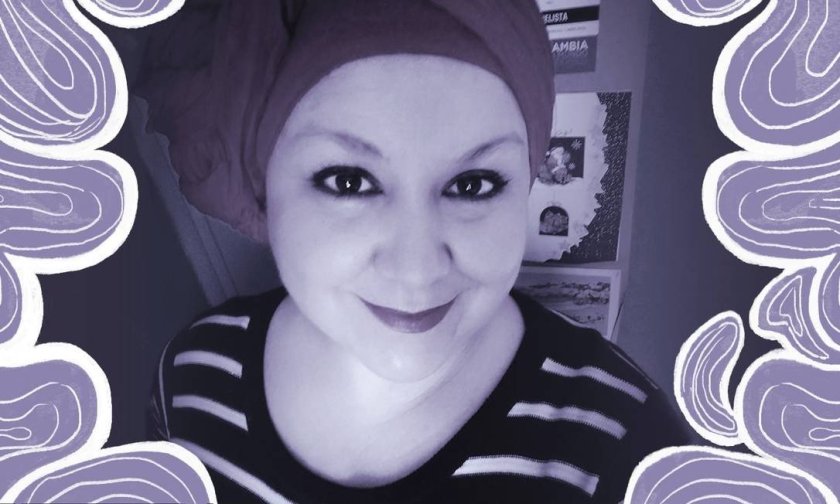
Vanessa Rivera de La Fuente is Muslim, feminist, and a human rights activist
Photo: Personal archive

Background: Journal O ‘Globo, one of the most important newspapers in Brazil, belonging to the transnational media group of the same name, published this interview with Vanessa Rivera de la Fuente on Islamic Feminism. Given its relevance to the discussion on the subject, it was translated by prominent Islamic feminist and scholar Keci Ali to share it with English-speaking readers.

The Muslim women’s movement has different agendas in accordance with the reality of each country. In Latin America, the Muslim Vanessa Rivera fights against prejudice about Islam.

by Isabela Aleixo*

Vanessa Rivera de La Fuente is Chilean and Muslim. Besides being an academic researcher, she’s also an Islamic feminist engaged with questions of gender, human rights, and social development. Vanessa has wide experience in social projects in Latin American countries.

In an interview with CELINA, she discusses the prejudices that Muslim women face in Latin America, explains the movement’s demands, destroys stereotypes, and declares: “I’m a woman and I demand to be treated as a person.”

Do you consider yourself an Islamic feminist? Why?

I consider myself a feminist woman, who lives feminism in all the distinct facets of her life: I’m Muslim; I’m a single mother; I’m a professional woman, an academic; and I’m a women’s rights activist. I’m feminist with all my life experiences. I think being a woman in male-dominated society is itself a political fact, so everything that I am as a woman can be resignified by feminism, including being Muslim. Islam is integrated into my life and my political struggle, which is intersectional. It’s based on the radical idea that all women are people and we deserve equal rights and a world free of violence.

Continue reading ““If All Knowledge Must be Reinterpreted, Why Not Religion?” Says Islamic Feminist”

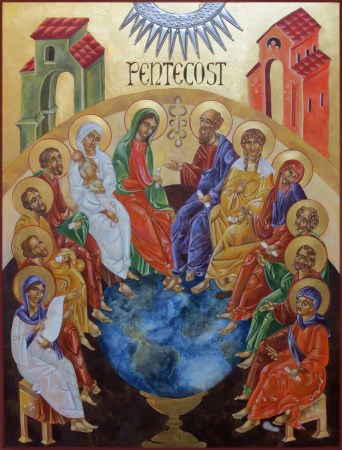
PENTECOST a time to FILL THE WORLD WITH SPIRIT by Mary Jane Miller

Pentecost is followed by Ordinary time, the longest season of the church year. It gives us plenty of time to think about what happened when the Holy Spirit descended on the Apostles. I have always loved the idea that this one moment changed us, it was and is the fulfillment of God’s promise to pour out the Holy Spirit on all flesh, empowering diverse people to exercise divine power. It is commonly understood that the first to receive the power from on high are the male disciples, “locked in a closed room for fear of persecution.” Apparently these Jewish disciples were not too worried about their wives and children.

After painting several Pentecost Feast Day icons as an artist, iconographer and child of God I cannot remain silent with what I think the icon has taught me. It feels obvious that the great gift of the Holy Spirit was for all of humanity. I want to commemorate an ongoing Pentecost, a time to fill the world with spirit, where women and children are invited into the closed room and given a rightful place at the table. Images have a great deal of influence in opening the heart and the mind. Imagine a new contemporary understanding of divine light touching all human beings as well as the planet.

The Spirit Descending

A half circle of twelve descending rays is commonly found at the top of any Pentecost icon. This representation is critically important for the beginning of our narrative. “Then there appeared to them divided tongues, as of fire, and one sat upon each of them.  And they were all filled with the Holy Spirit and began to speak with other tongues, as the Spirit gave them utterance. (Acts 2:2-4)

Imagine that these rays represent the uncreated energies filling the universe, the same rays any of us might feel when touched by grace. These divine rays envelope us as they come from beyond time and space.

Continue reading “PENTECOST a time to FILL THE WORLD WITH SPIRIT by Mary Jane Miller”

Bent on Kindness by Esther Nelson

Recently, with some fear and trepidation, I underwent spinal surgery.  When the surgeon visited me the day after my operation, he assured me that the procedure was a success, even though it will take several weeks to ascertain whether or not the surgery relieved my symptoms.  Healing from such a procedure takes time.

I have nothing but praise for the dozens of people responsible for my care during my six-day hospitalization.  Nurses, nursing care helpers, my surgeon along with the team in the operating suite, doctors-in-training, physical therapy workers, occupational therapy people, cleaning personnel, and the folks who regularly brought me healthy and delicious meals—all of them were respectful, empathetic, and kind.  And they were not kind just to me.  I overheard several hospital employees reply thoughtfully and considerately to a pugnacious patient in the room next to mine.

Continue reading “Bent on Kindness by Esther Nelson”

Productive Confusion by Sara Frykenberg

My experience of productive confusion, alternatively, shuffles categories. It breaks apart. It is life giving chaos; but god/dess does it FEEL loud (even though it often requires quiet). If I’m not surfing the internet, while watching a show, while having a glass of wine, I might have to hear my own thoughts. I might notice that my internal loudness is also a symptom of the institutionalized trauma, violence and oppression that works to keep me externally quiet.

My head is a little bit too full lately. My classes begin in two weeks and I am determined to create an “Intro to Christian Ethics” class that offers my students at least an idea about hope that resonates with them, if not with me. Trauma is both a daily reality for far too many of us, and the headline or undercurrent of nearly every news report. Images from popular media play against my desires, my training in feminist analysis and ideas about power and empowerment in endless abundance. And I am mothering a joyful three-and-a-half-year-old whose need for liveliness both challenges and taxes me, pushing me and putting me face to face with my own hopes and doubts.
I feel pulled in so many directions, so I get confused about where to start, what to write, or what to do. I am awash in input, goals, and distractions.

Yet, I have also been challenged lately to see my confusion as a retreat from responsibility. Continue reading “Productive Confusion by Sara Frykenberg”

Pain and Pausing, by Molly Remer

“I pin my hopes to quiet processes and small circles, in which vital and transforming events take place.”

—Rufus Jones

Last year in August, I wrote here at FAR about my own pattern of getting sick each July and 67552265_2390846147794260_5776927048312291328_othe steps I have been taking over the last three years to change that pattern for myself. This year in a surprisingly literal twist, I fell and hurt my ankle in June, and now, eight weeks later, am still recovering from that fall, thus inadvertently continuing my pattern of spending July of every year “out of commission.”

There is no dramatic story associated with my fall, I was quite literally just standing still on the front porch, waiting for my kids to open the front door after getting home from a Girl Scout meeting, when my foot slipped off the short front step and I came down hard on my ankle, twisting it beneath me at a 90 degree angle inward, as if I stepped down onto the end of my leg bone instead of my foot. I knew immediately that this was not a “normal” misstep or simple twist of the ankle, my leg hurt in a different and deeper way than I’ve ever experienced before, the swelling instantaneous and visible through my sock before I could even crawl inside. My husband Mark came running to help me and all I could say was, I think I’ve really, really hurt myself. Continue reading “Pain and Pausing, by Molly Remer”

Greenness, Whiteness, Blackness, and the Nature of the World by Marisa Goudy

There’s magic in hiking alone, but as women, we’ve been taught to worry about venturing far on our own. In fact, we’ve been taught to worry about a lot more than that.

Though once I merely shrugged off the warnings and the horror stories, confident that I was wrapped in some sort of “not me” protective veil, I don’t usually take my safety for granted anymore. Maybe it’s because I’ve outgrown the belief that I’m invincible. Maybe it’s because I’m a mother and have a different understanding of the fragility of life and the female body. Maybe it’s because that murderer on the Appalachian Trail went by the nickname “Sovereign,” appropriating the powerful, beautiful word that is so essential to my life’s work.

This particular day, however, my desire to be outside was more compelling than my new bend toward caution. I called my husband to tell him just where I’d be, joking that he needed to know where to look for me if I didn’t pick up the girls from camp on time.

Continue reading “Greenness, Whiteness, Blackness, and the Nature of the World by Marisa Goudy”

The Devil’s Bargain: “If You Can Convince a White Woman” by Carol P. Christ

This week’s news from America. Where to begin? When will it end?

The President of the United States is a racist who incites racist violence. Republicans have been slow to condemn the President and are not likely to pass a complete ban on assault weapons and to make those currently in circulation illegal.

After reading a speech condemning hate speech and gun violence that he obviously didn’t write, the President scheduled a round-up of brown people working in chicken-packing factories in Mississippi to coincide with his unsympathetic visits to the cities of Dayton and El Paso, where two recent mass killings by assault weapons occurred. The next morning, we were greeted by images of little children coming home from school in small towns in Mississippi to find their parents missing. We were told that none of the surviving victims of the El Paso shooting wanted to meet the President.

This is not the America I want. But it is the America that many Americans seem to want. I would like to think that women as a group reject the President and his agenda. Sadly, this is not true. Continue reading “The Devil’s Bargain: “If You Can Convince a White Woman” by Carol P. Christ”