 Candide, ou l’Optimisme (in English, Candide, or Optimism) is a satirical, picaresque novel published in 1759 by François-Marie Arouet, better known as Voltaire, who was possibly the smartest author of the Age of Enlightenment…but he annoyed so many courtiers and public officials that he was forever traveling around Europe to get away from their threats of arrest and bodily harm. A picaresque novel is an adventure novel with a clever,
 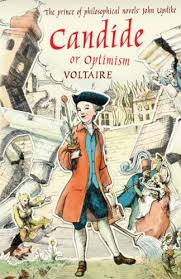 tricky hero who somehow survives and makes us like him. Voltaire wrote his novel primarily to criticize the optimism of the German writer Gottfried Wilhelm Leibniz, who said that because God is always benevolent, everything that happens is always for the best. This presumably includes the bloody Seven Years War (Protestant vs. Catholic, fought mostly in Germany and France) and the Lisbon earthquake of 1755, which occurs both in Lisbon and in the novel. Even though Voltaire was accused of blasphemy and heresy, among his other sins and crimes, Candide was enormously popular throughout Europe, a popularity that continues to this day.
In 1956, playwright and screenwriter Lillian Hellman (who had been persecuted by Sen. Joseph McCarthy and HUAC) proposed to composer/conductor Leonard Bernstein that they turn Voltaire’s novel into a Broadway musical. Bernstein composed some of the most beautiful music ever written for this show, which has been produced as an opera, an operetta, and a musical comedy. Hellman’s libretto turned out to be weak, so Bernstein turned to the poet Richard Wilbur and Stephen Sondheim, among others for new libretto and lyrics. It’s been through numerous revisions, and every time it’s staged, it’s different. I have four or five versions on DVD. My favorite is the New York Philharmonic staged concert written and directed by Lonny Price and broadcast on PBS in 2004. Continue reading “Lessons from Candide by Barbara Ardinger”



 I touch the earth and offer gratitude
 Part One of this post looked at connections between the cosmic dance and the Goddess Hera. To read it,
  A few years back, I turned forty years old. On the cusp of this landmark birthday, I wrote about the stigma of so-called midlife crises. I resisted the idea that changes associated with midlife should be mocked, when indeed many of those changes actually represent something like birth itself. I have come to think, however, that I was perhaps naïve in my wild embrace of midlife self-birthing. I still believe what I said before, basically, which was that midlife occasions opportunity for self-knowledge in a way that is largely inaccessible to babies, children, adolescents, and novice adults. What I could not have known a few years back is how much it costs to answer the waking self’s summons.
 Summer is here, and even with the terrible troubles going on in our world, I hope that some of us are managing to take time out and enjoy pleasant evenings outside under the stars. Gazing up at the heavens, we see the same starscape our ancestors saw, thousands of years ago.
 It happened in the blink of an eye. So much of how we got here is blurry. I try to parse out the moments that came together to add up to this many years. I pause to absorb fragments, moments of the past.
 Feminism and Religion